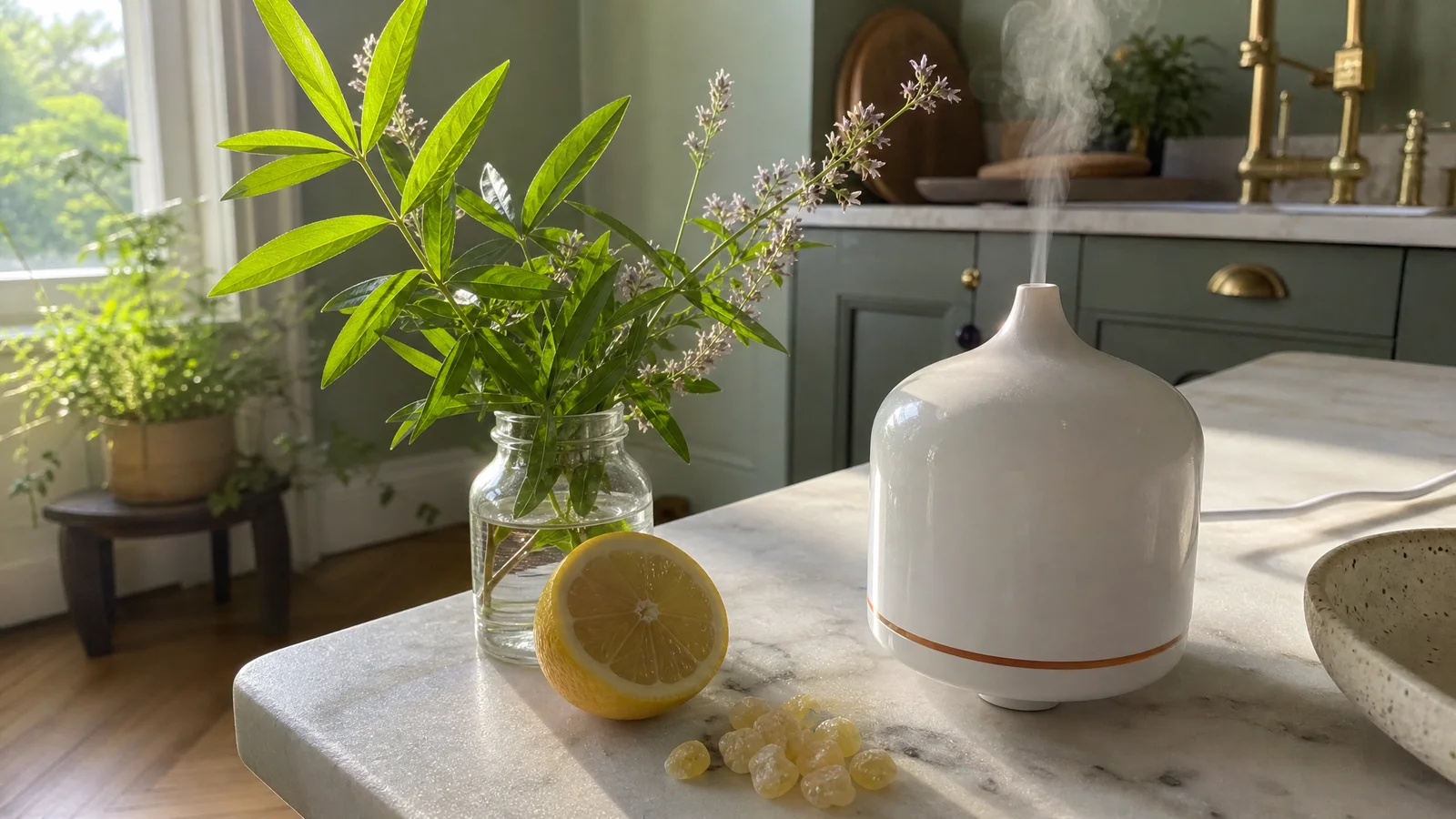
Lemon Verbena Diffuser Blends: Ratios by Parts
Two people can follow the same diffuser "recipe" and end up with different rooms. One has a 10 ml reservoir and the other 300 ml, and their partner oils come from different batches. That is why we like to think of a blend as a ratio first and a drop count second. Below are six ratio lines for lemon verbena, built from published compositions of the partner oils. We sell only the lemon verbena oil, so the partner oils come from a supplier of your choice; treat the lines as starting points for your own nose.
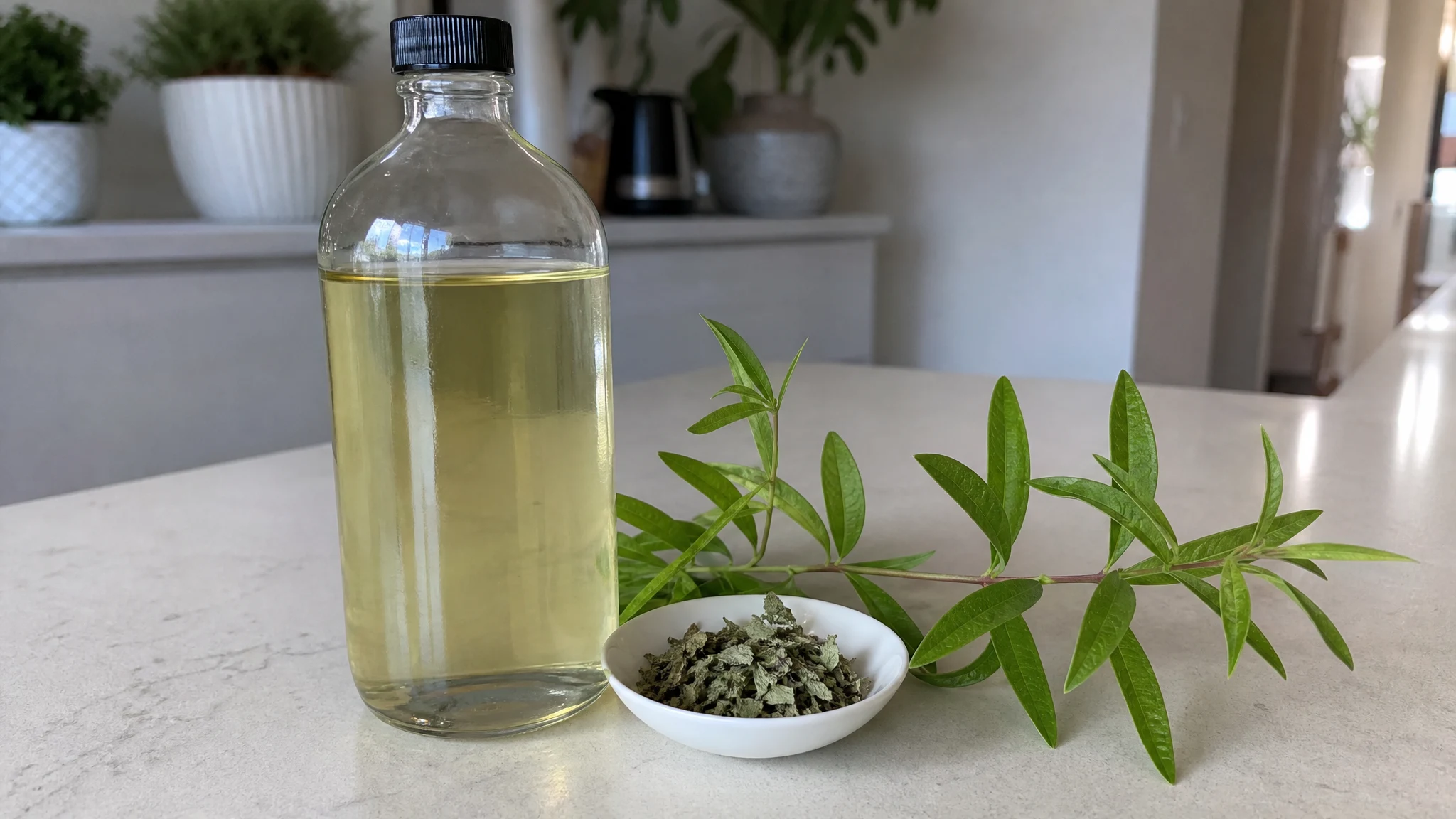
Lemon Verbena Essential Oil
Our own Lemon Verbena Essential Oil, in sizes from 0.5 oz to bulk.
From $12.99
Shop Now →Choose the verbena share first
No study sets the right proportion of lemon verbena in a blend, so the share is a matter of taste, and the tidy way to decide it is before you pick partners. The lines run from 25% to 50% of the drops. Start at the low end, because raising the share adds more of every verbena compound to the air, while lowering it simply adds a drop of the partner.
Verbena itself is not one fixed thing. An Ecuadorian oil had geranial at 26.8% and neral at 21.0%, while a Portuguese commercial leaf gave geranial from 18.7% to 21.1% and neral from 15.3% to 16.2% depending on the distillation method. Our certificate for one batch lists density and refractive index and no composition, so we cannot say which of those ours resembles.
Six lines to try
We list neroli, lavender, geranium, cedarwood and sandalwood as partners for our oil, along with bergamot and petitgrain. The table uses the partners whose compositions we could read.
| Line | Ratio by drops | Verbena share | What the sources say about the partner |
|---|---|---|---|
| A | Verbena 1, petitgrain 1 | 50% | Young-leaf bitter orange oil: linalool 58.21%, linalyl acetate 12.42%, limonene 0.53% |
| B | Verbena 3, petitgrain 2, neroli 1 | 50% | Flower oil: linalool 29.14%, limonene 12.04%, linalyl acetate 3.88% |
| C | Verbena 1, bergamot 2 | 33% | Bergamot to ISO 3520: limonene 32.0 to 47.0%, linalyl acetate 22.0 to 36.0% |
| D | Verbena 2, bergamot 1, lavender 1 | 50% | Lavender is one of our listed partners; ask the supplier for its GC-MS report |
| E | Verbena 1, lavender 3 | 25% | As D |
| F | Verbena 1, frankincense serrata 1 | 50% | One serrata sample: alpha-pinene 29.8%, alpha-thujene 5.92% |
Lines A to E pair a citral-led oil with oils led by linalool, linalyl acetate or limonene, which is how the compositions fit together on paper. Whether it smells good is for your nose to decide. For the trained-panel words on lemon verbena alone, see our scent profile, and for line F, our frankincense article goes through the numbers.
One citral oil is enough
Recipes sometimes add litsea cubeba "for extra lemon." It is nearly all citral: eight Chinese fruit oils had neral plus geranial from 78.7% to 87.4%. Take six drops of verbena and two of litsea, treat drops as equal volumes (an approximation) and use the Ecuadorian figure of 47.8% citral, and the stock's citral share goes from 47.8% to about 56% to 58%. With the Portuguese figure of 34.0%, it moves to about 45% to 47%. Two drops of an add-in lifted the citral share by roughly 8 to 13 percentage points.
That matters because citral is the compound IFRA's citral standard caps by product category, and a stock bottle can end up used for something other than a diffuser. Keeping to one citral oil keeps the blend centred on the verbena. Our comparisons of lemon oil and lemon-scented oils set the chemistry out.
Writing recipes you can repeat
A ratio is a memory aid as much as a recipe. Write it as parts on the stock bottle, something like "verbena 2, partner 1", with the date. When you find a mix you love, you will be able to make it again in a month without guessing, and if you want to change it you will know exactly which number to nudge. Change one part at a time and smell again; otherwise you never learn which change did what.
Dose from the manual
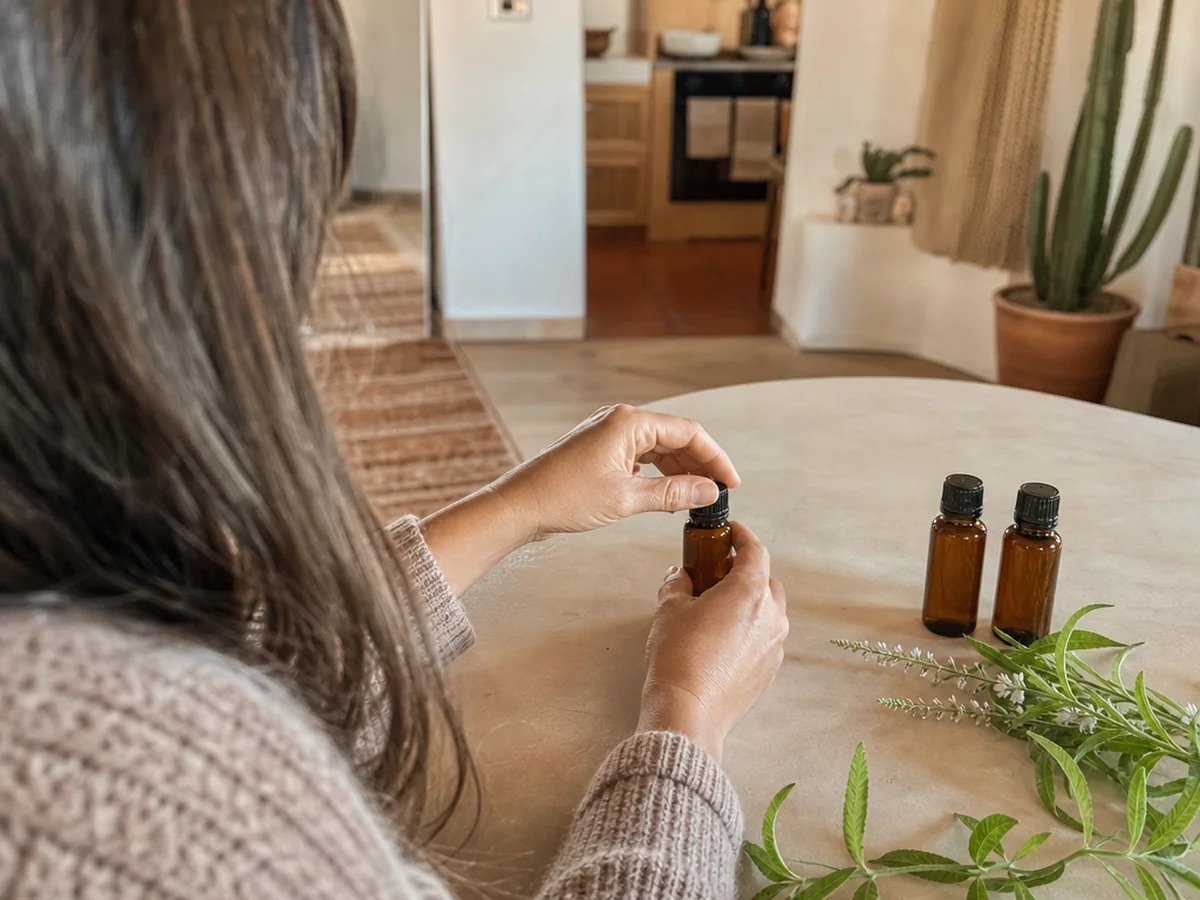
The diffuser's manual sets the oil quantity, not a blog. Our diffusing guide quotes one ultrasonic manual at 3 to 5 drops of oil per 100 ml of water and starts at about half that. The count covers all oils together, so mix a stock from one of the lines above and count stock drops, not verbena drops.
Smelling the blend before the diffuser
Before any blend goes into water, put a drop of the stock on a strip and give it ten minutes. A diffuser spreads scent widely, so it is kind to check that you actually like the mix up close. If the strip makes you smile after ten minutes and again after an hour, the blend is ready for a room. If not, adjust the parts and try again. It costs a drop or two and saves a whole tank of something you will not want to smell all afternoon.
When a blend is not the right tool
If there is a bird or cat at home, begin with our pets article. If fragranced products bother you, ask a physician before diffusing. If you plan to sell a product, IFRA's verbena standard says verbena oil should not be used as a fragrance ingredient, so talk to a regulatory professional; our IFRA article reads the standard. Nothing here is a skin recipe.
A ratio is only as good as the oils behind it, so write it on the bottle, change one thing at a time, and enjoy getting it right. If you mix stock often, larger sizes are on our bulk page, and our guide to buying lemon verbena oil in bulk covers what to check.
Lemon Verbena Essential Oil
Lemon Verbena Essential Oil from our own shop, in sizes from 0.5 oz to bulk.
From $12.99
Shop Now →Sources & Further Reading
- Parichanon P et al., 2025. Chemical Profiling, Sensory Qualities, and Bioactivities of Essential Oils Obtained from Aloysia citrodora and Bursera graveolens Ecuadorian Plants Against the Mosquito Aedes albopictus (Skuse) (Diptera: Culicidae). Insects 16(2):202. PMC11857052
- Sprea RM et al., 2023. Volatile Compounds and Biological Activity of the Essential Oil of Aloysia citrodora Paláu: Comparison of Hydrodistillation and Microwave-Assisted Hydrodistillation. Molecules 28(11):4528. PMC10254266
- Sarrou E et al., 2013. Volatile constituents and antioxidant activity of peel, flowers and leaf oils of Citrus aurantium L. growing in Greece. Molecules 18(9):10639-10647. PMC6270488
- ISO 3520:2022 - Quality Standards for Calabrian Bergamot Essential Oil (iTeh Standards summary). standards.iteh.ai
- Arabshahi S, Mohammadi A, 2016. Evaluation of active components and antioxidant activity of essential oil of Boswellia serrata. Journal of Food Science and Technology (Iran) 14(63):107-117. fsct.modares.ac.ir
- Si L et al., 2012. Chemical composition of essential oils of Litsea cubeba harvested from its distribution areas in China. Molecules 17(6):7057-7066. PMC6268156
- IFRA Standard: Citral, Amendment 49, 2020. ifrafragrance.org
- IFRA Standard: Verbena oil and absolute (Lippia citriodora Kunth.), Amendment 49, 2020. ifrafragrance.org