How Much Lemon Verbena Oil Goes in a Blend?
Ask ten people what blends well with lemon verbena and you will get ten lists of oils. The more useful question comes before the list: how much verbena should go in? This oil is a bright, high-impact lemon, and the right amount depends on what you are making, so let us start there and add the partners afterwards.
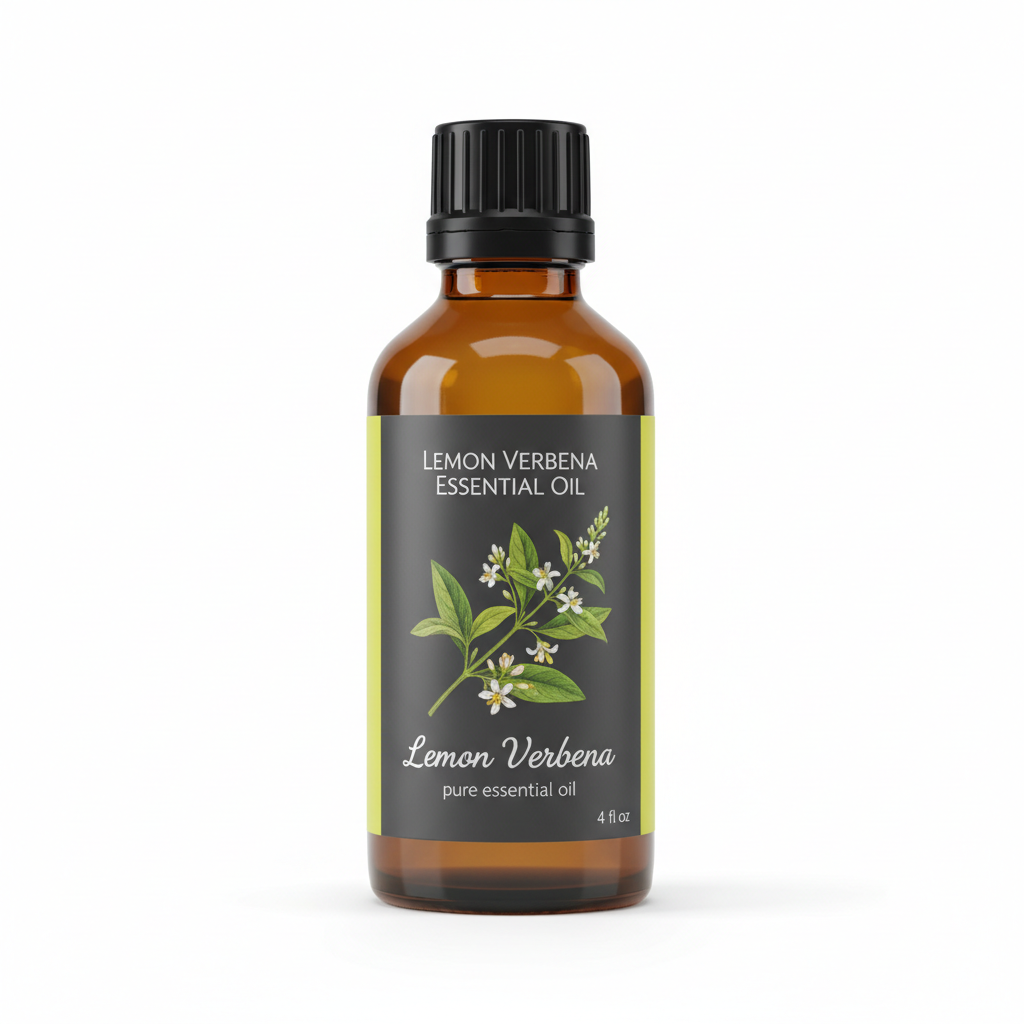
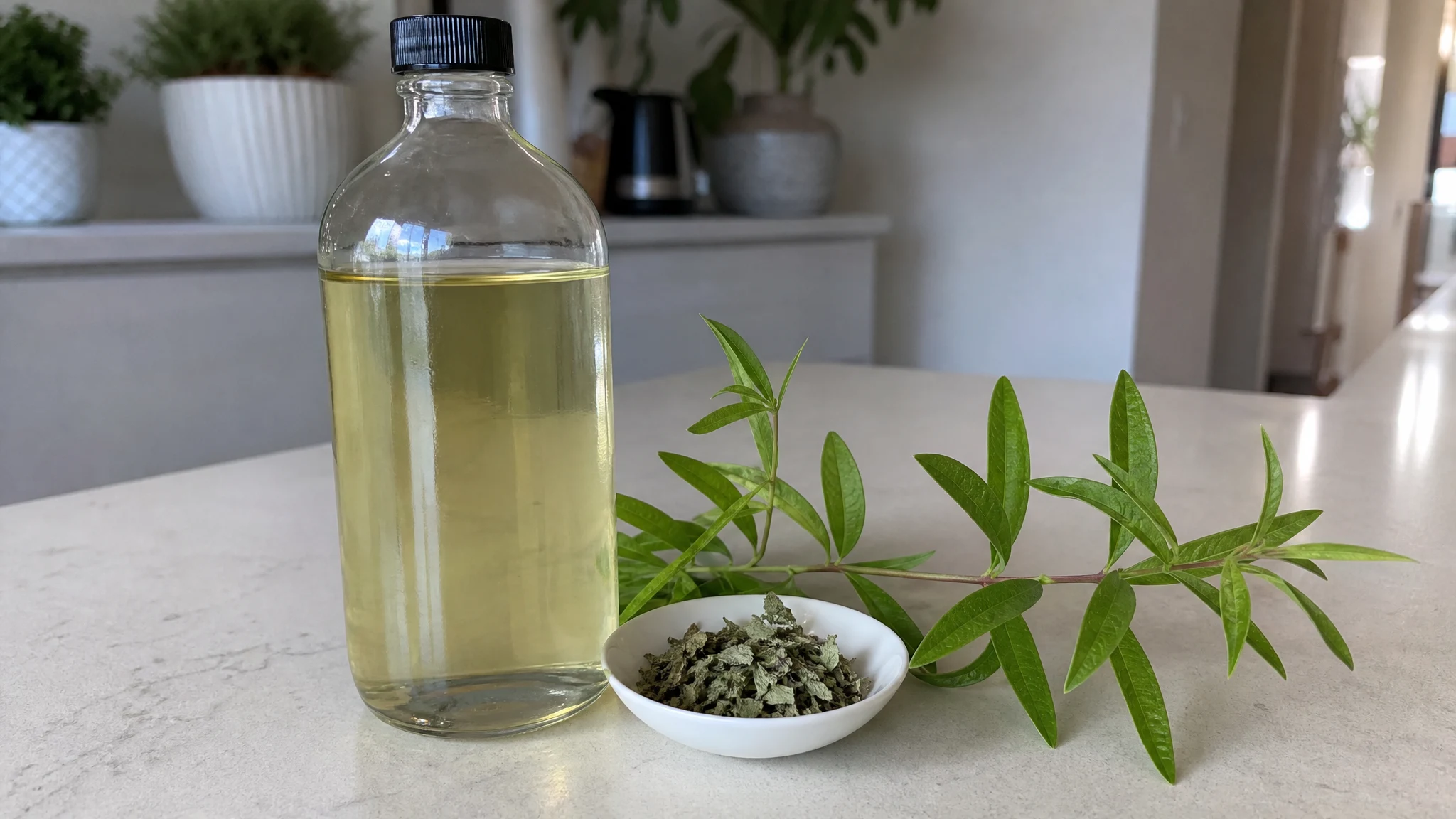
Lemon Verbena Essential Oil
Our own Lemon Verbena Essential Oil, in sizes from 0.5 oz to bulk.
From $12.99
Shop Now →Know what the lemon is made of
Much of lemon verbena's lemon character comes from citral, the pair of molecules geranial and neral. How much of it a sample carries varies a great deal. An Ecuadorian oil measured 26.8% geranial and 21.0% neral, about 47.8% together; Portuguese leaf oil came in at about 34% to 37% by two distillation methods; and five Moroccan oils had no geranial detected at all. The Certificate of Analysis we publish for one batch gives a relative density of 0.869 and a refractive index of 1.472 and does not list individual compounds, so if you want a citral figure for what you are blending, ask us in writing through our contact page before you order.
Let the product set the ceiling
IFRA's citral standard sets a maximum for citral in a finished product by category, and its guidance tells you which category a product belongs to: body oils and lotions are Category 5A, fine fragrance including oil-with-alcohol is Category 4, wash-off products such as bath and shower gels are Category 9, reed diffuser and lamp-ring oils are 10A, and candles are Category 12, which has no citral limit. Divide the citral ceiling by the oil's citral share, and you get the most verbena that product could hold on citral alone. Here is that arithmetic for two example shares, using the figures above.
| Product (IFRA category) | Citral ceiling | Max oil at 34.0% citral | Max oil at 47.8% citral |
|---|---|---|---|
| Body oil or lotion (5A) | 0.15% | 0.44% | 0.31% |
| Fine fragrance (4) | 0.60% | 1.76% | 1.26% |
| Wash-off bath product (9) | 1.2% | 3.5% | 2.5% |
| Reed diffuser or lamp-ring oil (10A) | 1.2% | 3.5% | 2.5% |
| Candle (12) | no citral limit | none | none |
This is our own arithmetic on example oils, not a statement about the oil in our bottle. It also looks only at citral. IFRA's verbena standard says verbena oils should not be used as a fragrance ingredient on sensitizing and phototoxic grounds, so none of these rows is an allowance. Treat them as a way to think about proportion in a personal project; anything you plan to sell needs a regulatory professional, and other citral-bearing oils in the same blend count toward the same ceiling. Our IFRA article explains the status of the standard.
From percent to drops
Using the 0.869 density and the common convention of 20 drops per millilitre, a one-ounce (29.57 ml) body oil at 0.31% verbena works out to about 1.8 drops, and at 0.44% about 2.6. Our dilution guidance for skin starts at 0.5%, roughly 3 drops per ounce, and we suggest the low end. A single drop in an ounce is a perfectly sensible first trial. Weigh instead of counting if you can: 0.31% of 100 g of finished blend is 0.31 g of oil.
Think of it as the first thing you smell
A useful way to picture proportion is to imagine walking into the room where the blend is. Lemon verbena is the first greeting, the bright, sweet lemon that reaches you at the door. The partners are what you notice when you stay and settle in. If the greeting is too loud, nobody gets to hear the rest of the conversation, so a smaller share of verbena often makes a more interesting blend than a bigger one.
That is why we like to begin low and add a drop at a time. You can always put more lemon in, but you cannot take it out of a blend once it is mixed.
Give it a job
We describe the scent as sparkling, sweet and lemony over a soft herbal-floral heart, and we place it as a top-to-middle note. That makes it a natural lift in a blend rather than the foundation. In the Ecuadorian oil's sensory panel, trained assessors picked up lemon, candied lemon, lemongrass, orange blossom, mint and sweet pastry notes, so there is a lot going on in a small amount. We suggest neroli, lavender, geranium, cedarwood and sandalwood as companions, and bergamot and petitgrain suit the citrus side. We sell only the verbena, so you will find those at an essential oil or perfumery supplier. The partners article goes through them one at a time, and the diffuser ratios article shows the parts approach in action.
A note on patience
Fresh blends often smell different a day later than they did when you mixed them, because the quick top notes settle and the oils get to know each other. Our suggestion is to mix, label, close the bottle and walk away. Come back tomorrow with a clean nose, perhaps after smelling something neutral like your own sleeve, and judge it then. Many a blend that seemed too sharp at first turns out to be exactly right the next morning, and the reverse is true too.
Test small, write it down
Make a small trial before a full batch, record the percentage by weight, and smell it a day later before you scale up. For anything on skin, patch test on the inner forearm and keep treated skin out of strong sun, since verbena can be mildly photosensitising. Carrier oils, bases and bottles come from a craft or soap-supply shop, because we sell only the oil. If you are pregnant, have eczema or reactive skin, or are blending for a child, check with your physician or dermatologist first; our safety guide gives the background.
A good blend starts as a proportion question and ends as a scent you enjoy. Pick the product, find its ceiling, then let the partners play.
Lemon Verbena Essential Oil
Lemon Verbena Essential Oil from our own shop, in sizes from 0.5 oz to bulk.
From $12.99
Shop Now →Sources & Further Reading
- Citral, IFRA Standard, 2020 (Amendment 49).
- Verbena oil and absolute (Lippia citriodora Kunth.), IFRA Standard, 2020 (Amendment 49).
- Guidance for the Use of IFRA Standards, June 30, 2023 (51st Amendment), IFRA.
- Chemical Profiling, Sensory Qualities, and Bioactivities of Essential Oils Obtained from Aloysia citrodora and Bursera graveolens Ecuadorian Plants Against the Mosquito Aedes albopictus (Skuse) (Diptera: Culicidae), Parichanon et al., Insects, 2025.
- Volatile Compounds and Biological Activity of the Essential Oil of Aloysia citrodora Paláu: Comparison of Hydrodistillation and Microwave-Assisted Hydrodistillation, Sprea et al., Molecules, 2023.
- Chemical Composition and Cytotoxic and Antibacterial Activities of the Essential Oil of Aloysia citriodora Palau Grown in Morocco, Oukerrou et al., Adv Pharmacol Sci, 2017.