Lemon Verbena and Frankincense: A Diffuser Stock
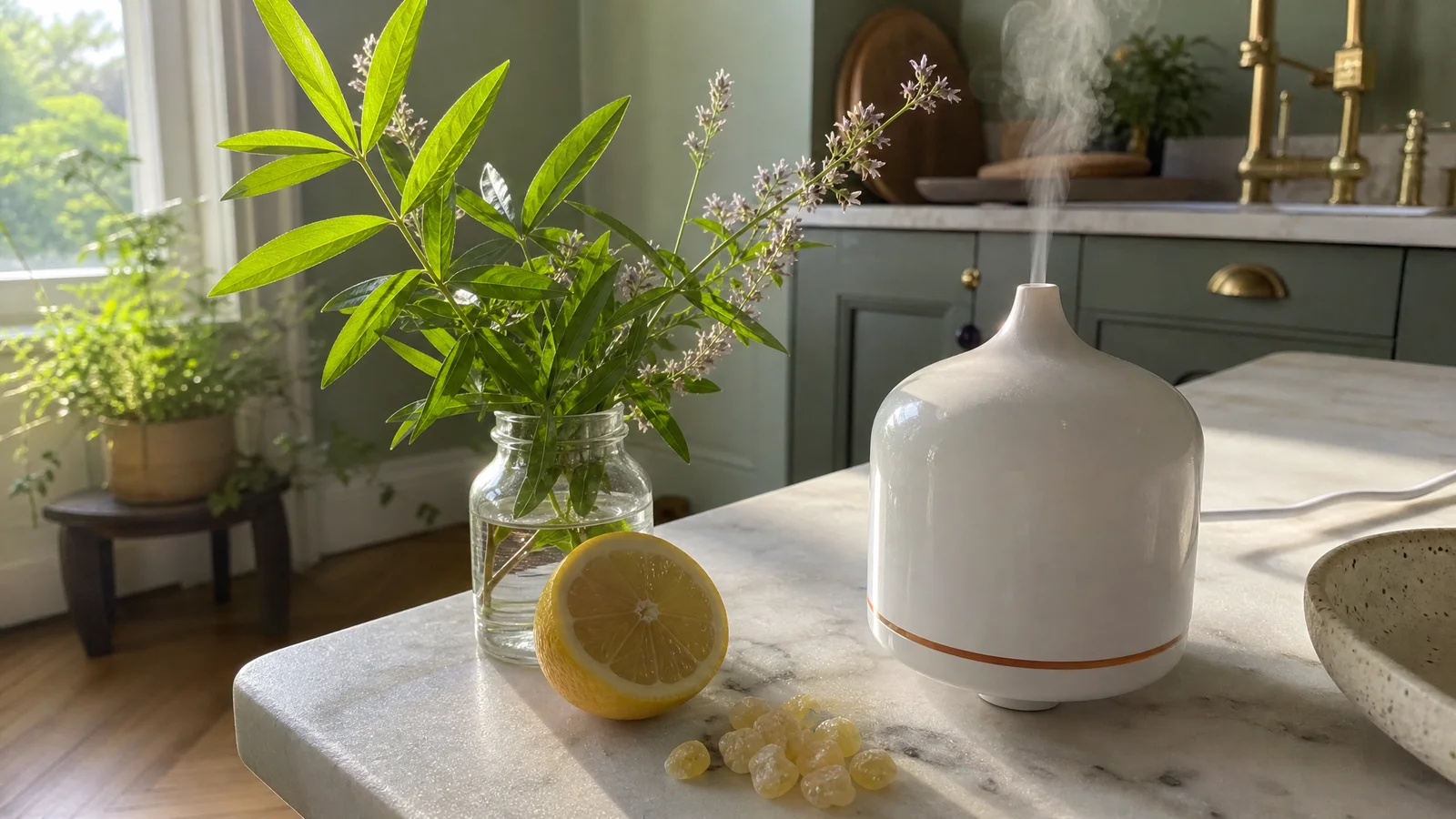
Lemon verbena and frankincense is a pairing you will see in plenty of diffuser blogs: bright citrus on top, resin underneath. It is a good-looking idea, and it raises two practical questions we find more interesting than the pairing itself. What does frankincense actually bring to the mix, and how do you turn a recipe written in drops into something you can scale? We sell only the lemon verbena oil, so the frankincense comes from a supplier of your choice, and what follows is worked out from published figures.
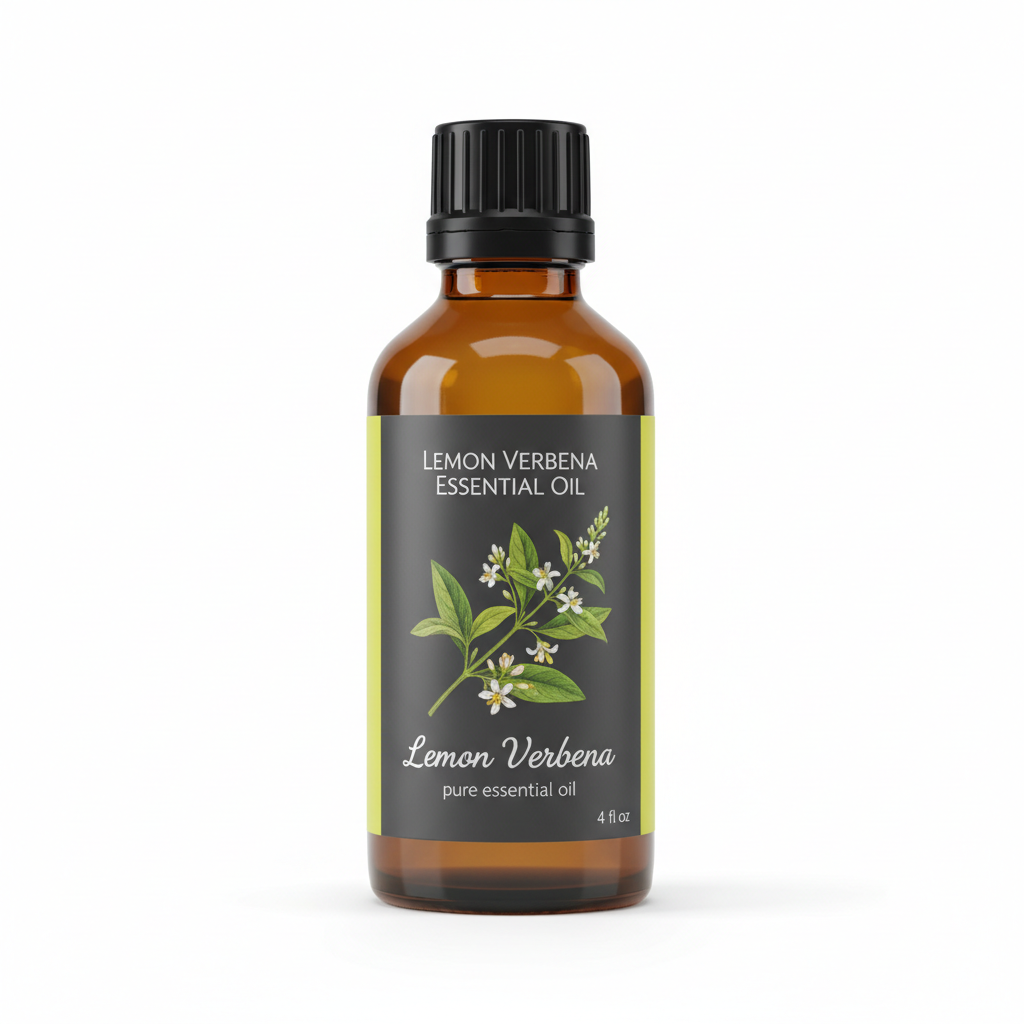
Lemon Verbena Essential Oil
Our own Lemon Verbena Essential Oil, in sizes from 0.5 oz to bulk.
From $12.99
Shop Now →What the serrata analysis shows
The usual story is that resin oil is the heavy, slow "base" that holds up a fleeting citrus. Boiling point is a rough stand-in for how readily a compound leaves a surface, and it is easy to look up. The one frankincense serrata analysis we could read, a study of a hydrodistilled Boswellia serrata oil in an Iranian food-science journal (the oil's origin is not stated), was led by alpha-pinene (29.8%), with alpha-thujene, beta-pinene and p-cymene next. Alpha-pinene boils at about 156 degrees C. In the Ecuadorian lemon verbena oil we use for comparison, geranial was 26.8% and limonene 7.2%, and geranial boils around 229 and limonene around 175 degrees C.
So in that sample, the frankincense leads with the lighter, quicker-leaving molecules, and lemon verbena's lead compound is the slower one. Boiling point is not an evaporation rate, and another origin or distillation will differ, so this is a reason to hold the "base note" label loosely and not a rule against the blend. The practical takeaway is friendly: if you want to design around how a blend unfolds, ask the supplier for the batch GC-MS report and let your nose confirm. A resin oil with a piney, fresh opening beside a sweet, lemony one can be very pleasant, and your own smelling strip will tell you quickly.
What the pairing might feel like
On a smelling strip, a lemony oil and a resin oil can feel like a sunny window and an old wooden chair. You will likely notice the lemon first and the resinous, slightly piney character after it, and the pleasure of the blend is in how those two moments follow each other. Whether you love it is a matter of taste. Some people want more resin and a shadow of lemon; others want mostly lemon with a slight edge underneath.
Why a stock bottle beats counting drops
A recipe written as thirty drops of this and twenty of that hides two things: the share of each oil, and how much actually reaches the room. A stock bottle mixed by parts shows both. For scale, a drop is roughly 1/20 ml by the usual convention (droppers vary, so weigh when you can), and with a relative density of 0.869 on the certificate for one of our batches, one drop of our oil is about 43 mg. That is arithmetic and not a spec.
Here is what a 24-drop stock looks like at three ratios:
| Verbena : frankincense | Verbena drops in the stock | Verbena by weight | Verbena share by drops |
|---|---|---|---|
| 1 : 2 | 8 | about 0.35 g | 33% |
| 1 : 1 | 12 | about 0.52 g | 50% |
| 2 : 1 | 16 | about 0.70 g | 67% |
Mixing by drops treats a drop of each oil as equal in volume, which is an approximation, and we give no weight for the frankincense because we have no density figure for it.
The stock earns its keep when you dose it. Our diffusing guide works from one manufacturer's manual of 3 to 5 drops of oil per 100 ml of water and starts at about half of that. At a 1 : 1 stock, one to two stock drops per 100 ml delivers half a drop to one drop of verbena. You cannot measure half a drop from a bottle, but you can from a stock, and that is the real case for premixing.
Making the stock well
- Mix the oils neat. Whether a carrier belongs in your diffuser is a question for the manual.
- Size the bottle to the stock. Oxygen, light and heat age essential oils, and a big bottle holding a few drops is mostly air. A small, dark, tightly capped bottle is better.
- Date the label and write the ratio. If the smell changes, you will know whether it is the blend or the age of the oil.
- Keep the oil count low. Two oils you can write ratios for are easier to dose, and to adjust, than six.
Giving the stock a few days
Once you have mixed a stock, let it sit for a day or two before judging it. The oils need time to blend into one another, and the first sniff often differs from the second. We would label the bottle with the ratio and the date, smell it again after a couple of days, and only then decide whether to change the parts. This is a slow, patient kind of blending, and it rewards you with a mix you actually know.
The fine print
This blend is for room air, not skin. Check frankincense's own safety guidance separately, and households with animals should start with our pets article. IFRA's verbena standard says verbena oil should not be used as a fragrance ingredient, which is why we keep our focus on small, personal room use; the IFRA article explains it. If you are looking at other partners, our partner guide goes one by one.
Mix a small stock, date it, dose it from the manual and decide by nose. That is a recipe with a reason behind it.
Lemon Verbena Essential Oil
Lemon Verbena Essential Oil from our own shop, in sizes from 0.5 oz to bulk.
From $12.99
Shop Now →Sources & Further Reading
- Arabshahi S, Mohammadi A, 2016. Evaluation of active components and antioxidant activity of essential oil of Boswellia serrata. Journal of Food Science and Technology (Iran) 14(63):107-117. fsct.modares.ac.ir
- Parichanon P et al., 2025. Chemical Profiling, Sensory Qualities, and Bioactivities of Essential Oils Obtained from Aloysia citrodora and Bursera graveolens Ecuadorian Plants Against the Mosquito Aedes albopictus (Skuse) (Diptera: Culicidae). Insects 16(2):202. PMC11857052
- PubChem, National Library of Medicine. Compound records for alpha-pinene, limonene and geranial (boiling point sections). pubchem.ncbi.nlm.nih.gov
- Tisserand Institute. Oxidation and the Shelf Life of Essential Oils. tisserandinstitute.org
- IFRA Standard: Verbena oil and absolute (Lippia citriodora Kunth.), Amendment 49, 2020. ifrafragrance.org