Lemon Verbena Oil Safety: What Each Authority Actually Says
The documented hazards of lemon verbena oil are narrow and specific: skin sensitization, phototoxicity, and change with age and air. Regulators have been stricter with it than retail copy usually admits, so this guide goes situation by situation and says what each authority actually wrote. It does not call the oil safe for anyone, because no source I read does.
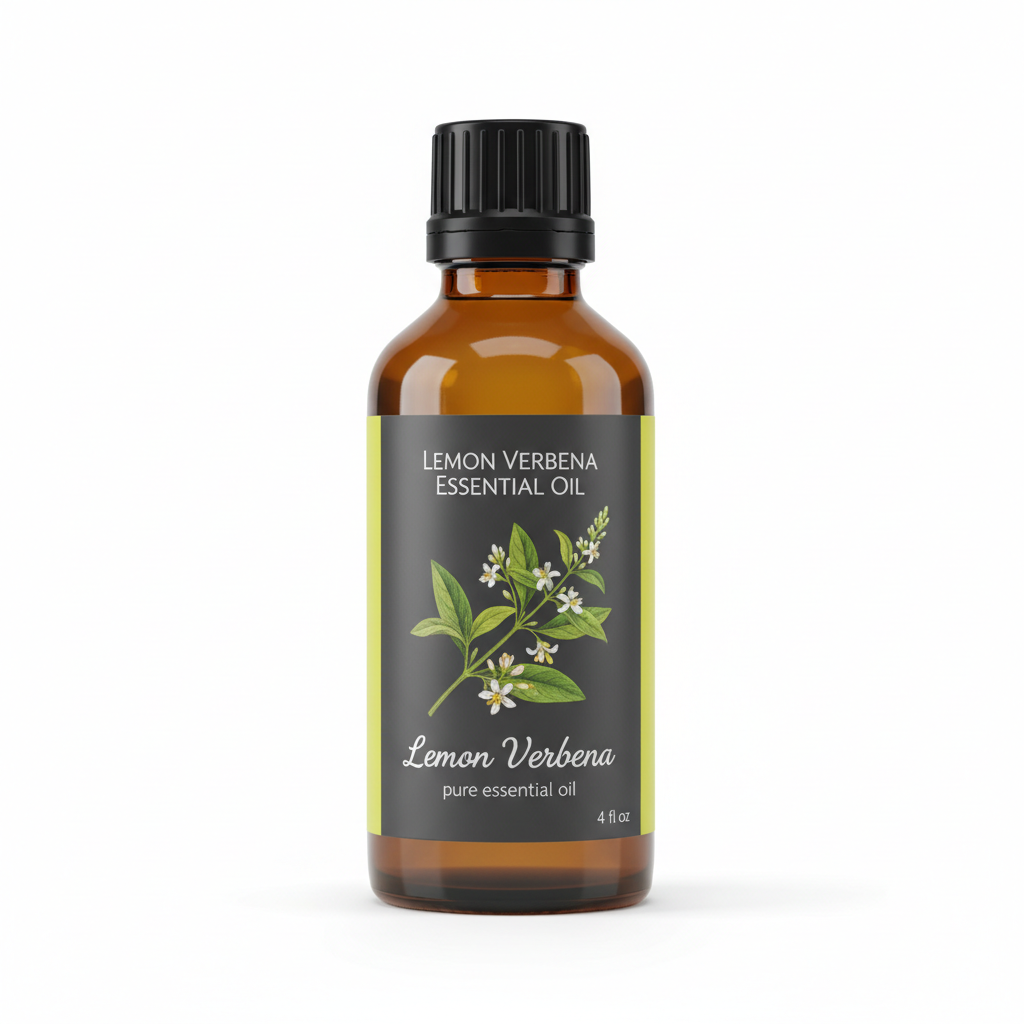
Lemon Verbena Essential Oil
Our own Lemon Verbena Essential Oil, in sizes from 0.5 oz to bulk.
From $12.99
Shop Now →Before it touches skin: the sensitization problem
IFRA's Standard on verbena says oils from Lippia citriodora (now Aloysia citrodora) "should not be used as a fragrance ingredient, based on its sensitizing and phototoxic potential" (IFRA, 2020). The European Commission's 2009 Directive records the same reasoning: the SCCNFP recommended a ban on verbena oil "based on the sensitising potential" (European Commission, 2009). The IFRA standards post reads that text in full.
Part of the concern is citral, a pair of isomers (geranial and neral) that dominates many lemon verbena oils. FDA lists citral among the 26 fragrance ingredients the European Commission identified as allergens in 2003 (FDA, 2026). Under the EU's 2023 amendment, an allergen above 0.001% in a leave-on product or 0.01% in a rinse-off product must be declared on the label, and amounts from several sources are added together (AGES, Austrian Agency for Health and Food Safety). The EU's scientific committee, reviewing citral in 2024, found the proposed concentrations acceptable for the induction of sensitisation but said "some refinement is needed before a firm conclusion" (SCCS, 2024). Read that as a sensitizer managed by concentration, not as zero risk.
How much citral is in a given oil is not a constant. A Portuguese study found geranial plus neral at about 34%, a Palestinian study found geranial alone at 43% to 48%, and a Moroccan study of five sites reported neral at only 6% to 10% with caryophyllene oxide and spathulenol among the larger peaks (Sprea et al., 2023; Jaradat et al., 2021; Oukerrou et al., 2017). The COA we publish for the batch it names shows appearance, smell, a relative density of 0.869 and a refractive index of 1.472, and nothing on constituents, so I cannot tell you our oil's citral share; our GC-MS reading guide covers what to ask for in writing.
Our own copy asks for 0.5% to 2% in a carrier, roughly 3 to 12 drops per ounce, a patch test first, and starting at the low end. My recommendation is to treat the bottom of that range as the default and the top as something to reach only after a patch test has gone quietly. The dilution table and patch-test steps are in the skin basics post.
Before you go outside: the sun question
IFRA's reasoning names phototoxicity as well as sensitization, and its Guidance says phototoxicity limits apply to any product used on body areas reasonably expected to meet sunlight, with no restriction for products that never touch skin (IFRA, 2023). Our own copy says verbena can be mildly photosensitising and to keep treated skin out of strong sun for a while. No source I read gives an interval in hours, so I will not invent one: that is a reason to keep it off exposed skin when you will be outdoors, not a reason to count down.
The sources disagree on how much this matters. Tisserand and Young's Essential Oil Safety (2014) calls the phototoxicity modest, argues the IFRA and EU position is unjustified because only 12% concentrations were used in testing, and recommends a maximum dermal use level of 0.9%. I read that only as quoted on a retailer's product page (secondary quotation), not in the book. So the numbers on the table are: IFRA, no use of the oil; Tisserand, 0.9% at most; our shop copy, 0.5% to 2%. At 20 drops per ml, 0.9% is about 5 drops in an ounce of carrier (29.57 ml), so it sits inside our range, and 2% (about 12 drops) sits above it.
Before it ages: oxidation
Air changes terpenes. In a patch-test study of 1,511 dermatitis patients at six European centres, oxidized linalool gave 1.3% positive reactions and oxidized caryophyllene about 0.5%, and the authors concluded that "autoxidation of fragrance terpenes contributes greatly to fragrance allergy" (Matura et al., 2005). That study did not test lemon verbena oil. The inference is mine: limonene and caryophyllene oxide appear in the verbena compositions above, so an old, half-empty, warm bottle deserves more caution than a fresh one. Our shop copy says typically 1 to 2 years, tightly capped, cool and dark; I report that as our stated guidance, not a measured shelf life.
If you have extra reasons for care
- Known fragrance allergy or eczema: DermNet estimates 1% to 2% of the general population is allergic to fragrance, and a positive patch test points to avoidance advice from a dermatologist (DermNet). Poison Control's page says not to use essential oils on damaged skin (National Capital Poison Center).
- Children and pets: that page adds that children's thin skin and immature livers may make them more susceptible; our copy says keep the oil away from children and pets. A veterinarian answers the pet question and a pediatrician the child one.
- Pregnancy and breastfeeding: a physician or midwife, not a blog. Sibling posts on pregnancy, children and pets report what authorities say.
- Swallowing: not a use. Our label says not for internal use; see the ingestion post.
Handling and storage routine
A 0.5 oz bottle holds about 14.8 ml, or about 12.85 g and 296 drops, of undiluted oil. Poison Control says essential oils "must be locked up, out of the sight and reach of children and pets." Decant working amounts, cap tightly, and keep the stock cool and dark. Keep neat oil away from eyes, and wash your hands after handling it.
What nobody has shown
The gaps matter as much as the warnings. We found no published human patch-test series on lemon verbena essential oil itself, and no case reports of contact dermatitis from it; the closest hits concerned citral and geraniol in citrus peel oil, and a different plant, Verbena officinalis. The laboratory papers on the oil measured composition and in vitro activity, not skin reactions, and the Palestinian paper's own text contradicts itself on which oil was more cytotoxic. So the sensitization concern rests on regulators' reading of the constituents and of older industry test data I could not access, and the dissent from Tisserand rests on a book I did not open. Absence of case reports is not evidence of absence, and an individual's skin does not read the literature.
If something goes wrong
For skin, Poison Control says to wash the oil off with soap and water (National Capital Poison Center), and the Missouri Poison Center says to rinse exposed skin with lukewarm water and soap, flush eyes with lukewarm water, and call right away after any coughing, gagging or choking from a swallowed oil (Missouri Poison Center). The US number, 1-800-222-1222, is free and open at all hours. For a persistent rash, see a physician or dermatologist and say which oil and dilution you used. FDA accepts adverse-event reports for cosmetics through MedWatch.
If you make products to sell, the safety picture becomes a regulatory one: FDA says a responsible person must document adequate safety substantiation, and a regulatory consultant should review your formula against the IFRA and EU texts first.
Lemon Verbena Essential Oil
Lemon Verbena Essential Oil from our own shop, in sizes from 0.5 oz to bulk.
From $12.99
Shop Now →Sources & Further Reading
- IFRA, 2020. Standard: Verbena oil and absolute (Lippia citriodora Kunth.), Amendment 49. abifra.org.br/213-Verbena-oil-and-absolute
- IFRA, 2023. Guidance for the use of IFRA Standards, 51st Amendment. ifra-51st-amendment-guidance
- European Commission, 2009. Directive 2009/164/EU. legislation.gov.uk/eudr/2009/164
- SCCS, 2024. Opinion on Citral, sensitisation endpoint (SCCS/1666/24). health.ec.europa.eu/sccs-opinion-citral
- AGES. New fragrance regulation in cosmetics (Regulation (EU) 2023/1545). ages.at/new-fragrance-regulation
- FDA, 2026. Cosmetics and U.S. Law. fda.gov/cosmetics-us-law
- FDA, 2026. Allergens in Cosmetics. fda.gov/allergens-cosmetics
- Sprea et al., 2023, Molecules 28(11):4528; Jaradat et al., 2021, BMC Complement Med Ther 21:143; Oukerrou et al., 2017, Adv Pharmacol Sci 7801924. PMC5485486
- Matura et al., 2005. Selected oxidized fragrance terpenes are common contact allergens. Contact Dermatitis 52(6):320-328. portal.research.lu.se
- Tisserand and Young, 2014. Essential Oil Safety, 2nd ed., pp. 464-465, as quoted on a retailer product page (secondary). retailer product page
- National Capital Poison Center. Essential oils. poison.org/essential-oils; Missouri Poison Center. missouripoisoncenter.org
- DermNet. Fragrance mix allergy. dermnetnz.org/fragrance-mix-allergy