How Much Leaf Makes One Bottle of Lemon Verbena Oil?
Our smallest retail bottle of lemon verbena oil is half an ounce, and it is easy to look at it and wonder what went into it. The honest answer is anywhere from about a kilogram of dried leaf to more than twelve, and the reason is a lovely bit of plant science: the same species gives very different yields depending on where it grew, how it was dried and how it was distilled.
Lemon Verbena Essential Oil
Our own Lemon Verbena Essential Oil, in sizes from 0.5 oz to bulk.
From $12.99
Shop Now →What the distillation papers report
Yield is usually quoted as grams of oil per 100 g of dried leaf. In the studies we read, it ranges more than tenfold.
- Ecuador, air-dried ground leaf, Clevenger apparatus for 2 hours: 0.18% (Parichanon et al., 2025).
- Morocco, five sites sampled in July and August: 0.1% to 0.2% (Oukerrou et al., 2017).
- Portugal, commercial dried leaf: 1.05% by Clevenger and 1.29% by microwave-assisted distillation (Sprea et al., 2023).
Method matters as much as the plant. The Portuguese team put the same leaf through two stills and got a different quantity, and a slightly different oil too: geranial 21.1% against 18.7% and neral 16.2% against 15.3%, small shifts they report as significant, though the overall profile stayed the same. Every choice a distiller makes nudges what ends up in the bottle.
How much leaf is in half an ounce?
A 0.5 oz bottle holds 14.79 ml. At the relative density of 0.869 on the Certificate of Analysis we publish for one batch, that is about 12.85 g of oil. The sums below assume a dry-leaf basis and use 0.869 for every oil, which the papers do not report, so treat the results as a scale model.
| Yield (dry leaf) | Dry leaf behind 12.85 g of oil |
|---|---|
| 0.10% (Morocco, low end) | about 12.9 kg |
| 0.18% (Ecuador) | about 7.1 kg |
| 0.20% (Morocco, high end) | about 6.4 kg |
| 1.05% (Portugal, Clevenger) | about 1.2 kg |
| 1.29% (Portugal, microwave) | about 1.0 kg |
It is easier to feel on a single drop. A drop of about 0.05 ml weighs roughly 43 mg, which at 0.18% takes about 24 g of dried leaf and at 1.29% about 3 g. Either way, you are smelling a good handful of leaves in one drop on a tissue.
Picturing the leaf
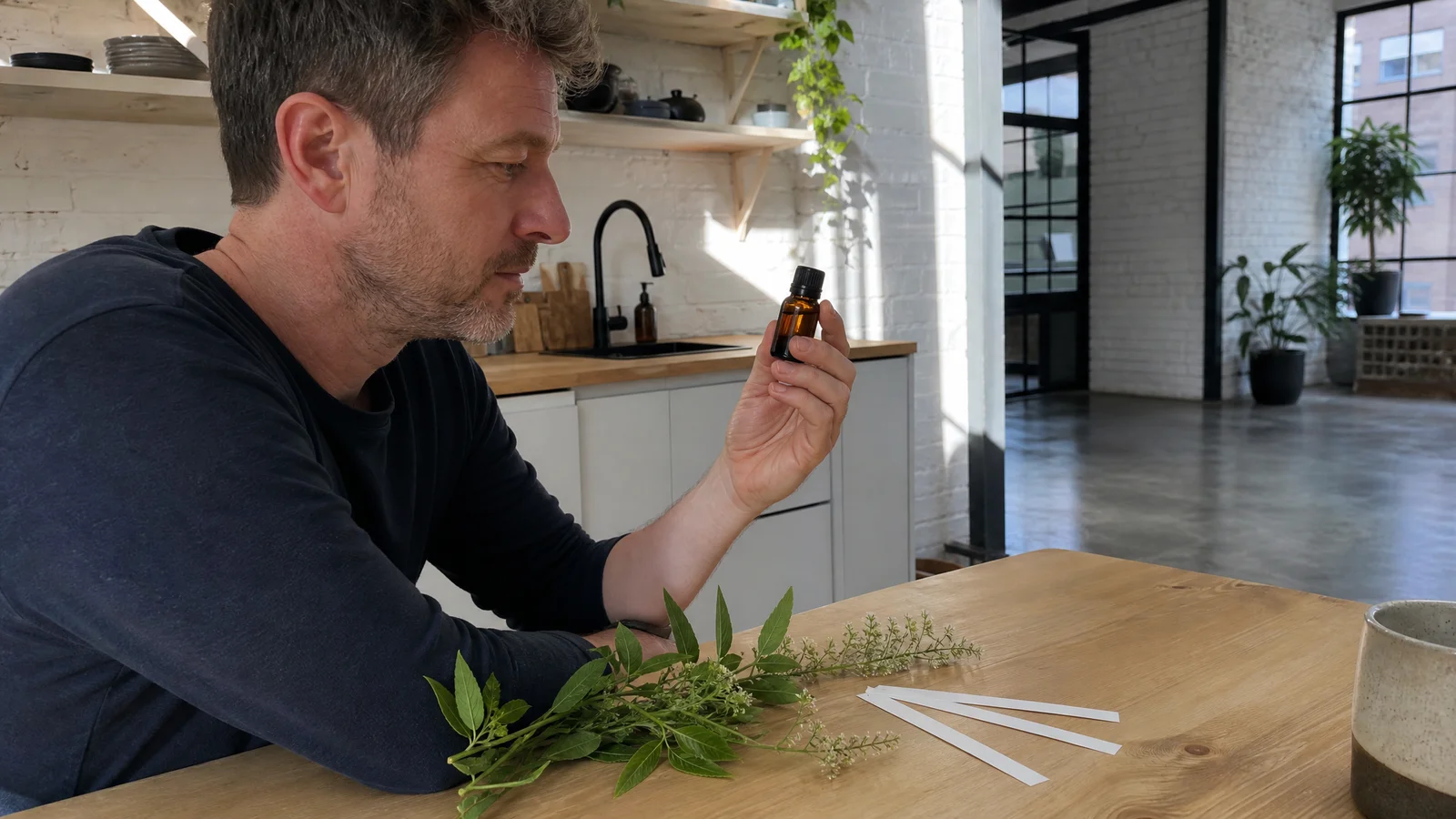
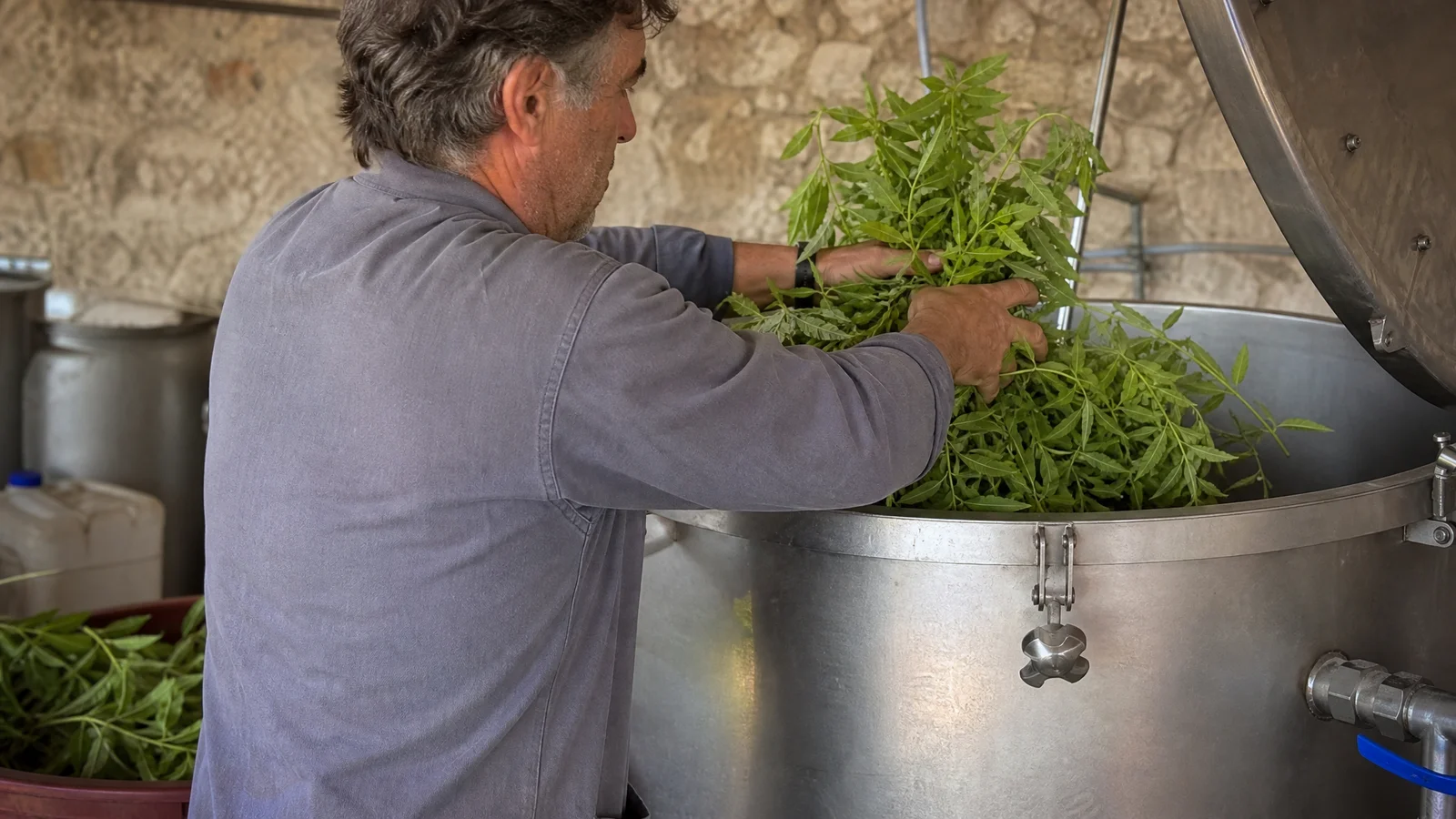
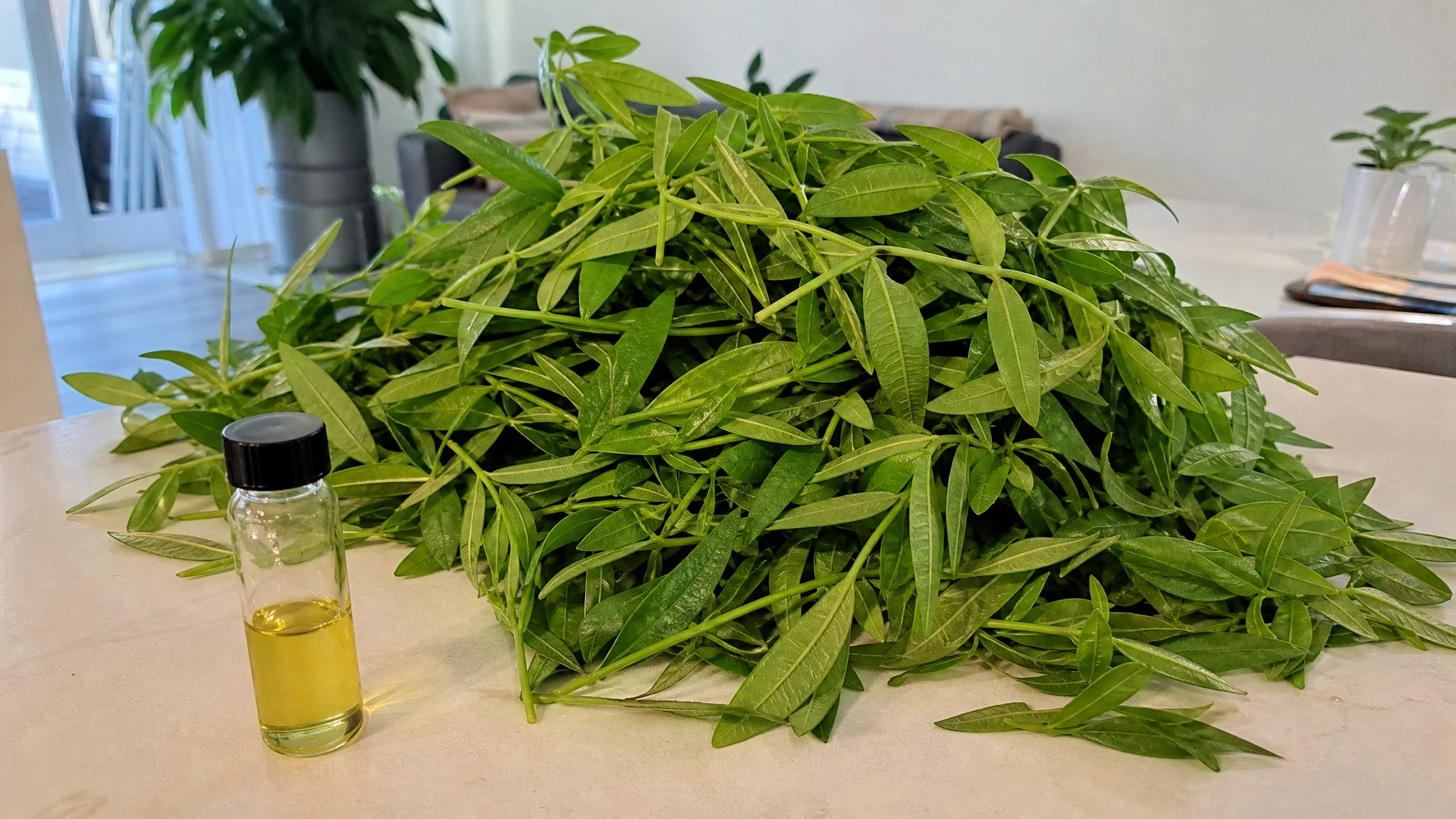
Numbers are easier to hold onto with a picture. A dried lemon verbena leaf is thin, narrow and nearly weightless, and it takes a surprising pile of them to make a kilogram. Rub a fresh leaf between your fingers and the lemon comes up at once, bright and green, so it is natural to assume the leaf is bursting with oil. The still tells a humbler story: most of that scent is a whisper, and a whole bushel of leaves gives up only a small bottle's worth.
Fresh leaf and dry leaf are not the same sum
Every figure above is on dried or air-dried material. Fresh leaf carries water, so reasoning from that, a yield quoted per kilogram of fresh leaf would come out smaller than the same oil quoted per kilogram of dry leaf. We found no source giving the water content for this species, so we cannot say by how much. It is a good reason to ask any supplier quoting a yield what basis it uses.
What it means when you use a drop
Knowing the scale changes how you handle the bottle. You stop thinking of a drop as a trivial thing and start treating it as something concentrated. That is a good reason to measure with a clean dropper, to mix small amounts and to keep the cap tight so none of it drifts away. It is also a good reason to enjoy it slowly. One drop on a cotton pad in a drawer will scent that drawer for days, and it feels like quite a luxury when you remember how many leaves are in it.
Is low yield the whole story?
Our own line is that the leaves give up very little oil, and the Ecuadorian and Moroccan work backs that up. But the Portuguese figures show that "very little" is not a fixed number. A hydrodistilled lemongrass leaf oil from Nepal was reported at 1.4% (Dangol et al., 2023), inside the Portuguese verbena range, so it is the particular leaf and still that decide the arithmetic, more than the family of oil. If you want to see how verbena sits beside lemongrass on aroma and chemistry, our lemongrass comparison picks that up.
One more wrinkle: the Ecuadorian paper describes its method as steam distillation in the abstract and hydrodistillation in the methods, a reminder that even published sources use the terms loosely. Our pages say steam-distilled, from the leaves, and our Certificate of Analysis names no origin or yield, so which of these numbers is closest to our bottle is not something we claim to know.
What the numbers do give you is a feel for scale. A half-ounce bottle is the product of a lot of leaf, and a few drops go a long way, which is worth keeping in mind when you read the diffusing guide or plan how long a bottle should last. Our article on the shrub itself tells the plant's side of the story.
Lemon Verbena Essential Oil
Lemon Verbena Essential Oil from our own shop, in sizes from 0.5 oz to bulk.
From $12.99
Shop Now →Sources & Further Reading
- Parichanon et al., 2025. Chemical Profiling, Sensory Qualities, and Bioactivities of Essential Oils Obtained from Aloysia citrodora and Bursera graveolens Ecuadorian Plants Against the Mosquito Aedes albopictus (Skuse) (Diptera: Culicidae). Insects 16(2):202. pmc.ncbi.nlm.nih.gov
- Oukerrou et al., 2017. Chemical Composition and Cytotoxic and Antibacterial Activities of the Essential Oil of Aloysia citriodora Palau Grown in Morocco. Advances in Pharmacological Sciences. pmc.ncbi.nlm.nih.gov
- Sprea et al., 2023. Volatile Compounds and Biological Activity of the Essential Oil of Aloysia citrodora Paláu: Comparison of Hydrodistillation and Microwave-Assisted Hydrodistillation. Molecules 28(11):4528. pmc.ncbi.nlm.nih.gov
- Dangol et al., 2023. Essential Oil Composition Analysis of Cymbopogon Species from Eastern Nepal by GC-MS and Chiral GC-MS, and Antimicrobial Activity of Some Major Compounds. Molecules 28(2):543. pmc.ncbi.nlm.nih.gov