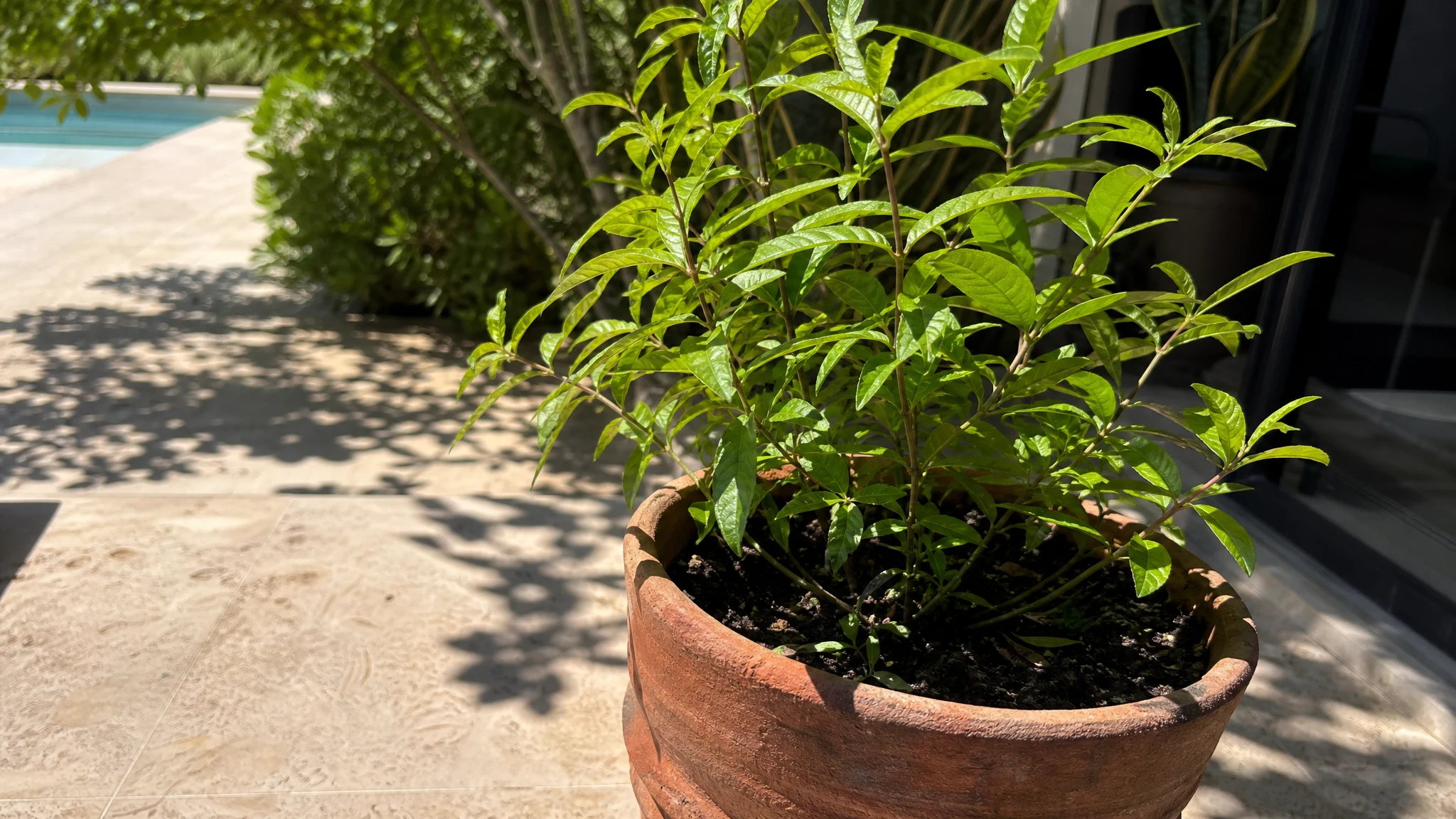
Where Does Lemon Verbena Oil Come From? Origins Explained
Lemon verbena is a South American shrub that now grows in gardens from Portugal to Morocco, and its leaves end up in a still almost anywhere. That is part of its charm, and also the reason "where does it come from?" has a more interesting answer than a single country name.
Lemon Verbena Essential Oil
Our own Lemon Verbena Essential Oil, in sizes from 0.5 oz to bulk.
From $12.99
Shop Now →A shrub of the Andean foothills
The accepted botanical name is Aloysia citrodora Paláu, in the verbena family, and you will still see it sold under older names such as Lippia citriodora or Aloysia triphylla. Its native range is generally given as north-western Argentina and southern Bolivia (ColPlantA lists dry inter-Andean valleys in Salta, Jujuy, Tarija and Cochabamba among them), and it has been carried to warm regions around the world since. If you want the plant's own story, our profile of the shrub goes deeper.
A shrub that travels well
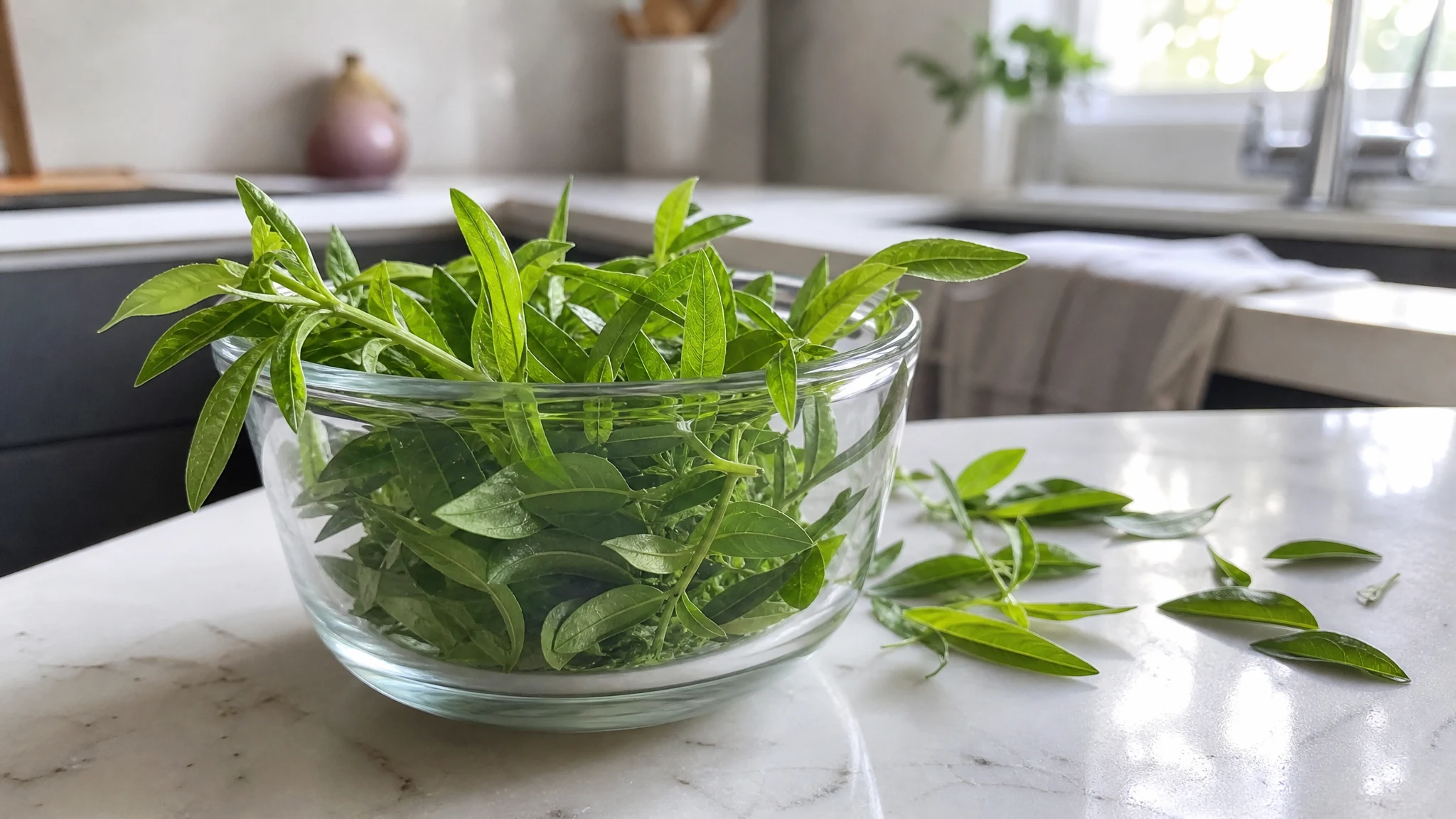
Part of the plant's story is how easily it moves. Gardeners have long grown it in pots and sunny borders, and it is the sort of shrub that perfumes a path when you brush past it. It drops its leaves in cold weather and returns when it warms up, which is one reason it has found a home in so many mild climates. Anyone who grows a plant on a windowsill or in a garden knows the small thrill of pinching a leaf and getting a burst of lemon on their fingers.
Same plant, very different oils
Researchers have distilled leaves from many places, and the results show why a plant name is only the beginning of a description. Each of the following is a single study, with its own leaf, season and method, so they are snapshots and not country averages.
- In Ecuador's Intag Valley, cultivated leaf gave an oil led by geranial and neral (together about 48%, the pair known as citral) with a yield of 0.18% of dry leaf weight.
- In Chile's Olmué area, fresh leaf gave a yield of 1.25% and an oil led by spathulenol (38.84%) with citral at only 3.16%.
- In five Moroccan regions, yields ran 0.1% to 0.2%, geranial was not detected, and caryophyllene oxide and spathulenol led.
- In Argentina, 36 collections showed yields from 0.16% to 1.93% and five distinct chemotypes, with citral leading in just two of them.
Those are all lemon verbena. The sparkling, citral-forward profile many people expect is one of several that exist, and that is true even in the plant's homeland.
Why origin and composition travel together
It is tempting to read the list as "Ecuador makes this, Chile makes that." The studies do not let us say so. Dried versus fresh leaf, distillation time, harvest month and the plant's own genetics all change from row to row, and the Portuguese study we draw on notes that genotype, growing conditions and collection period all matter. The honest reading is that place, plant and process move together, so a country name is a clue and not a fingerprint.
The yields make the same point in drops. A hundred grams of dry leaf at the Ecuadorian yield gives about 0.18 g of oil, a few drops. The Chilean figure is roughly seven times that (the methods differ, so treat it as scale, not a ranking). It is a big part of why lemon verbena oil is made in small quantities, which we explain in our distillation article.
Why we enjoy not knowing everything
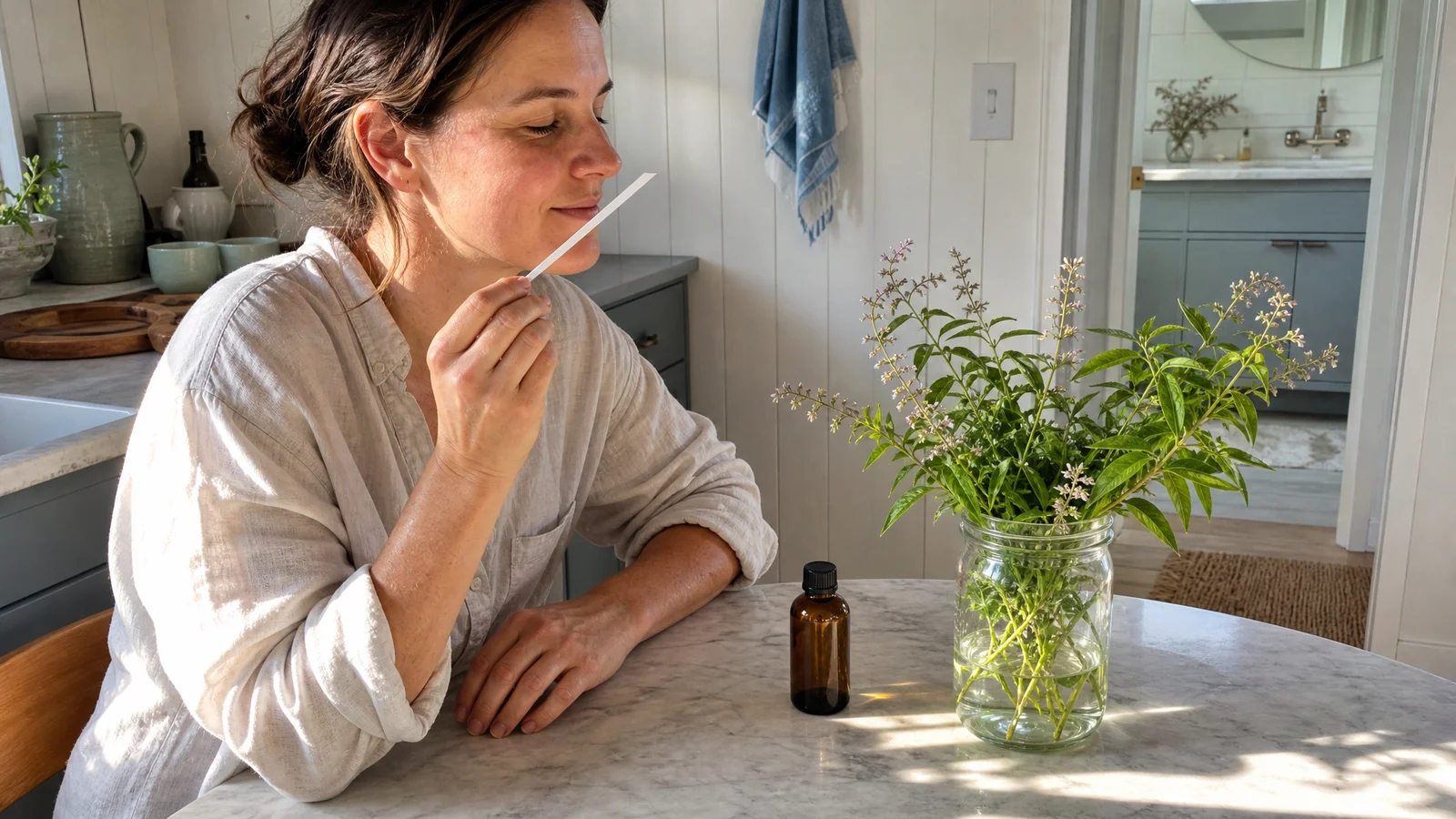
There is something rather lovely about a scent that cannot be pinned to a single postcard. Every bottle is a small mystery of leaf, place and process, and we think the best response is curiosity. Sniff it, compare it, write down what you notice, and let the aroma teach you what it can. A small notebook beside your bottle, with the date, the weather and a few words about the smell, becomes surprisingly good company over a season. The questions about origin and paperwork are for the practical side of a project. The pleasure of the scent itself does not depend on a map.
What to do with that if origin matters to you
If a particular country, a wild versus cultivated plant or a harvest year matters for your project, treat it as a question to ask in writing and keep the answer in writing. Useful items are growing region, plant part, distillation method and a GC-MS report for the lot, which is the document that shows composition. Our guide to reading a label and GC-MS report shows what to look for in the reply. Our oil is steam-distilled from the leaves, and if you need more than that for a product you plan to sell, please ask us through the contact page before you order.
A bottle's scent is a fair test of whether you like an oil in your own formula. It is not a way to work out where it grew, which is another good reason to ask. If you are comparing oils, our piece on what you can check before buying covers the rest.
A shrub from a few Andean valleys now perfumes the world. It is no wonder the oil has so many faces.
Lemon Verbena Essential Oil
Lemon Verbena Essential Oil from our own shop, in sizes from 0.5 oz to bulk.
From $12.99
Shop Now →Sources & Further Reading
- ColPlantA. Aloysia citrodora Paláu | Colombian Plants made accessible. colplanta.org
- Parichanon P et al., 2025. Chemical Profiling, Sensory Qualities, and Bioactivities of Essential Oils Obtained from Aloysia citrodora and Bursera graveolens Ecuadorian Plants Against the Mosquito Aedes albopictus (Skuse) (Diptera: Culicidae). Insects 16(2):202. PMC11857052
- Silva V et al., 2025. Chilean Aloysia Essential Oils: A Medicinal Plant Resource for Postharvest Disease Control. Plants 14(20):3121. PMC12566967
- Oukerrou MA et al., 2017. Chemical Composition and Cytotoxic and Antibacterial Activities of the Essential Oil of Aloysia citriodora Palau Grown in Morocco. Adv Pharmacol Sci. PMC5485486
- Sprea RM et al., 2023. Volatile Compounds and Biological Activity of the Essential Oil of Aloysia citrodora Paláu: Comparison of Hydrodistillation and Microwave-Assisted Hydrodistillation. Molecules 28(11):4528. PMC10254266
- Elechosa MA et al., 2017. Essential oil chemotypes of Aloysia citrodora (Verbenaceae) in Northwestern Argentina. Biochem Syst Ecol 74:19-29. repositorio.inta.gob.ar