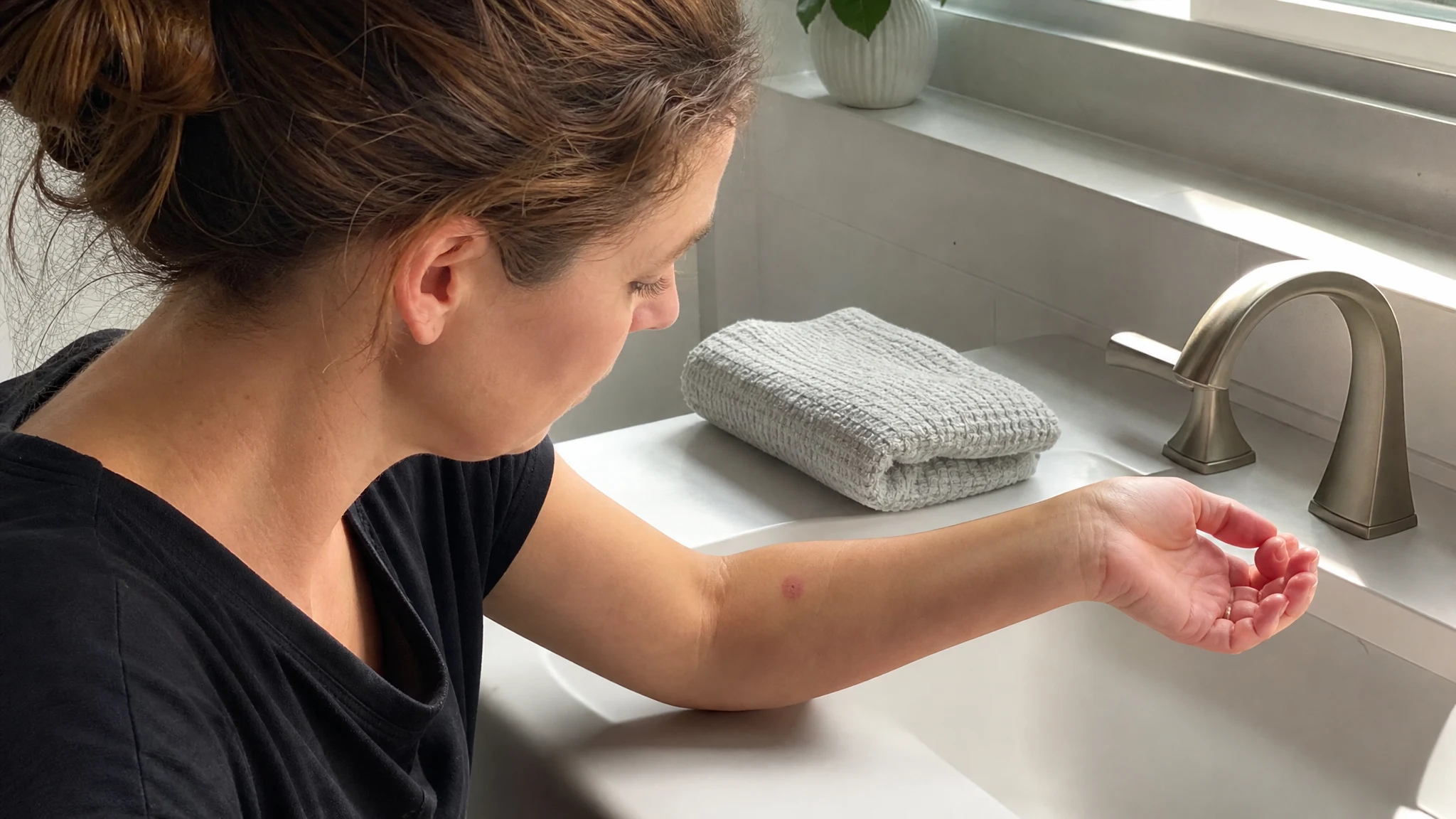
Lemon Verbena Oil for Skin: Risks and What Studies Measured
No source I read shows that lemon verbena oil does anything useful for skin, while the evidence that it can irritate or sensitize skin, and that regulators restrict it, is documented. This page weighs the two columns honestly, risks first, and says plainly where the "benefit" papers stop. It is not skincare advice, and a dermatologist is the right person for anything about your own skin.
Lemon Verbena Essential Oil
Our own Lemon Verbena Essential Oil, in sizes from 0.5 oz to bulk.
From $12.99
Shop Now →The risk column
| Concern | What the source says | How strong it is |
|---|---|---|
| Sensitization | IFRA's 2020 Standard: verbena oils "should not be used as a fragrance ingredient, based on its sensitizing and phototoxic potential" (IFRA, 2020). The EU banned verbena oil in cosmetics on the SCCNFP's "sensitising potential" finding (European Commission, 2009). | Two regulators' judgements. The underlying test data are not in the documents I could read. |
| Citral | On the EU's 2003 list of 26 fragrance allergens (FDA, 2026). IFRA caps citral at 0.15% in body lotions and oils (Category 5A) (IFRA, 2020). | Strong for citral. How much citral a given oil carries varies by origin and method. |
| Phototoxicity | Named by IFRA. Tisserand and Young (2014) call it modest and argue the IFRA and EU position is unjustified because only 12% concentrations were tested (quoted on a retailer's page, secondary). | Disputed between named sources. |
| Ageing in the bottle | Oxidized linalool gave 1.3% positive patch tests in 1,511 dermatitis patients (Matura et al., 2005). | A different set of terpenes; the oil itself was not tested. Applying it here is inference. |
Our own safety copy asks for 0.5% to 2% in a carrier, a patch test first, the low end first, and sun awareness. The IFRA reading is in the IFRA standards post, and the wider hazard list is in the safety guide.
What a quantitative risk assessment is, and why it matters here
When IFRA does set a number, such as the citral limit above, it comes from a quantitative risk assessment (QRA) for skin sensitization. IFRA's Guidance describes the steps: a benchmark dose at which sensitization induction is not expected (the NESIL), safety factors, an estimate of how much of a product a consumer puts on per square centimetre per day, and then a comparison of the acceptable exposure with the actual exposure for each product type (IFRA, 2023). The newer method, QRA2, also adds up exposure across everyday products. The EU's scientific committee, reviewing citral with that method in 2024, called QRA2 an improvement but wrote that more case studies are needed, so it would judge it case by case (SCCS, 2024). The practical point: a limit is a managed risk at a stated concentration.
For verbena oil nobody has published such a limit that I could find. The arithmetic that is possible is a thought experiment. If an oil were 34% citral (the Portuguese figure below), 0.5% oil in a body oil would deliver 0.17% citral, which is above the 0.15% Category 5A figure, and the shop's 2% ceiling would deliver 0.68%. I cannot say where our oil falls, because the COA we publish for its batch records appearance, smell, relative density 0.869 and refractive index 1.472, and no constituents.
The benefit column: what the papers measured
The literature on the oil is laboratory work, and each paper used oil from a different place and a different distillation. None of the three I read tested people, and the cell types named were tumor lines, kidney, blood, liver and macrophage cells, not skin cells.
| Paper | Material and method | What it reported |
|---|---|---|
| Jaradat et al., 2021 | Wild leaf from two sites (Umm al-Fahm and Baqa al-Gharbiyye), September 2020, Clevenger distillation; geranial 47.62% and 43.46% | DPPH test-tube antioxidant assay: IC50 11.74 and 35.48 µg/ml against 2.45 for a Trolox standard. Minimum inhibitory concentration against S. aureus of 2.5 µg/ml. The paper's cytotoxicity values contradict each other on which oil was stronger. |
| Oukerrou et al., 2017 | Leaf from five Moroccan sites, hydrodistillation, yield 0.1% to 0.2%; neral 6% to 10%, no dominant citral | Cytotoxicity on mouse mastocytoma, human breast and monkey kidney lines (IC50 6.6 to 79.6 µg/ml), no cytotoxicity in normal blood cells. Minimum inhibitory concentrations against E. coli of 2.84 to 8.37 mg/ml. |
| Sprea et al., 2023 | Portuguese dried leaf, Clevenger versus microwave-assisted distillation; geranial 18.7% to 21.1%, neral 15.3% to 16.2% | Both oils active in assays, with different profiles; the Clevenger oil was markedly cytotoxic to pig liver cells (GI50 18 µg/ml), which the authors say needs further study before any internal use. |
Two things stand out. The oils differ so much in composition that one paper's result cannot stand in for another's, let alone for ours. And the two bacterial growth results are far apart: 2.5 µg/ml against S. aureus in one paper, 3.51 to 6.42 mg/ml in the other. If the units are as printed, that is roughly a thousand-fold gap, and I did not re-derive either from raw data. Concentrations in a dish are also not doses on skin: to mean something for a skin product, a result would need a human skin test, the oil in a real carrier, and an applied dose per square centimetre, none of which these papers supply. The Portuguese team also measured nitric oxide release in macrophage cells (IC50 29 and 40 µg/ml for the two oils), which tells you the oils act on cells in a dish and nothing about a cream. I have not reviewed trials of leaf extracts or tea, which are different materials from a steam-distilled oil and do not transfer.
What a cosmetic can claim, and where I stop
FDA decides cosmetic versus drug by intended use, and says claims such as restoring hair growth can turn a cosmetic into a drug (FDA, 2026). That is why this shop makes no skin claims, and why the table above reports what experiments did and nothing more. We sell the oil neat and make no medical claim for it.
If you still want it on your skin
Decide in this order. First, skip it if you have a known fragrance allergy, damaged or inflamed skin, or you are choosing for a child or pet; a dermatologist, pediatrician or veterinarian is the person to ask. DermNet estimates 1% to 2% of people are allergic to fragrance (DermNet). Second, patch test a diluted drop on a small area first, as the skin basics post walks through. Third, stay low: at about 20 drops per ml, 0.5% in an ounce of carrier (29.57 ml) is about 3 drops. Fourth, keep treated skin out of strong sun. A formulation worked from that arithmetic is in the skincare recipes post; the broader research summary belongs in the benefits research post.
If a rash appears, stop, wash with soap and water, and see a physician or dermatologist.
Lemon Verbena Essential Oil
Lemon Verbena Essential Oil from our own shop, in sizes from 0.5 oz to bulk.
From $12.99
Shop Now →Sources & Further Reading
- IFRA, 2020. Standard: Verbena oil and absolute (Lippia citriodora Kunth.), Amendment 49. abifra.org.br/213-Verbena-oil-and-absolute
- IFRA, 2020. Standard: Citral, Amendment 49. perfumersworld.com/IFRA-Standards/Citral.pdf
- IFRA, 2023. Guidance for the use of IFRA Standards, 51st Amendment. ifra-51st-amendment-guidance
- European Commission, 2009. Directive 2009/164/EU. legislation.gov.uk/eudr/2009/164
- SCCS, 2024. Opinion on Citral, sensitisation endpoint (SCCS/1666/24). health.ec.europa.eu/sccs-opinion-citral
- FDA, 2026. Allergens in Cosmetics. fda.gov/allergens-cosmetics; Cosmetics and U.S. Law. fda.gov/cosmetics-us-law
- Jaradat et al., 2021. BMC Complement Med Ther 21:143. PMC8130314
- Oukerrou et al., 2017. Adv Pharmacol Sci 2017:7801924. PMC5485486
- Sprea et al., 2023. Molecules 28(11):4528. PMC10254266
- Matura et al., 2005. Contact Dermatitis 52(6):320-328. portal.research.lu.se
- Tisserand and Young, 2014. Essential Oil Safety, 2nd ed., as quoted on a retailer product page (secondary). retailer product page
- DermNet. Fragrance mix allergy. dermnetnz.org/fragrance-mix-allergy