Can You Ingest Lemon Verbena Oil? What the Sources Say
No. Our lemon verbena oil is sold neat, labelled not for internal use, and we are not a food seller, so we do not recommend swallowing it, in water, honey, capsules or anywhere else. The sections below show why with arithmetic and with what the regulatory lists and poison-centre sources actually say, because the "food grade" claims that circulate online rarely come with either.
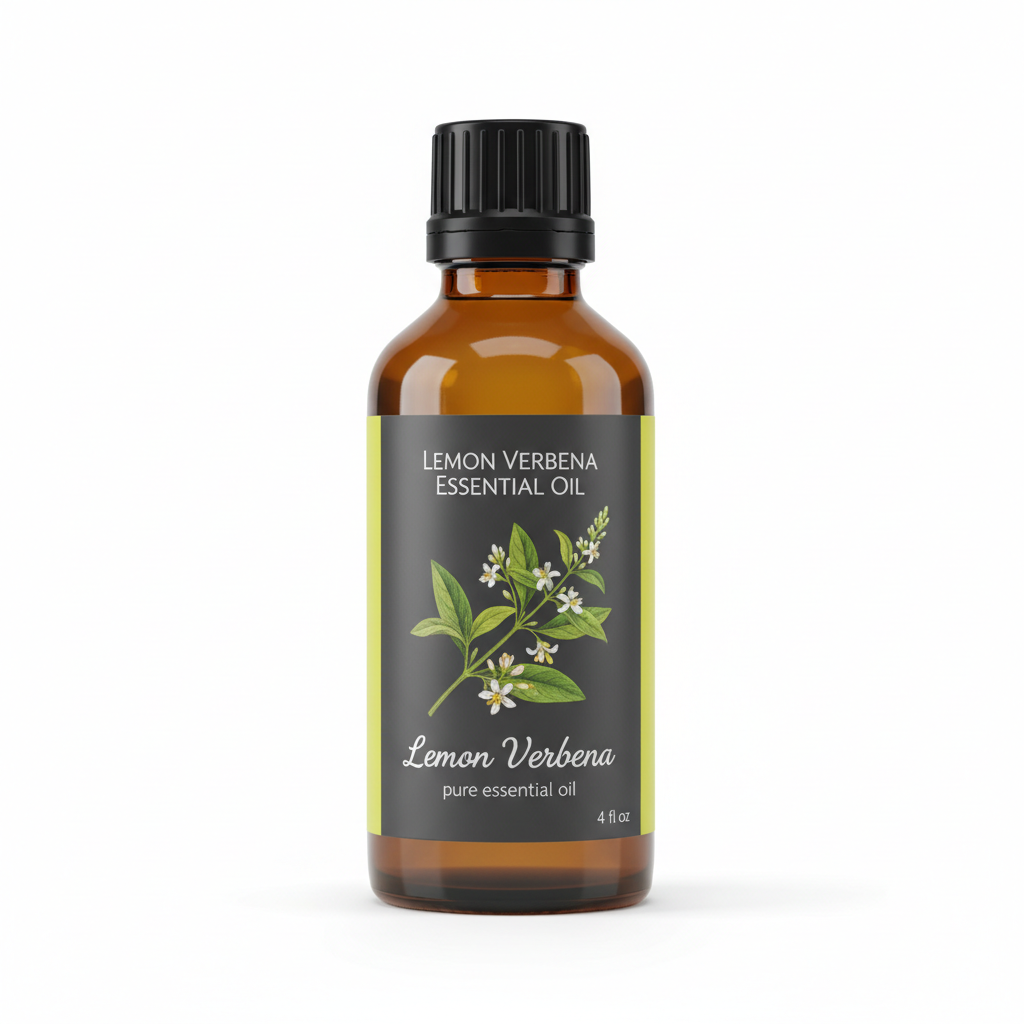
Lemon Verbena Essential Oil
Our own Lemon Verbena Essential Oil, in sizes from 0.5 oz to bulk.
From $12.99
Shop Now →One drop against one cup of tea
The comparison that matters is between a leaf and a distillate. From our COA batch, the relative density is 0.869, so 1 ml weighs about 0.869 g. At about 20 drops per ml (droppers vary; weigh if it matters), one drop is about 0.043 g, or 43 mg of oil.
How much leaf makes 43 mg? A study of five Moroccan lemon verbena leaf oils (Oukerrou et al., 2017) reported oil yields of 0.1% to 0.2% from shade-dried leaf by hydrodistillation. At 0.2%, 43 mg of oil is the full yield of about 22 g of leaf; at 0.1%, about 44 g. Now set that against the only regulator-written dosing we could read for the plant, the European Medicines Agency's monograph on lemon verbena leaf tea (EMA/HMPC/376770/2019, adopted 13 January 2021). Its infusions use 1 to 3 g of leaf in 200 ml of boiling water, and its decoction for one indication uses 5 g in 100 ml. By this arithmetic one drop of oil is the distilled yield of roughly 4 to 44 times the leaf in one of those doses (22 g against 5 g, to 44 g against 1 g).
That is reasoning, not a measurement. A hot-water infusion may not pull out all of the leaf's oil; if it does not, a cup of tea holds less oil than the distillation yield implies and the gap is wider still. What the arithmetic does show is that "it is the same plant as the tea" says nothing about dose. A drop is a different order of exposure. The EMA monograph also covers only the dried leaf as a tea; it does not mention the essential oil.
What the food-regulation lists say, and what they do not
The US rule people point to is 21 CFR 182.20, which lists essential oils, solvent-free oleoresins and natural extractives (including distillates) that are "generally recognized as safe for their intended use". On the eCFR text read for this article (27 October 2026), the botanical entries from the letter L include lemon (Citrus limon), lemon grass, lemon peel and lavender, and there is no entry for lemon verbena, Aloysia, or verbena. Lemon balm appears only as a cross-reference to balm. 21 CFR 182.20 and the neighbouring 182.10 (spices and other natural seasonings and flavorings) do not list it either; the only "Lippia" in 182.10 is the oregano entry (Lippia spp.), a different plant.
Read that carefully, because it is easy to over-read. Absence from 182.10 and 182.20 is not a ban, and it is not evidence of toxicity. A food additive can be permitted through other FDA routes or an industry safety determination, and we did not read those: we did not check FDA's flavouring regulations in 21 CFR 172, the Flavor and Extract Manufacturers Association lists, or the EU flavouring list. So this article does not say lemon verbena oil is, or is not, permitted as a flavouring. It says only what these two sections say, and that "generally recognized as safe" is defined in the text "for their intended use", which is a statement about a listed substance in a food at flavouring levels, not about drops swallowed from a perfumery bottle.
FDA's page on aromatherapy (content dated 8 September 2023) makes a related point about plant products generally: coming from a plant does not exempt a product from regulation, and plant-derived ingredients "can still be toxic, irritating, or allergenic". Intended use drives the category, which is why a bottle sold for scent and craft should not be repurposed as a food.
What poison-centre and medical sources say about swallowing
- The UK Teratology Information Service says "Undiluted essential oils are highly toxic and should not be swallowed during pregnancy or at any other time", and that anyone who swallows one should seek immediate medical advice (UKTIS, version 4.0, December 2023).
- The Connecticut Poison Control Center advises "Avoid ingesting essential oils", notes that children under 6 are most at risk and that adults tend to make more severe mistakes, and gives 1-800-222-1222 for poisonings (tip sheet, undated).
- In New South Wales, essential oils generated 4,412 calls to the Poisons Information Centre between July 2014 and June 2018; 31% of callers already had symptoms, and the authors say as little as 5 mL can cause severe toxicity in children (Lee, Harnett and Cairns, 2020). That is about essential oils as a class, not lemon verbena.
- For animals, the ASPCA lists lemon verbena plant as toxic to dogs, cats and horses with essential oils as the toxic principle (ASPCA entry); see our pets article.
No source read for this article sets an oral dose for lemon verbena essential oil, and none says swallowing it is appropriate. For pregnancy specifically, see the pregnancy article.
Why "a drop" is not a defined dose even in principle
Lemon verbena oil is not a fixed composition. The Moroccan set above reported neral at about 6% to 10% with no geranial detected, and limonene around 0.5% on average, with spathulenol, ar-curcumene and caryophyllene oxide among the main compounds. A 2025 study of Chilean oils (Silva et al., Plants) described Aloysia citriodora oil as characterised by spathulenol and caryophyllene oxide, which is a different profile from one led by neral and geranial. Neither study analysed our oil. Our published COA records appearance, smell, a relative density of 0.869 and a refractive index of 1.472, and nothing about composition, so it cannot tell you what a drop of our batch contains. The article on reading a label and GC-MS report explains what to ask for if you need that data.
If you want lemon verbena in food or drink
Use a material sold and labelled for that purpose by the people who make it: the dried leaf as a tea (for which the EMA gives its tea doses above), or a flavouring whose own label says it is one. We sell only the essential oil, not leaf, tea or flavourings, and our oil is not one. The cooking article covers the leaf in the kitchen, and the tea versus oil comparison sets out the difference.
If someone has swallowed it
Call poison control (in the US, 1-800-222-1222) or emergency services straight away, and have the bottle and the botanical name, Aloysia citrodora, to hand. We cannot give first aid advice for a particular exposure, and a physician or poison centre can.
For anything beyond that, such as whether you can take a specific product alongside medicines, ask a physician or pharmacist.
Lemon Verbena Essential Oil
Lemon Verbena Essential Oil from our own shop, in sizes from 0.5 oz to bulk.
From $12.99
Shop Now →Sources & Further Reading
- US Food and Drug Administration, 21 CFR 182.20, Essential oils, oleoresins (solvent-free), and natural extractives (including distillates) (eCFR). ecfr.gov
- US Food and Drug Administration, 21 CFR 182.10, Spices and other natural seasonings and flavorings (eCFR). ecfr.gov
- US Food and Drug Administration, 2023. Aromatherapy. fda.gov
- European Medicines Agency, HMPC, 2021. EU herbal monograph on Aloysia citrodora, folium (EMA/HMPC/376770/2019). ema.europa.eu
- Oukerrou M.A. et al., 2017. Chemical composition of the essential oil of Aloysia citriodora Palau grown in Morocco (title continues with laboratory assays). Advances in Pharmacological Sciences. PMC5485486
- Silva V. et al., 2025. Chilean Aloysia essential oils: a medicinal plant resource for postharvest disease control. Plants 14(20):3121. doi:10.3390/plants14203121
- UK Teratology Information Service, December 2023. Essential oils (Medicines in Pregnancy). medicinesinpregnancy.org
- Connecticut Poison Control Center, undated. Essential Oils tip sheet. health.uconn.edu
- Lee K.A., Harnett J.E., Cairns R., 2020. Essential oil exposures in Australia: analysis of cases reported to the NSW Poisons Information Centre. Medical Journal of Australia 212(5). mja.com.au
- ASPCA, accessed 27 October 2026. Toxic and Non-Toxic Plants: Lemon Verbena. aspca.org