
Lemon Verbena Oil in Pregnancy: What the Sources Say
No authority in the sources read for this article clears lemon verbena essential oil for use in pregnancy or breastfeeding, and none condemns it either. The record is silent, and silence is not clearance. We sell the oil and we do not call it safe for anyone in this situation; what follows is what the documents say, so you can take a specific question to your midwife, obstetrician or pharmacist.
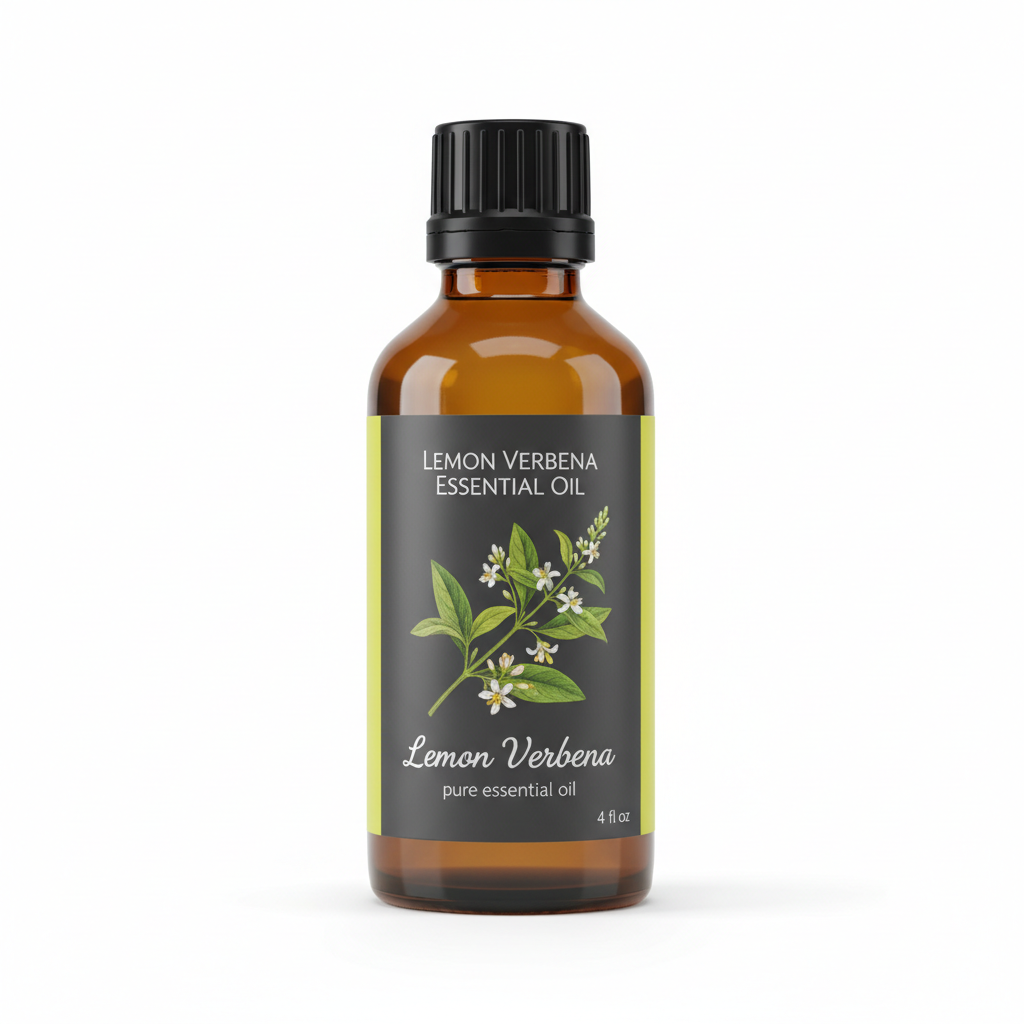
Lemon Verbena Essential Oil
Our own Lemon Verbena Essential Oil, in sizes from 0.5 oz to bulk.
From $12.99
Shop Now →The sources, and what each one covers
Three documents bear on this question. None of them is about our oil, and only one mentions the plant at all.
| Source | What it covers | What it says about pregnancy | What it does not cover |
|---|---|---|---|
| UKTIS essential oils page, version 4.0, December 2023 | Essential oils as a group, in toiletries, massage and decongestant products | Small amounts in shop-bought toiletries and some foods "will not harm the unborn baby"; many women have aromatherapy massage "without problems"; "certain specific essential oils" are avoided at any stage because of a "hypothetical risk" of womb contractions | It names no oil to avoid in that passage, and it does not name lemon verbena. It also states that "no scientific studies have been carried out" on whether essential oils for pregnancy massage are safe |
| EMA herbal monograph on lemon verbena leaf, EMA/HMPC/376770/2019, adopted 13 January 2021 | The dried leaf, taken as a herbal tea, as a traditional herbal medicinal product | "Safety during pregnancy and lactation has not been established. In the absence of sufficient data, the use during pregnancy and lactation is not recommended." Also: "No fertility data available" and "Adequate tests on reproductive toxicity, genotoxicity and carcinogenicity have not been performed." | The essential oil. The monograph covers comminuted leaf for tea only |
| Our own product copy | Our neat oil | Nothing about pregnancy. The copy says not for internal use, dilute to 0.5% to 2% for skin, patch test first, and keep away from children and pets | It makes no pregnancy statement, so do not read one into it |
What the EMA statement is, and is not
The EMA text is the closest thing to a regulator's word on this plant, so it is worth reading precisely. It is a monograph for a leaf infusion. The same document gives the doses it contemplates (for example 1 to 2 g of leaf in 200 ml of boiling water as an infusion for the sleep indication) and says use in children "has not been established due to lack of adequate data". For pregnancy it does not say the leaf is harmful. It says nobody has shown it is not, and it recommends against use for that reason.
Reasoning from that: if the committee found too little data to support a leaf tea in pregnancy, a concentrated distillate of the same leaf has no stronger evidence behind it. That is an inference, not something the EMA wrote. The EMA also lists a contraindication for hypersensitivity to plants of the Verbenaceae family, which is a separate point for anyone who has reacted to verbena plants before.
Three routes of exposure, kept apart
Swallowing
This is the one route where the UKTIS page is blunt: "Undiluted essential oils are highly toxic and should not be swallowed during pregnancy or at any other time", and anyone who swallows one should seek immediate medical advice. Our label says not for internal use. If this was the question behind the search, the answer is no, and the article on ingesting lemon verbena oil covers why.
On the skin
UKTIS says oils are normally diluted for massage and that the risk rises when a large area is treated or the skin is broken. It gives no percentage. Our skin copy gives a general 0.5% to 2% range, which is a dilution for adults, not a pregnancy-specific limit; no pregnancy-specific limit for this oil appears in the sources read. Two product-specific points apply regardless of pregnancy: our own site notes that verbena can be mildly photosensitising, and citral, which is made of the isomers neral and geranial, is a fragrance ingredient that the EU's scientific committee assessed for skin sensitisation in SCCS opinion 1666/24 (adopted 29 July 2024). That opinion judged citral acceptable for induction of sensitisation at proposed cosmetic concentrations, while noting that parts of its method still need clarification. A cosmetic-law database lists labelling thresholds of 0.001% in leave-on and 0.01% in rinse-off products (coslaw.eu, a secondary source). How much citral any given lemon verbena oil holds varies: one Moroccan set of five leaf oils reported neral at about 6% to 10% and no geranial (Oukerrou et al., 2017), and our published COA does not give a citral figure. If you are already advised to avoid fragrance allergens, ask about that directly. The skin basics article has the dilution arithmetic.
In the air
Smelling an oil is the lowest-dose route, and for lemon verbena it is also the least studied. UKTIS mentions inhaled oils only for decongestant products (thought "unlikely to cause harm when used as directed") and for labour. Neither is lemon verbena. No study of lemon verbena oil vapour in pregnant women turned up in the sources read. Fragrance sensitivity is a separate matter: in a 2016 survey of 1,136 US adults, Steinemann (2016) reported that 20.4% said they had health problems from air fresheners or deodorizers, most often respiratory (9.5%), mucosal (7.6%) and migraine (7.2%). That is self-reported and not specific to pregnancy or to essential oils, but it is a reason that someone who finds scent a trigger should not diffuse in a closed room. The diffusing guide covers running time and ventilation.
Breastfeeding: even less to report
The UKTIS page does not discuss breastfeeding, so it gives no answer there. The EMA monograph groups pregnancy and lactation in one sentence, with the same "not recommended" wording and the same reason. Anything more specific, such as whether to avoid putting oil near the breast or on skin the baby touches, is a question for your midwife, health visitor or pharmacist, because it depends on your product and dilution. The practical point that needs no study: a baby can swallow or rub into the eyes whatever sits on your skin, so keep any oil away from the chest, hands and clothing the baby contacts.
If you are pregnant and want to use it anyway
Here is the order we recommend, as a recommendation and not as medical advice.
- Ask your midwife, obstetrician or pharmacist, naming the oil by its botanical name, Aloysia citrodora (also written Aloysia triphylla or Lippia citriodora). Ask about your own history, not just the oil.
- Do not swallow it, in any amount or any carrier.
- If a professional agrees to skin use, use the lowest dilution on our range (0.5%, about 3 drops per ounce of carrier) and patch test first. That arithmetic is ours and is not a pregnancy limit.
- Keep the bottle capped and stored where children cannot reach it, which our copy says as well.
- If you feel unwell after smelling or using it, stop and call your midwife or doctor. In the US, poison control is 1-800-222-1222 (Connecticut Poison Control Center, undated tip sheet).
If you only want the scent of lemon verbena, the leaf tea is a different material with its own EMA statement above, and our comparison of tea and oil explains the difference. We sell only the oil, so for any other product ask the shop or pharmacist selling it.
Our oil is a perfumery and craft material, sold neat, with no medical claims. If pregnancy changes how you should handle it, the people to ask are the ones who know your pregnancy, and the sources above say the same.
Lemon Verbena Essential Oil
Lemon Verbena Essential Oil from our own shop, in sizes from 0.5 oz to bulk.
From $12.99
Shop Now →Sources & Further Reading
- UK Teratology Information Service (UKTIS), December 2023, version 4.0. Essential oils (Medicines in Pregnancy). medicinesinpregnancy.org
- European Medicines Agency, HMPC, 2021. European Union herbal monograph on Aloysia citrodora Paláu, folium (EMA/HMPC/376770/2019). ema.europa.eu
- Steinemann A., 2016. Fragranced consumer products: exposures and effects from emissions. Air Quality, Atmosphere & Health 9(8):861-866. PMC5093181
- Scientific Committee on Consumer Safety, 2024. Opinion on citral, sensitisation endpoint (SCCS/1666/24). health.ec.europa.eu
- Oukerrou M.A. et al., 2017. Chemical composition of the essential oil of Aloysia citriodora Palau grown in Morocco (title continues with laboratory assays). Advances in Pharmacological Sciences. PMC5485486
- Connecticut Poison Control Center, undated. Essential Oils tip sheet. health.uconn.edu