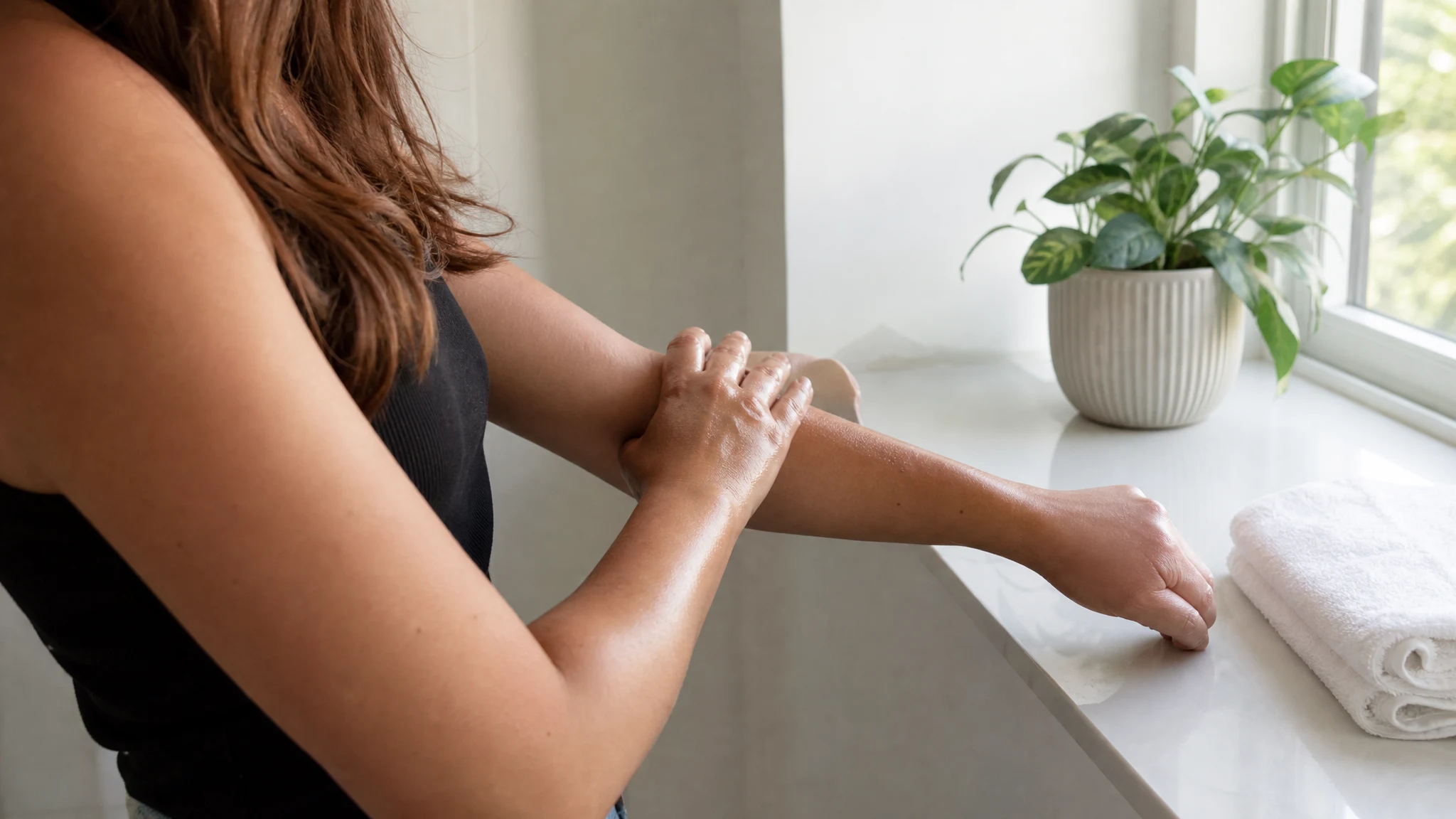
Lemon Verbena Body Oil: A Low-Dose Formulation, Worked Out
There is one leave-on lemon verbena recipe I would write down: a scented body oil, in a carrier oil, with no water in it, at a dose well below the bottom of our own 0.5% to 2% range. A lotion, a cream or a spray is a different job, and I do not think a kitchen is the place for it. We have not made or tested any recipe on this page; it is arithmetic worked out from cited limits, and you should do a small batch and a patch test before relying on it.
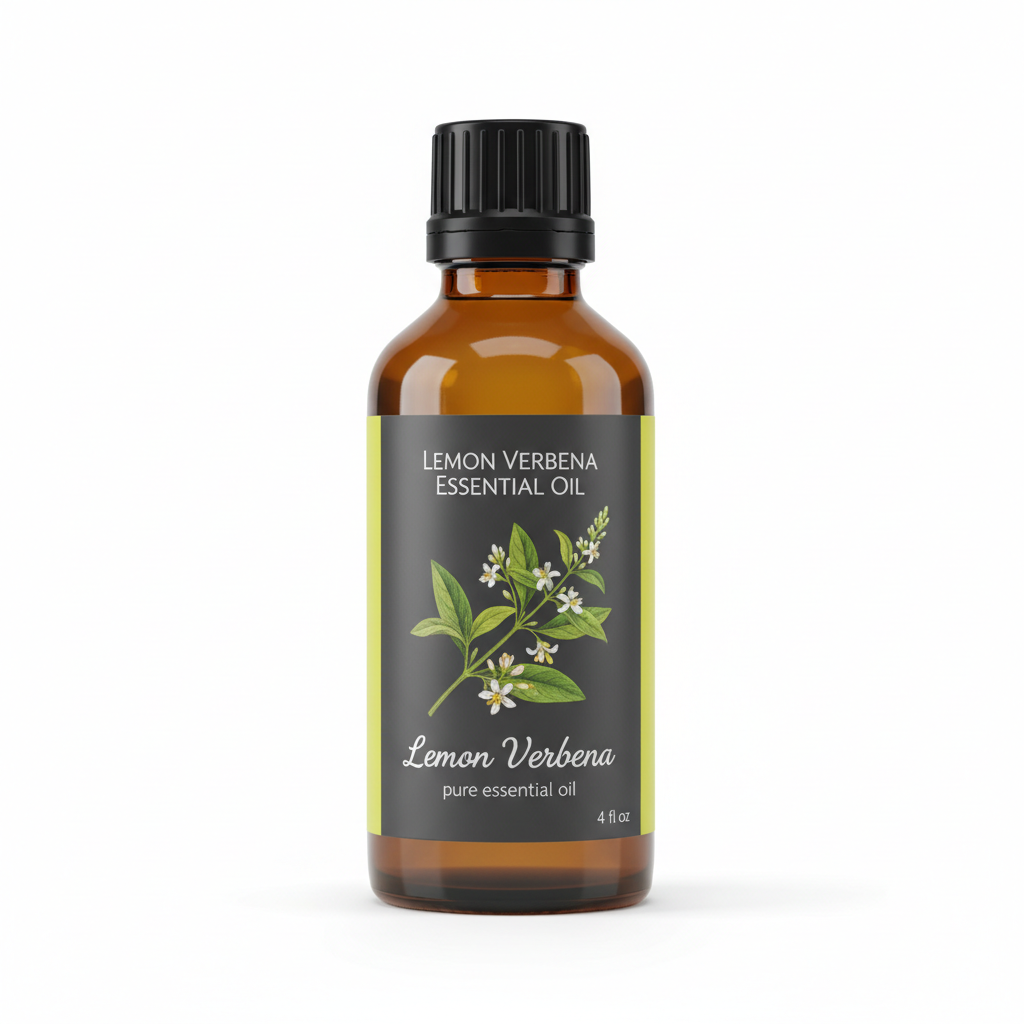
Lemon Verbena Essential Oil
Our own Lemon Verbena Essential Oil, in sizes from 0.5 oz to bulk.
From $12.99
Shop Now →First decide whether to make it at all
Read this before you buy a carrier. IFRA's 2020 Standard says verbena oil from Lippia citriodora "should not be used as a fragrance ingredient", and its Expert Panel recommends "not to use Verbena oil in any finished product application" (IFRA, 2020). The EU prohibits derivatives other than the absolute as a fragrance ingredient in cosmetics (European Commission, 2009). The IFRA standards post goes through the text. So this recipe is for your own use. Do not sell it, give it as a product, or put it in front of customers without a regulatory consultant. FDA's small-business sheet says that if you make or market cosmetics you carry the legal responsibility for their safety and labelling (FDA, 2025).
Skip it too if you have a known fragrance allergy, damaged skin, or the oil is for a child, pregnant person or pet: a dermatologist, physician or veterinarian decides that, not a recipe. See the safety guide for the reasons.
Why a body oil and not a lotion
Water changes the problem. FDA says cosmetics need not be sterile but that "microbial contamination can pose a health hazard, making a product adulterated" (FDA, 2025). A US outbreak of Burkholderia cepacia complex infections linked to a no-rinse cleansing foam counted 60 cases in six states as of May 2018; FDA's investigators found a flawed purified-water system and failures to investigate microbial test results, and noted the organism resists many disinfectants and preservatives (Seelman et al., 2022). That product was an industrial contract-manufactured one, so it is an extreme example, but it shows that a preservative is not the whole answer for water-based products. Choosing and dosing a preservative system is a cosmetic chemist's task, and we sell none. An anhydrous oil blend has no water for microbes to grow in, which is reasoning on my part rather than a result I fetched, and why I limit this page to it.
Choose the dose from the lowest limit you can find
Three numbers are on the table. Our shop copy says 0.5% to 2% in a carrier. The one published use level I found is 0.9% from Tisserand and Young (2014), which I saw only as quoted on a retailer's page (secondary). And IFRA's citral Standard caps citral at 0.15% in body creams, oils and lotions, Category 5A (IFRA, 2020). Citral shares in published oils run from about 34% (geranial plus neral, Sprea et al., 2023) up to geranial alone at 47.62% (Jaradat et al., 2021); I did not capture that paper's neral figure, so its citral pair is higher. Our published COA gives no constituent data, so we cannot say where our oil sits.
The formula is oil % = citral limit divided by citral share. At 34% that is 0.15 / 0.34 = 0.44% oil, and at 47.6% it is 0.32%. Because the real share could be higher, this recipe uses 0.25%, below both. The shop's 0.5% already gives 0.17% citral at a 34% share, so I treat 0.5% as the most you would go after a quiet patch test, and 2% as outside this recipe.
The recipe and the drop count
Volume basis, 20 drops per ml (droppers vary; this is the shop's working figure), 1 oz = 29.57 ml, and the oil's relative density of 0.869 on the published COA batch, so 1 ml weighs about 0.869 g.
| Carrier in bottle | 0.25% | 0.5% | 0.9% |
|---|---|---|---|
| 1 oz (29.57 ml) | 1.5 drops | 3 drops | 5 drops |
| 2 oz (59.15 ml) | 3 drops | 6 drops | 11 drops |
| 4 oz (118.3 ml) | 6 drops | 12 drops | 21 drops |
Formulation (not made or tested by us): 2 oz of a liquid carrier oil in a clean amber glass bottle, plus 3 drops of lemon verbena oil. Three drops is 0.15 ml, about 0.13 g of oil, and 0.25% of the volume. By IFRA's citral figure it stays under 0.15% citral unless the oil is more than about 59% citral, and I cannot rule that out for any particular oil without a GC-MS report. Cap, swirl, label with the date and the percentage.
- Carrier: a liquid oil you already use on your skin, from a craft or soap supply shop. Ask for its data sheet and its shelf life; the blend lasts no longer than the shorter of that date and the 1 to 2 years our copy gives for the oil, which I treat as a limit and not a promise.
- Measuring: three drops from an orifice reducer is a coarse measure. A 1 ml graduated pipette from the same supply shop lets you draw 0.15 ml.
- Test first: follow the patch test in the skin basics post with the finished blend, on a small area, before using it more widely.
- Sun: our copy says verbena can be mildly photosensitising, so use it on covered skin in the evening, not before a day outdoors. That is my recommendation, not a sourced interval.
The order of work
- Wash and fully dry the bottle and any funnel or pipette, because a drop of water is the one thing an oil blend should not contain.
- Pour the carrier in first, then add the oil, so the drops fall into a larger volume and mix more evenly.
- Cap, swirl for a minute, and write the date, the percentage (0.25%) and the batch size on the label.
- Run the patch test with this exact blend, following the steps in the skin basics post, before any wider use.
- Keep it capped, cool and dark, away from children and pets, and discard it if the smell turns flat or sharp.
What goes wrong
The likeliest error is the drop count. A fast dropper that delivers 30 drops per ml instead of 20 turns "3 drops" into 0.10 ml, a one-third drop in dose, and a slow one the other way; weigh or pipette if the number matters. The second is scaling up by eye: 12 drops in a 4 oz bottle is 0.5%, not 0.25%. The third is old oil: a bottle opened years ago and stored warm is not the oil the arithmetic assumed.
For other formats, the bath oil post, the rollerball post and the solid balm post cover their own bases, and the skin-risk picture is in the skin evidence review.
If you want a lotion, take the formula to a cosmetic chemist, and treat the citral arithmetic above as a question to put to them.
Lemon Verbena Essential Oil
Lemon Verbena Essential Oil from our own shop, in sizes from 0.5 oz to bulk.
From $12.99
Shop Now →Sources & Further Reading
- IFRA, 2020. Standard: Verbena oil and absolute (Lippia citriodora Kunth.), Amendment 49. abifra.org.br/213-Verbena-oil-and-absolute
- IFRA, 2020. Standard: Citral, Amendment 49. perfumersworld.com/IFRA-Standards/Citral.pdf
- European Commission, 2009. Directive 2009/164/EU. legislation.gov.uk/eudr/2009/164
- FDA, 2025. Small Businesses and Homemade Cosmetics: Fact Sheet. fda.gov/small-businesses-homemade-cosmetics
- Seelman et al., 2022. Burkholderia cepacia complex outbreak linked to a no-rinse cleansing foam, United States 2017-2018. Epidemiol Infect. PMC9428903
- Sprea et al., 2023. Molecules 28(11):4528. PMC10254266
- Jaradat et al., 2021. BMC Complement Med Ther 21:143. PMC8130314
- Tisserand and Young, 2014. Essential Oil Safety, 2nd ed., as quoted on a retailer product page (secondary). retailer product page