
What Is Lemon Verbena Essential Oil? The Complete Guide
Key Takeaways
- Lemon verbena essential oil comes from Aloysia citrodora, a flowering shrub native to South America and now cultivated widely across the Mediterranean and North Africa.
- It is one of the most labor-intensive citrus-family oils to produce: yields are exceptionally low, which is why authentic oil commands a premium price.
- The oil's signature scent is bright, sparkling, and intensely lemony with soft floral and faintly herbaceous undertones, making it a prized ingredient in fine perfumery and cosmetics.
- Its key aromatic compounds include citral (geranial and neral), limonene, and linalool, all of which contribute to both scent character and cosmetic potential.
- Quality varies enormously. Learning to read labels and source from reputable suppliers is the single most important skill a buyer can develop.
- Proper dilution and a patch test before skin use are essential. The oil contains furanocoumarins and should never be applied undiluted to skin that will be exposed to sunlight.
Few oils in the aromatic world inspire as much quiet devotion as lemon verbena essential oil. Perfumers seek it for its unmatched citrus clarity. Cosmetic formulators value its elegant lift. Home enthusiasts prize it for the way a single drop transforms a room into something that smells genuinely alive rather than synthetic. And yet, despite this admiration, lemon verbena oil remains surprisingly misunderstood, often confused with lemongrass, lemon balm, or any number of cheaper lemon-scented oils that bear almost no resemblance to the real thing.
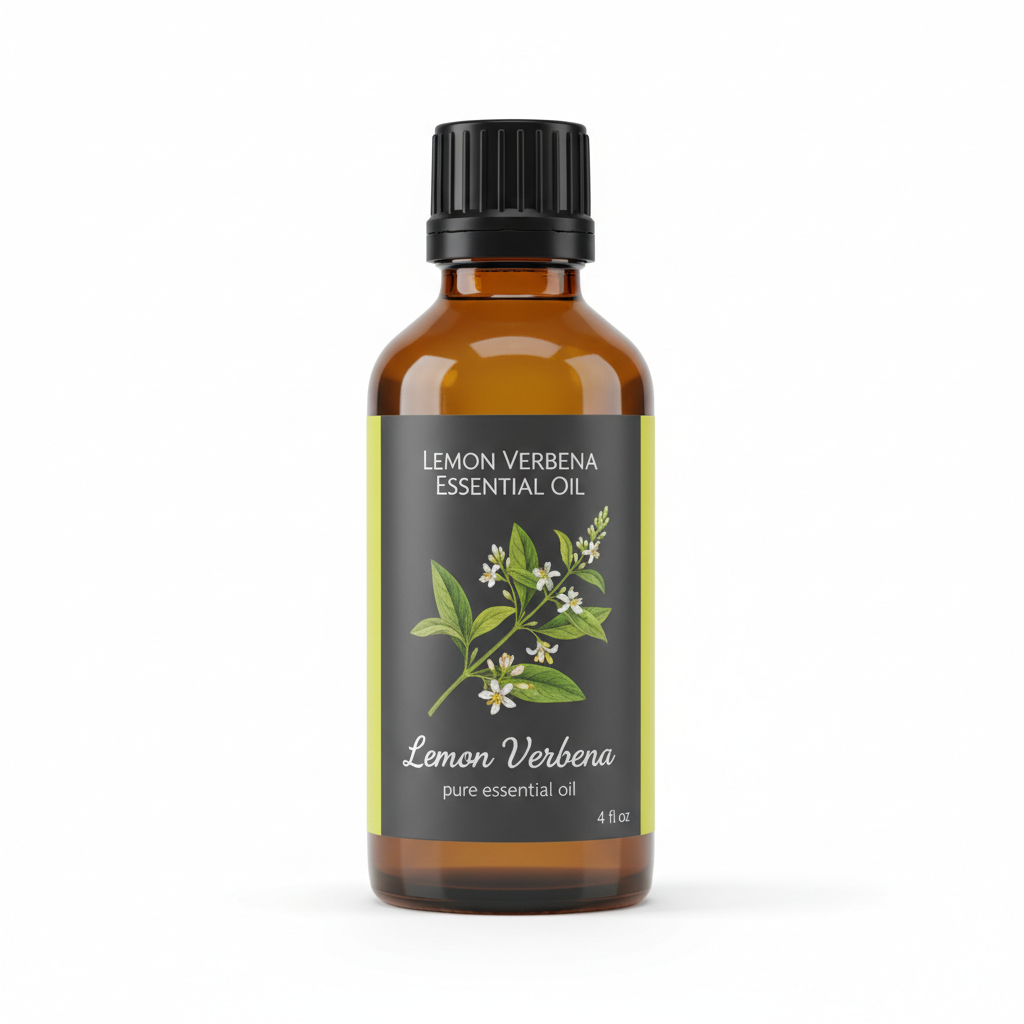
Lemon Verbena Essential Oil
Our own Lemon Verbena Essential Oil, in sizes from 0.5 oz to bulk.
From $12.99
Shop Now →This guide exists to change that. Here you will find everything worth knowing about lemon verbena essential oil: where it comes from, how it is produced, what it actually smells like, how to read its chemistry, and how to use it safely and purposefully. If you are encountering this oil for the first time, welcome. If you already know it a little and want to go deeper, this is the right place.
1. Botanical Origins: The Plant Behind the Oil
Meet Aloysia citrodora
Lemon verbena essential oil is distilled from the leaves and flowering tops of Aloysia citrodora, a woody perennial shrub in the Verbenaceae family. The plant is native to the Andean foothills of Argentina, Chile, Bolivia, and Peru, where it grows in warm, dry slopes at moderate elevation. European explorers brought it back to Spain and Portugal in the late seventeenth century, and it spread quickly across the Mediterranean basin, where the climate suited it perfectly.
Today, the majority of commercially distilled lemon verbena oil originates from Morocco, Algeria, France, and Spain, with smaller quantities produced in Argentina, Chile, and parts of the Middle East. Moroccan and Algerian material is generally the most widely available at the commercial scale. French-origin oil, particularly from Provence, carries considerable prestige and is prized by the perfume industry, though it has become increasingly rare and correspondingly expensive.
For a deeper look at the plant's history, growth habits, and cultivar differences, see our dedicated piece on Aloysia citrodora: The Shrub Behind the Connoisseur's Lemon.
Botanical Classification at a Glance
| Classification Level | Name |
|---|---|
| Family | Verbenaceae |
| Genus | Aloysia |
| Species | citrodora |
| Common Names | Lemon verbena, lemon beebrush, herb Louisa, cedron |
| Former Synonym | Lippia citriodora (you may see this name on older documents) |
| Plant Part Used | Leaves and flowering tops |
| Extraction Method | Steam distillation |
| Typical Yield | 0.1% to 0.4% (varies by origin and season) |
Why the Latin Name Matters When You Shop
The Latin binomial is your most reliable quality signal when purchasing any essential oil. A supplier listing only "lemon verbena oil" on a label without citing Aloysia citrodora leaves room for substitution or adulteration. Always look for the botanical name. You may also see the old synonym Lippia citriodora; this refers to exactly the same plant and the oil is identical, but modern botanical taxonomy uses Aloysia citrodora as the accepted name.
2. Scent Profile: What Lemon Verbena Oil Actually Smells Like
The First Impression
Open a bottle of authentic lemon verbena essential oil and the scent hits you with an almost electric brightness. It is emphatically lemony, yet nothing about it feels flat or one-dimensional the way a synthetic lemon flavor does. There is lift and sparkle in the top notes, a kind of effervescence that makes you want to breathe deeply rather than pull back.
Most first-time users describe it as cleaner and more refined than lemongrass, warmer than cold-pressed lemon peel, and distinctly more complex than citronella. Those comparisons are useful starting points, but lemon verbena really does occupy its own register. The closest natural parallel in the perfumer's palette might be a bright, slightly herbaceous lemon peel crossed with the softest suggestion of rose, though that description still falls short.
Mid Notes and Dry-Down
As the top notes settle, a subtle floral quality emerges. It is not flowery in any obvious sense; rather, it gives the oil a roundness that keeps it from reading as purely sharp or acidic. Beneath that, faint green and herbaceous notes ground the whole composition. The dry-down retains a gentle, citrus-tinted warmth that lingers longer than you might expect from an oil with such an airy opening.
In perfumery terms, lemon verbena oil functions primarily as a top-to-heart note. It gives immediate brightness and freshness, bridges toward more tenacious middle notes, and shares space gracefully with florals (jasmine, rose, neroli), woods (cedarwood, sandalwood), and other citruses (bergamot, petitgrain).
How It Compares to Common Lookalikes
| Oil | Scent Character | Key Difference from Lemon Verbena |
|---|---|---|
| Lemongrass | Sharp, grassy, very high citral | Louder, less refined, more linear |
| Lemon balm (Melissa) | Soft, herbaceous, slightly rosy citrus | Quieter and less bright; also frequently adulterated |
| Lemon peel (cold-pressed) | Fresh, clean citrus, slightly waxy | Simpler, less floral, shorter longevity |
| Citronella | Strong, camphorous, grassy citrus | Heavier and less elegant; often used as an adulterant |
| Bergamot | Citrus with prominent floral, slightly spicy | More rounded and less purely lemony |
For a much more detailed exploration of the scent, including how lemon verbena oil performs across different fragrance families and blending contexts, visit our guide on What Does Lemon Verbena Smell Like? A Sparkling Scent Profile.
3. How Lemon Verbena Essential Oil Is Made
Steam Distillation: The Only Practical Method
Authentic lemon verbena oil is produced by steam distillation of the fresh or partially dried leaves and flowering tops. In this process, steam passes through the plant material, volatilizing the aromatic compounds. The steam and vaporized oil compounds travel together through a condensation coil, where they cool and return to liquid form. Because oil and water do not mix, the essential oil floats to the top of the collection vessel and is separated out.
The simplicity of the description, however, belies the difficulty of the actual production. Lemon verbena leaves are delicate. The aromatic compounds are relatively volatile, meaning timing and temperature management during distillation matter enormously. Distill too hot or too long and the finer top notes are driven off or altered. Distill too gently and the yield suffers further. Getting this balance right is a craft, not merely a procedure.
The Yield Problem
Yield is where lemon verbena oil distinguishes itself from almost every other lemon-family oil, and not in a pleasant way for producers. A typical yield from Aloysia citrodora leaf material falls somewhere between 0.1% and 0.4% by weight. That means distilling 100 kilograms (about 220 pounds) of leaves produces, at best, 400 milliliters of oil. Often considerably less.
By comparison, lemongrass yields anywhere from 0.5% to 1.5%, and cold-pressed lemon peel oil yields are similarly higher. This fundamental scarcity is the primary reason genuine lemon verbena essential oil costs what it does. Any bottle priced comparably to lemongrass or standard lemon oil deserves skepticism. Real oil costs real money, and those economics are baked into the production reality.
Seasonal timing also plays a role. The oil content in the leaves peaks just as the plant begins to flower, generally in late summer in Northern Hemisphere growing regions. Harvesting at exactly this window, before the plant's energy shifts fully into seed production, gives the most aromatic material. This is another reason production is relatively difficult to scale cheaply without sacrificing quality.
To understand the full production story, including distillery practices, harvest logistics, and why some origins command higher prices than others, see our article on How Lemon Verbena Oil Is Made and Why the Yield Is So Small.
Absolutes and CO2 Extracts: Related but Different
Beyond steam-distilled essential oil, lemon verbena is also available in two other extraction forms worth knowing about.
An absolute is produced using solvent extraction followed by alcohol washing. Absolutes are denser, more complex, and often more true-to-plant in aroma than distilled oils because extraction by solvent captures a wider range of aromatic molecules, including some heavier ones that do not survive steam distillation. Lemon verbena absolute is used in high-end perfumery. It is not suitable for the same applications as the essential oil and should not be used interchangeably in skincare formulations without reformulation guidance.
A CO2 extract (supercritical carbon dioxide extraction) sits somewhere between a distilled oil and an absolute in terms of aromatic complexity. CO2 extracts can be very high quality, and some perfumers prefer them for certain applications. As with absolutes, they are distinct products from steam-distilled essential oil and behave differently in formulations.
For most home users and aromatics enthusiasts, steam-distilled lemon verbena essential oil is the starting point and the focus of this guide.
4. The Chemistry: Key Aromatic Compounds
Why Chemistry Matters to a Buyer
You do not need a chemistry degree to appreciate lemon verbena oil. But understanding which compounds are present, and roughly in what proportions, gives you a powerful tool for evaluating quality and understanding how the oil behaves. A gas chromatography/mass spectrometry (GC/MS) report from a reputable supplier translates the oil's chemistry into readable data. Learning a few key markers lets you use that data.
The Main Compounds
Citral (a mixture of geranial and neral): This is the dominant aromatic compound in authentic lemon verbena oil, typically accounting for 30% to 45% of the total composition. Citral is the main driver of the oil's intensely lemony scent character. Geranial (also called citral A) tends to smell more sharply lemony; neral (citral B) is softer and slightly floral. Together they create the oil's characteristic brightness. Lemongrass oil is also high in citral, which explains some of the surface similarity between the two, though lemon verbena's additional compounds give it considerably more complexity.
Limonene: A common monoterpene found across virtually all citrus-family oils, limonene typically appears at 5% to 15% in lemon verbena oil. It reinforces the clean, fresh citrus quality and contributes to the sparkling top-note effect. Limonene is also known to be volatile, which is one reason citrus-rich oils like lemon verbena do not last as long on the skin as heavier resinous oils.
Linalool: Present in smaller amounts (often 2% to 8%), linalool softens the overall composition with a gently floral, slightly woody quality. It is part of why lemon verbena oil reads as more refined than straightforward citral-dominant oils.
1,8-cineole: Sometimes called eucalyptol, this compound contributes a fresh, slightly cooling quality. It appears in modest quantities in lemon verbena oil but is part of the faint herbaceous character you may notice in the mid notes.
Beta-caryophyllene and other sesquiterpenes: These heavier compounds appear in the base of the oil's scent profile and contribute to its dry-down longevity. They are present in relatively small percentages but play an outsized role in the oil's depth and tenacity.
Furanocoumarins (including bergapten): This is the chemistry you most need to understand for safety purposes. Lemon verbena oil, like bergamot and certain other citrus oils, contains furanocoumarins, compounds that can cause phototoxic reactions when applied to skin that is then exposed to UV light. This is not a minor or theoretical concern. See the safety section of this guide for full detail.
A Simplified Chemical Profile
| Compound | Typical Range | Contribution to Oil Character |
|---|---|---|
| Citral (geranial + neral) | 30% to 45% | Core lemon brightness, primary scent driver |
| Limonene | 5% to 15% | Fresh, sparkling top note |
| Linalool | 2% to 8% | Floral softness, elegance |
| 1,8-cineole | 1% to 5% | Faint herbaceous freshness |
| Beta-caryophyllene | <3% | Dry-down depth, longevity |
| Furanocoumarins | Trace to notable levels | Phototoxicity risk (safety concern) |
Note: Exact percentages vary by origin, harvest time, distillation method, and the age of the oil. Always request a batch-specific GC/MS report from your supplier rather than relying on generic composition tables.
5. Quality and Sourcing: How to Buy Wisely
The Adulteration Problem
Lemon verbena oil occupies an awkward market position. It is highly desirable, expensive to produce, and easy to approximate with far cheaper materials. This creates a persistent adulteration problem. Common adulterants include citral isolates (pure synthetic or natural-isolate citral added to bulk out cheaper base materials), lemongrass oil, lemon balm oil of uncertain quality, and various blended concoctions marketed under the lemon verbena name.
The difficult reality is that some of these adulterants smell reasonably convincing to a nose that has never encountered authentic lemon verbena oil. The compounds that make lemon verbena distinctive, its nuanced mid-note complexity and refined dry-down, are exactly the components that are costly and hard to replicate precisely. A straight citral-boosted substitute has the brightness but lacks the character.
This is why sourcing from suppliers who publish batch-specific GC/MS reports is so important. It is also why prices matter as a rough signal: if the price per milliliter is comparable to lemongrass or basic lemon oil, consider the offering with considerable caution.
What to Look for on a Label and in a Listing
- Botanical name: Aloysia citrodora or the older synonym Lippia citriodora should appear clearly.
- Country of origin: Morocco, Algeria, France, Spain, or Argentina are the credible producing regions. A vague "imported" or no origin listed is a red flag.
- Plant part: Should specify leaves or flowering tops.
- Extraction method: Steam distillation for essential oil; solvent extraction or CO2 for absolutes and extracts.
- GC/MS report availability: Reputable suppliers make these available, either posted online or on request. A supplier unwilling to provide one should raise questions.
- Batch or lot number: This confirms that testing is done per-batch, not just for a generic oil profile.
- Price: Expect to pay significantly more per milliliter than you would for lemon, lemongrass, or similar common citrus oils. Authentic lemon verbena oil is never a bargain purchase.
Organic and Conventional: Does Certification Matter?
Certified organic lemon verbena oil is available, primarily from French and some Moroccan producers. Organic certification means the plant material was grown without synthetic pesticides or fertilizers. For those who prioritize clean ingredient sourcing in their cosmetic formulations or personal care routines, organic certification is worth seeking. However, it is important to understand that organic certification does not guarantee superior aroma quality or compositional authenticity. A well-sourced, non-certified oil from a conscientious small distillery may outperform a certified organic product from a larger operation. Where possible, seek both: certified organic and GC/MS verified.
Storage and Shelf Life
Lemon verbena oil is relatively vulnerable to oxidation compared to heavier, more resinous oils. The high limonene content in particular degrades with exposure to heat, light, and air. A properly stored, sealed bottle kept in a cool, dark environment should maintain good quality for one to two years. Once opened, use within twelve months and keep the bottle tightly capped and away from sunlight.
Signs of degradation include a noticeably flattened or harsh scent (fresh citrus notes gone, something thin or slightly rancid remaining), and color changes toward darker amber. Degraded oil should not be used on skin.
For a full guide to keeping your oil in peak condition, see How to Store Lemon Verbena Oil: Protecting a Costly Citrus.
6. Uses in Fragrance, Cosmetics, and the Home
Fine Fragrance and Perfumery
In professional perfumery, lemon verbena oil occupies an honored position. It appears in the top-note compositions of many classic fougères, aquatic colognes, and citrus-chypre constructions. Its ability to read as simultaneously clean and complex, brightly citrus yet softly botanical, makes it a useful bridge between assertive citrus openings and more tenacious floral or woody hearts.
Perfumers also value lemon verbena oil for its naturalistic quality. Unlike synthetic lemon aromachemicals, which can read as aggressively clean or industrial, lemon verbena oil carries the organic complexity of a real plant. This makes it valuable in natural perfumery specifically, where achieving interesting top notes without synthetic materials is a genuine challenge.
For the home perfumer or blending enthusiast, lemon verbena oil works particularly well alongside bergamot, neroli, petitgrain, cedarwood, vetiver, jasmine, and ylang ylang. It lightens heavier compositions with botanical lift rather than sharp synthetic citrus punch.
Skincare and Cosmetic Formulations
At properly diluted concentrations, lemon verbena oil finds its place in a range of cosmetic applications. It is used as a fragrance component in toners, facial mists, light serums, body lotions, and hair rinses. Its scent character is often described as uplifting and refreshing, which makes it a popular choice for morning-routine products.
Some formulators are drawn to the oil's citral content, noting that citral is also found in lemon and other skincare-adjacent oils and has been the subject of research interest in cosmetic contexts. It is worth being clear here: the research on lemon verbena oil in cosmetic applications is still relatively limited, and responsible formulators frame this oil primarily as a fragrant botanical ingredient rather than making specific efficacy claims.
Critically, because lemon verbena oil contains furanocoumarins, it should not be formulated into products intended for use on skin exposed to sunlight without careful consideration of furanocoumarin levels and appropriate usage rates. See the safety section below, and consult our dedicated article on Lemon Verbena Oil Skin Basics: Dilution, Patch Tests, and Sun before incorporating this oil into any topical product.
Diffusion and Aromatic Home Use
Diffusing lemon verbena oil is one of the most accessible and rewarding ways to experience it. A cool-mist ultrasonic diffuser is the preferred method, as it disperses the oil without applying heat that could alter the finer volatile notes. Even at modest diffusion rates (3 to 5 drops in a standard home diffuser), the oil is impressively present.
In the home, people use diffused lemon verbena oil to create a bright, welcoming atmosphere in living areas, to freshen home office spaces, and to add a clean botanical note to kitchens. In bedroom spaces, some people find that the lighter, brighter character of lemon verbena suits a morning or afternoon diffusion rather than a late-evening wind-down, when heavier lavender or cedarwood profiles are more often preferred. That said, personal preference varies considerably.
Candles, Reed Diffusers, and Crafts
Lemon verbena oil blends beautifully into soy wax and coconut wax candles. Its throw is moderate rather than overwhelming, which suits refined home fragrance well. Because the oil's finest top notes are volatile, some formulators add a small proportion of lemon verbena absolute alongside the essential oil to improve longevity in wax applications.
For reed diffuser formulations, lemon verbena oil works well in standard dipropylene glycol carrier bases. In room sprays, it disperses cleanly and leaves a bright botanical impression without the sharp edge of synthetic lemon fragrance oils.
For 15 specific, well-developed ideas across all of these categories, see our guide to Lemon Verbena Oil Uses: 15 Refined Ideas for Home and Craft.
Culinary Fragrance Consideration
A brief but important note: the dried herb lemon verbena is widely used in cooking, teas, and culinary preparations. The essential oil is an entirely different product and is not the same as food-grade flavoring extracts. Do not use steam-distilled lemon verbena essential oil as a food ingredient. Essential oils are highly concentrated and are not intended for culinary use unless a product is specifically formulated, tested, and labeled for that purpose by the manufacturer.
7. Safety, Dilution, and What to Know Before You Apply
Phototoxicity: The Most Important Safety Point
Lemon verbena essential oil contains furanocoumarins, specifically compounds that cause phototoxic reactions in skin exposed to UV radiation within roughly 12 to 18 hours of application. A phototoxic reaction can range from a mild darkening of the skin to a significant burn-like response, and the discoloration may persist for months. This is not a rare or edge-case risk. It is a well-documented chemical property of the oil.
The practical rule is straightforward: do not apply any product containing lemon verbena oil to skin that will be exposed to sunlight or UV light (including tanning beds) within 12 to 18 hours of application. Body areas that are typically covered by clothing are generally lower risk. For facial applications, the restriction is more critical because facial skin is almost always sun-exposed.
Some formulators address this by using a steam-distilled lemon verbena oil that has been tested to confirm low furanocoumarin content, or by keeping usage percentages extremely low. If you are formulating products for sale, you should obtain the furanocoumarin content data for your specific batch from your supplier and apply IFRA (International Fragrance Association) guidelines accordingly.
Dilution Guidelines for Skin Use
Never apply lemon verbena essential oil undiluted directly to skin. Essential oils are highly concentrated and can cause skin sensitization even when the individual application does not produce an obvious reaction. Repeated low-level sensitization exposure can lead to a lasting sensitization response.
General dilution guidance for home use:
- For most adult body applications: 1% to 2% dilution in a carrier oil or lotion base (1 to 2 drops per teaspoon of carrier).
- For facial skin: 0.5% to 1% dilution is often recommended as a starting point, and many formulators keep it lower still.
- For rinse-off products such as shampoo or body wash: slightly higher percentages may be used, following supplier and IFRA guidance.
- For children, pregnant individuals, and nursing individuals: Consult a qualified healthcare provider before use. Many essential oils require additional precautions or avoidance in these groups.
Always consult a qualified healthcare provider if you have any questions about essential oil use in relation to your personal health situation. This guide does not constitute medical advice.
Patch Testing: Non-Negotiable
Before using any lemon verbena oil product on a larger area of skin, perform a patch test. Apply the diluted product to a small, discreet area of skin (the inside of the elbow or wrist is commonly used). Leave it for 24 hours without washing. If you notice redness, itching, swelling, or any other reaction, do not proceed with broader application.
Patch testing is not an inconvenient optional step. It is a basic practice that protects you from discovering a sensitivity reaction on a large and visible area of skin.
Sensitization and Citral
Citral, the dominant compound in lemon verbena oil, is a known potential skin sensitizer, particularly at higher concentrations and with repeated exposure. The European Union's cosmetic regulation framework requires that citral be listed as a named allergen on cosmetic product labels when it is present above a certain threshold. This is relevant context for anyone formulating products for sale in EU markets, and it is useful background knowledge for all users.
Keeping your dilutions within recommended ranges and avoiding frequent, daily application to the same area of skin are the practical ways to minimize sensitization risk in personal use.
Additional Precautions
- Keep all essential oils away from eyes and mucous membranes.
- Store out of reach of children and pets.
- If accidental contact with eyes occurs, flush with a carrier oil first (not water, which will not disperse the oil) and seek medical attention if irritation persists.
- Do not ingest lemon verbena essential oil.
Full detail on safe use, dilution ratios, and sun avoidance protocols is available in our guide to Lemon Verbena Oil Skin Basics: Dilution, Patch Tests, and Sun.
8. Frequently Asked Questions
Is lemon verbena essential oil the same as lemon verbena extract or tea?
No. Lemon verbena dried herb, herbal tea, and food-grade extracts are different products made from the same plant but using different processes and intended for different applications. Steam-distilled lemon verbena essential oil is a highly concentrated aromatic product used in fragrance, cosmetics, and home aromatics. It is not a food ingredient and should not be confused with culinary products.
Why is lemon verbena essential oil so expensive?
Primarily because of yield. Producing even a small amount of oil requires a large volume of plant material harvested at a precise moment in the plant's growth cycle. The yield from distillation is among the lowest of any commonly used aromatic oil. When you also factor in the relatively small scale of most lemon verbena cultivation compared to commodity citrus oils, the price reflects genuine production economics rather than arbitrary markup. Full context is available in our article on How Lemon Verbena Oil Is Made and Why the Yield Is So Small.
How do I know if the lemon verbena oil I bought is real?
The most reliable method is requesting a GC/MS report from your supplier. Authentic lemon verbena oil (Aloysia citrodora) will show a characteristic compound profile with citral as the dominant component alongside limonene, linalool, and the other compounds outlined in the chemistry section of this guide. If your supplier cannot or will not provide a GC/MS report, that is meaningful information in itself. Scent alone is not a sufficient test because some adulterants are close enough to deceive an inexperienced nose.
Can I use lemon verbena oil every day?
Frequent, repeated application to the same skin area carries a risk of sensitization due to the citral content. Most experienced formulators and aromatics users recommend rotating oils rather than using any single citral-rich oil daily on the same area. For diffusion, reasonable breaks between sessions are advisable rather than continuous all-day diffusion. Consult a qualified healthcare provider if you have specific questions relevant to your situation.
Does lemon verbena oil smell the same as the fresh herb?
It is remarkably faithful, but not identical. The fresh herb has a slightly greener, more living-plant quality. The distilled oil concentrates the brightest citrus-aromatic facets and loses some of the very fresh green top that you get from crushing a leaf between your fingers. Many people find the oil compellingly beautiful for exactly this reason: it is the herb's finest aromatic moment, concentrated and clarified.
What carrier oils work well with lemon verbena essential oil?
For skin applications, lighter carriers tend to complement lemon verbena oil better than heavy ones, because they allow the oil's brightness to come through without competing aromas. Jojoba (technically a liquid wax), fractionated coconut oil, and squalane are all popular choices. Argan oil works well for facial applications where a slightly richer feel is desired. Heavily scented carriers like unrefined hemp or unrefined avocado can compete with the oil's delicate aromatic character.
Is aloysia citrodora oil the same as what is marketed as lemon verbena oil?
It should be. Aloysia citrodora oil and lemon verbena oil are names for the same thing: the steam-distilled essential oil from the leaves and flowering tops of Aloysia citrodora. When you see both names used interchangeably, that is correct. When a product is labeled "lemon verbena oil" without citing Aloysia citrodora, the label is incomplete and the product's authenticity deserves verification.
Where can I learn more about the plant itself?
We have covered the botany, history, cultivation, and regional variations in detail in our guide to Aloysia citrodora: The Shrub Behind the Connoisseur's Lemon. It is worth reading alongside this guide for a complete picture.
Summary: What Makes Lemon Verbena Essential Oil Worth Knowing
Lemon verbena essential oil is a genuinely distinctive aromatic ingredient. It comes from a specific plant, produced by a labor-intensive process, at yields that explain its price. Its scent occupies a unique register in the citrus family: bright, nuanced, and more refined than its cheaper lookalikes. Its chemistry is readable and meaningful. Its quality varies enormously by source, which makes supplier diligence non-negotiable.
Used with proper dilution, careful patch testing, and awareness of its phototoxic properties, lemon verbena oil is a rewarding addition to perfumery projects, cosmetic formulations, and aromatic home routines. The investment in understanding it is paid back many times over in the quality of what you can create with it.