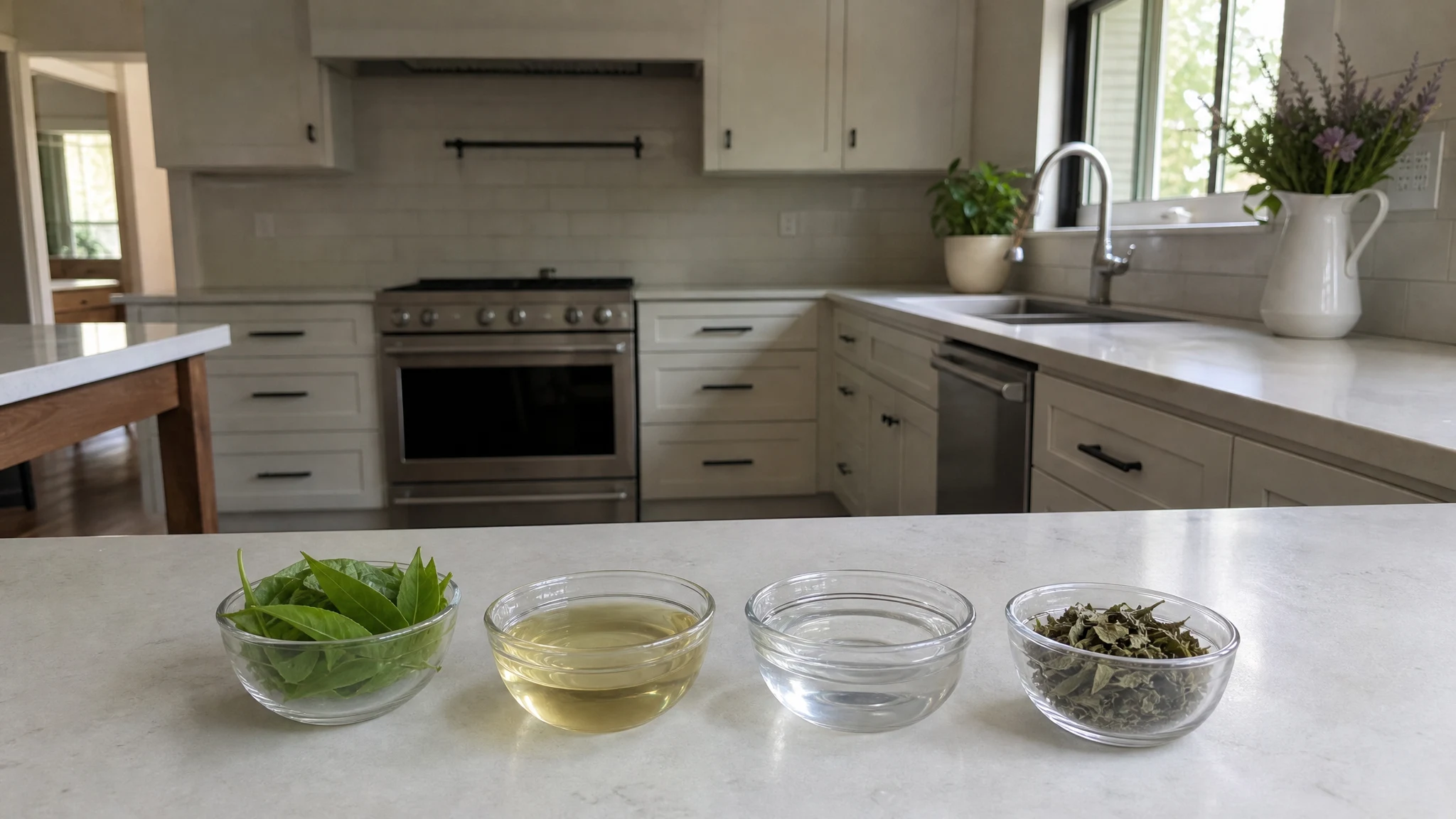
Lemon Verbena Oil, Absolute, Hydrosol, Infused Oil Compared
Four different products are sold under the name lemon verbena: a steam-distilled essential oil, a solvent-made absolute, the water that comes off the still (a hydrosol), and leaves steeped in a carrier oil. They share a plant and very little else. We sell only the first, so this guide sorts the four by the job you have and by what can go wrong with each, and it says where our oil is the wrong answer.
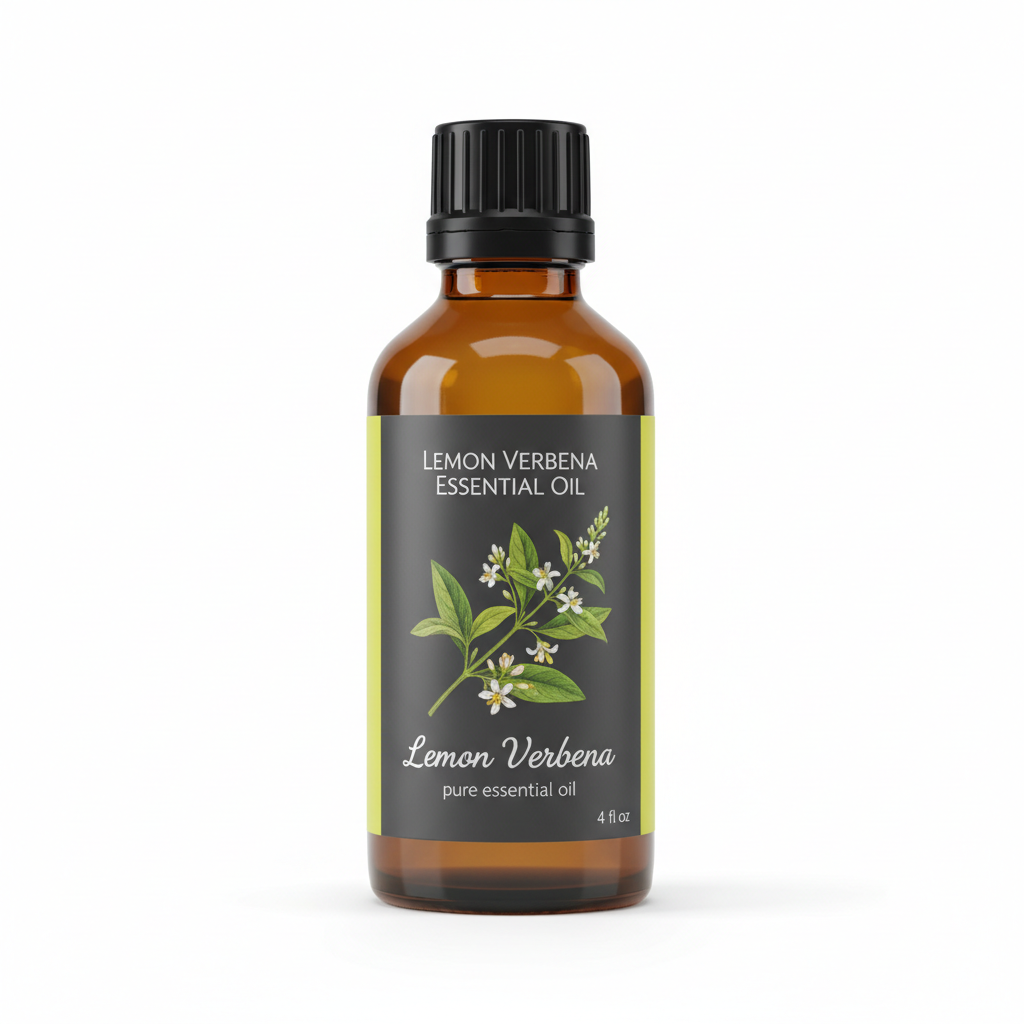
Lemon Verbena Essential Oil
Our own Lemon Verbena Essential Oil, in sizes from 0.5 oz to bulk.
From $12.99
Shop Now →Pick the job first, the form second
Most confusion here is naming. "Verbena" on a label can mean the leaf oil of Aloysia citrodora (also filed as Lippia citriodora), a different plant, or a fragrance blend, which the myths post untangles. Once the plant is settled, the decision runs in this order: what the product will be (scent in a wax, soap or perfume; a water-based mist; something for the kitchen), what the maker has to control (dilution, water, preservative, shelf life), and only then which of the four forms.
| Form | What it is | What a source says about strength or risk | Our position |
|---|---|---|---|
| Essential oil | Volatile fraction carried over by steam from the leaf | Sold neat. Our skin guidance is 0.5% to 2% in a carrier, roughly 3 to 12 drops per ounce | We sell this, from 0.5 oz |
| Absolute | Leaf extracted with a solvent, then the alcohol-soluble part kept | IFRA restricts it by product category; no composition data found for lemon verbena | We do not sell one |
| Hydrosol | Distillation water with a trace of oil in it | Under 1 g/L of oil in the orange blossom and rose hydrosols studied; microbes grew in all 22 kept in non-sterile containers | We do not sell one; buy preserved |
| Infused oil | Leaves steeped in a carrier oil | Extension services warn about botulism when fresh herbs sit in oil | We do not sell one; see the recipe post |
The essential oil: strong, and regulated like it
An essential oil is what steam carries out of the leaf, then condenses and separates from the water. How much comes out varies widely. A Portuguese laboratory got 1.05% and 1.29% of the dried leaf weight with two distillation methods (Sprea et al., 2023), while a Moroccan study reported 0.1% to 0.2% from shade-dried leaves (Oukerrou et al., 2017). The yield spread is one reason the oil costs what it does, and the how-it-is-made post covers that side.
Because ours is sold neat, the dilution arithmetic is yours. With the relative density on our published COA (0.869, so 1 ml is about 0.869 g) and about 20 drops per ml, one ounce of carrier (29.57 ml) is about 591 drops of volume, and 0.5% to 2% of it is roughly 3 to 12 drops. Droppers vary, so weigh if the batch matters. Our own copy adds that the oil can be mildly photosensitising and that you should patch test first.
There is also a rule that has nothing to do with scent. IFRA, the fragrance industry's standard-setting body, published Standard 083 in Amendment 49 (2020). It states that verbena oils from Lippia citriodora Kunth "should not be used as a fragrance ingredient, based on its sensitizing and phototoxic potential." The same standard allows absolutes, with ceilings that depend on the product category. That is the single biggest practical difference between the two forms. We publish no IFRA certificate for our oil, and the standard governs fragrance mixtures supplied to industry, so a person selling finished products should take this to a fragrance safety assessor or regulatory consultant before relying on any verbena oil in a formula. The planned IFRA explainer goes through it in more detail. The standard may have been revised since Amendment 49.
The absolute: a different material with its own ceiling
An absolute is made in two stages. A solvent such as n-hexane pulls the aromatic material out of the plant and, once evaporated, leaves a waxy extract called a concrete. Ethyl alcohol then dissolves the part that is soluble in it, which is the absolute. That is how a 2023 paper on clary sage describes the two terms (Zanotti et al., 2023); the paper is about sage, not verbena, so the definition is borrowed, not measured on our plant.
IFRA names the material: Standard 083 lists "Lippia citriodora absolute" and the synonyms Aloysia triphylla absolute and Verbena triphylla absolute. Its limits in the finished product run from 0.037% in category 2 and 0.072% in category 8, through 0.12% in category 1, 0.69% in category 4 and 1.4% in categories 7A and 7B, up to 4.8% in categories 10A and 10B, with no restriction in category 12. The standard says the limit is set because of the phototoxic effects of verbena oil and absolute. It also says only absolutes from Lippia citriodora Kunth may be used.
What I could not find is any peer-reviewed analysis of a lemon verbena absolute: no constituent table, no comparison with the distilled oil, no residual-solvent figure. So there is no honest way to say what one smells like or contains compared with the oil. If you are offered one, ask in writing which solvent was used, how the solvent was removed, and for a GC-MS report. That is advice on what to request, not something we can supply, because we sell no absolute.
The hydrosol: mostly water, and water grows things
A hydrosol is the condensate water left after the oil separates. A French study measured 22 hydrosols of orange blossom and two kinds of rose and found median essential oil concentrations of 677, 205 and 116 mg/L (Labadie et al., 2015). In every hydrosol kept in a non-sterile container, microbes multiplied, at room temperature and at 5 °C, and the worst reached about 7 log10 CFU/mL against a French pharmacopeia recommendation of 2 log10, a difference of 100,000 times. The authors concluded that chemical preservatives or aseptic packaging are needed.
Arithmetic on those numbers shows how weak a hydrosol is next to the oil. 677 mg/L is 0.068% oil by weight per volume. Our lowest skin dilution is 0.5%, which is 5 g per litre, so it is about 7 times stronger than the strongest of those hydrosols; against the rose figure of 116 mg/L it is about 43 times stronger. Those are orange blossom and rose waters, not verbena, and I found no oil concentration for a lemon verbena hydrosol, so treat the ratio as an order of magnitude only.
The hydrosol post gives the full picture on spoilage, preservatives and where not to use one. For choosing between forms, the point is that a hydrosol is a water-based product, and a water-based product is a different job from a dilution of oil in a carrier.
The infused oil: leaves in a carrier, with a food-safety catch
An infused oil is a carrier oil that has sat on leaves. It contains whatever dissolves in the carrier, and it is not an essential oil; nobody has given it a strength figure I could cite. The catch is water. The University of Maine's bulletin says fresh herbs likely carry Clostridium botulinum spores, that the bacterium thrives where oxygen is absent, and that oil is such a place; its home method uses dried herbs with oil heated to 180 °F and a storage limit of three months (University of Maine Cooperative Extension, Bulletin 4385). Penn State Extension says fresh-herb oils without acidification should be refrigerated and used within 2 to 4 days, and its citric acid method applies only to garlic, basil, oregano and rosemary (Penn State Extension).
Lemon verbena is not on Penn State's list. Reasoning from that, a fresh-leaf oil kept at room temperature has no validated method behind it. Both sources are about food. Maine says nothing about non-food use, so whether the same limits should apply to a body oil is a question for the person who will sell or use it. The existing infused oil recipe post covers the method.
A plain verdict by job
- Scent in a candle, soap or body product that you will sell: the oil is the material, diluted by your own arithmetic, with the IFRA question settled first. If your formula needs an absolute, you will have to source one elsewhere and ask the questions above.
- A face or room mist: buy a hydrosol that names its preservative and comes in sealed packaging. Do not drop our oil into water; oil does not dissolve in water, and floating droplets are undiluted oil on skin.
- Something for the kitchen: that is the leaf, not any of these four. Our oil is not for internal use. See tea versus essential oil.
- A body oil from garden leaves: expect to follow food-safety guidance for herbs in oil, not aromatherapy lore.
We have made none of these four forms and tested none, so everything above is reported from the sources below, and our own part is limited to the oil and its published COA.
Lemon Verbena Essential Oil
Lemon Verbena Essential Oil from our own shop, in sizes from 0.5 oz to bulk.
From $12.99
Shop Now →Sources & Further Reading
- IFRA, 2020. Standard 083, Verbena oil and absolute (Lippia citriodora Kunth.), Amendment 49. ifrafragrance.org/IFRA_STD_083
- Sprea RM et al., 2023. Volatile Compounds and Biological Activity of the Essential Oil of Aloysia citrodora Paláu. Molecules 28(11):4528. PMC10254266
- Oukerrou MA et al., 2017. Chemical Composition and Cytotoxic and Antibacterial Activities of the Essential Oil of Aloysia citriodora Palau Grown in Morocco. Adv Pharmacol Sci. PMC5485486
- Zanotti A et al., 2023. Supercritical Fluid Extraction of Essential Oil and Sclareol from a Clary Sage Concrete. Molecules 28(9):3903. PMC10179952
- Labadie C et al., 2015. Hydrosols of orange blossom, and rose flower support the growth of a heterogeneous spoilage microbiota. Food Res Int 76:576-586. doi.org/10.1016/j.foodres.2015.07.014
- University of Maine Cooperative Extension. Safe Homemade Flavored and Infused Oils, Bulletin 4385. extension.umaine.edu/publications/4385e
- Penn State Extension. How to Safely Make Infused Oils. extension.psu.edu