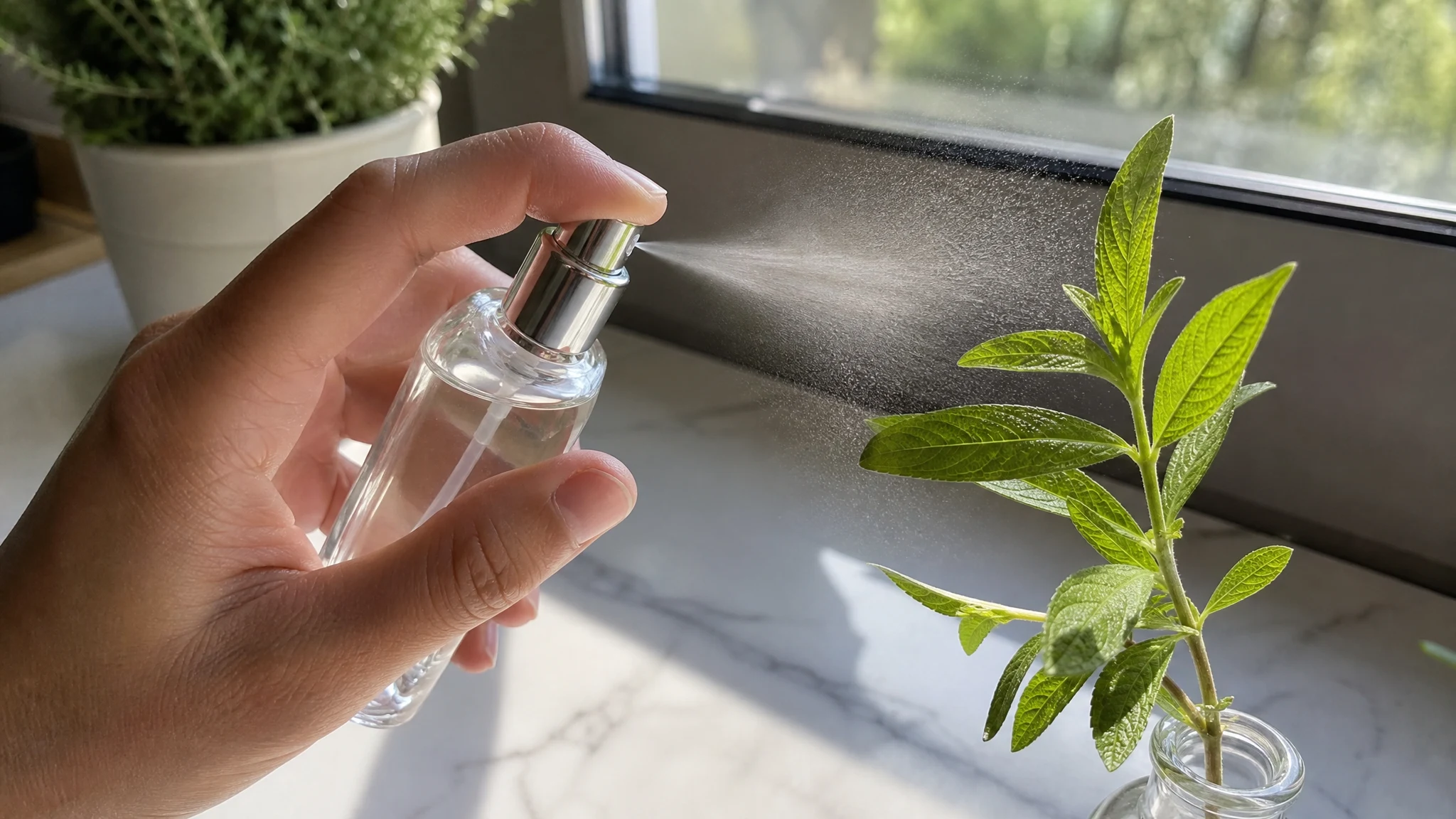
Lemon Verbena Hydrosol: What the Studies Show and How to Buy
A lemon verbena hydrosol is the water that comes off the still with a trace of the plant's volatile oil dissolved or dispersed in it. It is mostly water, and water that carries plant residue is a good place for microbes to grow. We do not sell a hydrosol and we have never made one, so this guide reports what the studies measured, then tells you what to ask a seller and where not to use one.
Lemon Verbena Essential Oil
Our own Lemon Verbena Essential Oil, in sizes from 0.5 oz to bulk.
From $12.99
Shop Now →What is in the bottle, in numbers
The best measurements I could find are on other flowers. A French team analysed 22 hydrosols of orange blossom and two kinds of rose. The median essential oil content was 677 mg/L for orange blossom, 205 mg/L for Rosa damascena and 116 mg/L for Rosa centifolia, and the authors describe hydrosols as holding less than 1 g/L (Labadie et al., 2015).
Turn that into the units this site uses elsewhere. 677 mg/L is 0.068% oil. Our own guidance for skin starts at 0.5% oil in a carrier, which is 5 g per litre, so a 0.5% dilution of our oil is about 7 times stronger than the strongest of those hydrosols, and about 43 times stronger than the Rosa centifolia figure. I found no oil concentration for a lemon verbena hydrosol, so read the ratio as a scale, not a prediction. The practical meaning is that a hydrosol is a faint, water-based scent. It does not replace a dilution of oil, and a dilution of oil does not replace it.
Two analyses of "the same" hydrosol that do not agree
Composition is not fixed either. A Portuguese group distilled fresh Aloysia citrodora leaf at a 1:1 plant-to-water weight ratio (50 g with 50 mL of distilled water), collected distillate for 10 minutes after boiling began, and stored it at 4 °C. By GC-MS the hydrosol was geranial 38.91% and neral 39.01%, with 1,8-cineole 4.58%, nerol 2.85% and alpha-terpineol 1.64%, at pH 4.1 (Almeida et al., 2024).
An Iranian survey bought aromatic waters at the herbal market in Fars province and extracted each with petroleum ether before GC-MS. Its single lemon verbena sample listed limonene 20.55%, geranial 13.72%, caryophyllene 9.5%, neral 6.42% and alpha-terpineol 6.3% (Hamedi et al., 2017). Neral and geranial together are about 78% in the first and about 20% in the second. The papers differ in plant, method and what "hydrosol" meant (a laboratory distillate against a marketplace product of unstated origin), so they cannot say which is typical. What they do show is that a bottle labelled "lemon verbena hydrosol" does not guarantee a profile.
The microbial problem, as measured
In the French study, microbes multiplied in every hydrosol stored in a non-sterile container, at room temperature and at 5 °C. In contaminated samples counts reached about 7 log10 CFU/mL; the French pharmacopeia recommends a maximum of 2 log10, so the worst samples were about 100,000 times over that. Neither yeast nor mould was found. The organisms were environmental Gram-negative bacteria, mostly Pseudomonas and the Burkholderia cepacia complex. The authors suggest that non-volatile material carried over by foaming during distillation feeds them, and conclude that the oil content and cold storage do not give microbial stability: preservatives or aseptic packaging are needed.
A follow-up from the same group tested preservatives on the same two hydrosols. Isothiazolinone, chlorphenesin, parabens, benzyl alcohol and sodium benzoate at pH 5.0 held growth of the natural Pseudomonas and Burkholderia strains for more than 90 days at 30 °C, but only at concentrations close to the authorised limits. Major pathogens inoculated into the hydrosols grew poorly, and the authors judged pathogen risk low, while saying the oils do not prevent spoilage by the microbes already present. Without aseptic conditions, they write, only preservatives can stabilise a hydrosol for storage of several months (Labadie et al., 2016). Both papers include authors from the company Albert Vieille SAS (Vallauris, France) and concern orange blossom and rose, not verbena. Applying them to lemon verbena is inference, though a reasonable one for any water-based distillate.
FDA says contaminated cosmetics can carry harmful bacteria and fungi, that contamination can come from water and from an ineffective preservation system, and that adding water to a product dilutes the preservative (FDA, Microbiological Safety and Cosmetics, current as of 2024-10-15).
What one laboratory study did with a lemon verbena hydrosol
The Portuguese group also added their hydrosol to cultures at 10% and 20% by volume and counted colonies after 24 hours at 37 °C. Against E. coli the counts were 90.8% lower at 10% and 90.4% lower at 20%; against Candida albicans 84.8% and 83.7% lower; against Staphylococcus aureus 33.7% lower at 20% and not significant at 10%. The article does not say whether the hydrosol was sterilised or preserved before testing, and it notes that hydrosols lack quality standards in global pharmacopoeias. That is a culture dish, not skin, and a 20% hydrosol broth is not a use anyone is advised to copy. We make no claim about what a hydrosol does on skin or anywhere else.
Buying one: what to ask in writing
- Preservative: its name, its concentration, and the pH it was designed for. The study above shows effectiveness depends on both.
- Packaging: sealed, with a pump or spray that does not let air and fingers in. The sources above name aseptic packaging as the alternative to preservatives.
- Batch and date: a bottling date and lot, so that a bad smell or cloudiness can be traced.
- Microbial result: a count or challenge-test result for the batch. The Portuguese authors note that hydrosols lack quality standards in the world's pharmacopoeias, so ask what limit the seller applies.
- Identity: the plant's botanical name, Aloysia citrodora, so that you are not buying lemon balm, lemongrass or a fragrance water under a similar name.
These are my reasoned questions from the evidence, not a certification scheme, and a cosmetic-chemistry professional is the right person to ask about a product you intend to sell.
Where not to use one, and why not to improvise
Keep it away from the eyes. FDA says misusing eye cosmetics can let dangerous bacteria or fungi grow in them (FDA, Eye Cosmetic Safety), and its microbiological safety page lists eye-area products among those that have caused serious infections. By the same logic an unpreserved water is a poor thing to put near broken skin. For an infant, ask the child's physician; no source I read addresses lemon verbena hydrosol on babies. Because the Portuguese hydrosol was roughly three quarters citral-type components, a patch test on a small area is a sensible first step for anyone with sensitive skin.
Do not copy the label by dropping our oil into water. Oil does not dissolve in water, so droplets float and sit undiluted on whatever they touch. A water-based spray needs a solubiliser and a preservative from a cosmetic supply shop, and the preservative's own hazard and limits need checking; we sell none of those materials, only the oil. The same goes for making your own distillate: the Portuguese method used laboratory glassware, and the French work found growth in every hydrosol kept in a non-sterile container. The distillation post covers the oil side of the still, the comparison of forms sets the hydrosol next to the oil, absolute and infused oil, and the growing guide covers the plant. Skin use of our oil is covered in the safety guide.
Lemon Verbena Essential Oil
Lemon Verbena Essential Oil from our own shop, in sizes from 0.5 oz to bulk.
From $12.99
Shop Now →Sources & Further Reading
- Labadie C et al., 2015. Hydrosols of orange blossom, and rose flower support the growth of a heterogeneous spoilage microbiota. Food Res Int 76:576-586. doi.org/10.1016/j.foodres.2015.07.014
- Labadie C, Cerutti C, Carlin F, 2016. Fate and control of pathogenic and spoilage micro-organisms in orange blossom and rose flower hydrosols. J Appl Microbiol 121(6):1568-1579. doi.org/10.1111/jam.13293
- Almeida HHS et al., 2024. Hydrosols of Cupressus leylandii, Eucalyptus globulus, Aloysia citrodora and Melissa officinalis as eco-friendly antimicrobial agents. Nat Prod Bioprospect 14:1. PMC10758378
- Hamedi A et al., 2017. A Survey on Chemical Constituents and Indications of Aromatic Waters (Hydrosols) Used in Persian Culture. J Evid Based Complementary Altern Med 22(4):744-752. PMC5871290
- FDA, 2024. Microbiological Safety and Cosmetics. fda.gov/microbiological-safety-and-cosmetics
- FDA. Eye Cosmetic Safety. fda.gov/eye-cosmetic-safety