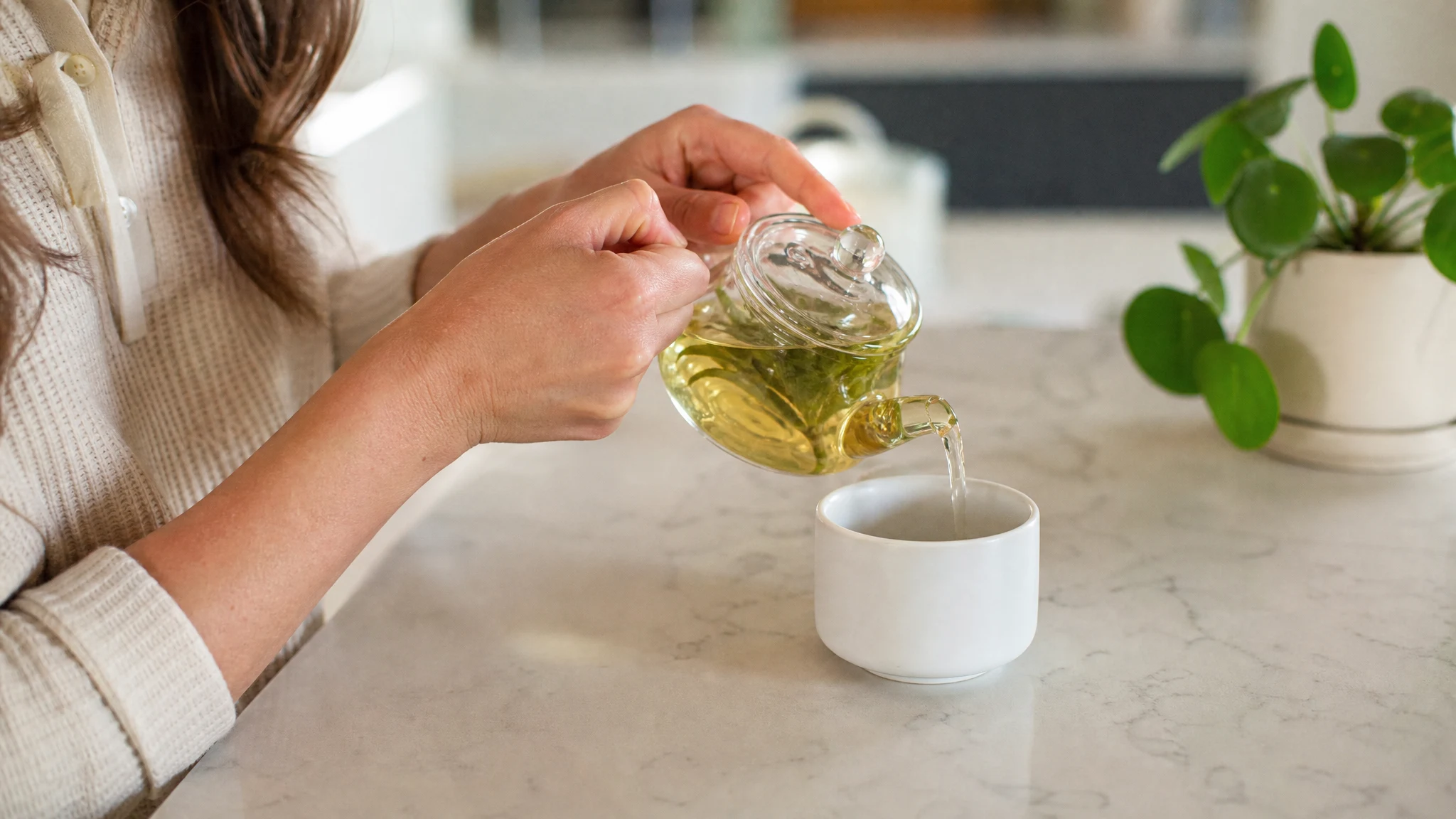
Lemon Verbena Tea vs Essential Oil: The Arithmetic of a Drop
Lemon verbena tea and lemon verbena essential oil are not two strengths of one thing. The tea is a hot-water infusion of dried leaf, and the oil is the volatile fraction of the leaf collected by distillation. Whatever you read about the tea does not describe the oil, and the oil must not go into a cup. The numbers below show how far apart the two are.
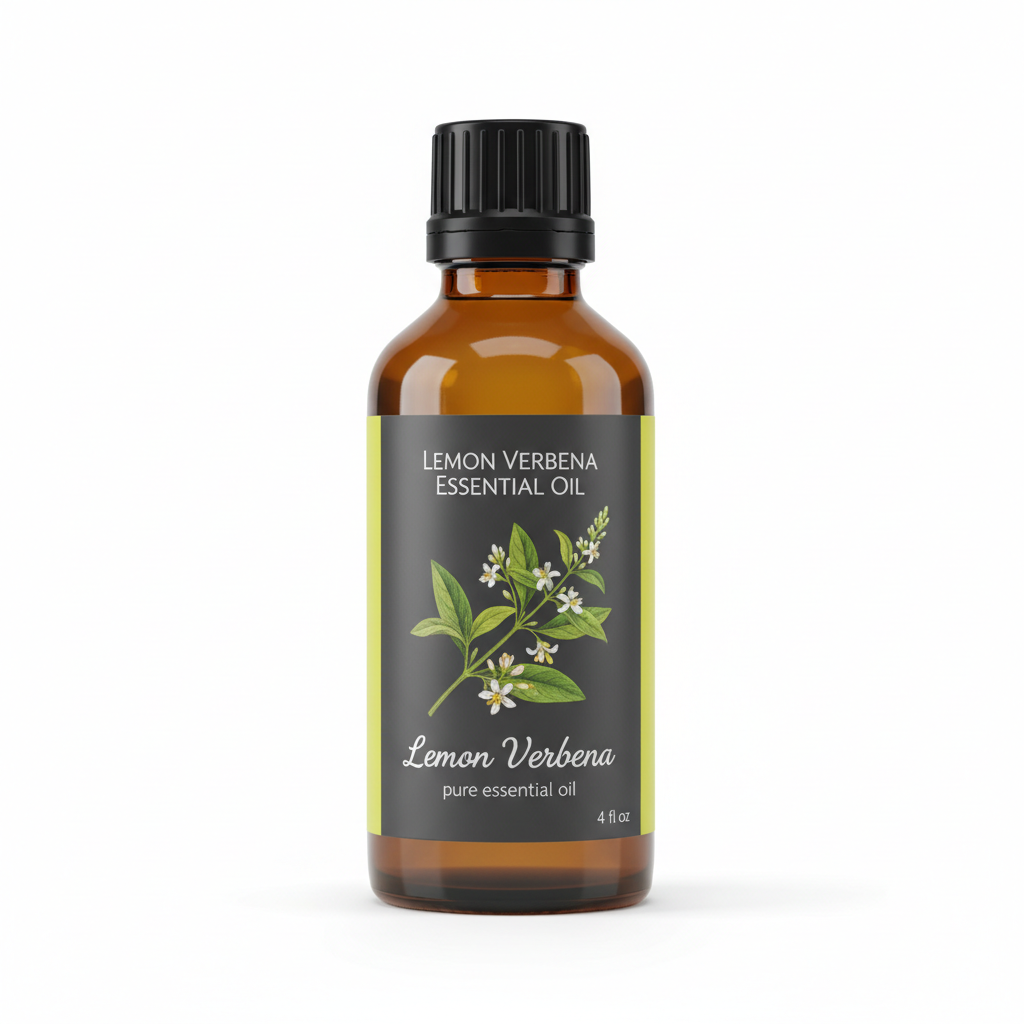
Lemon Verbena Essential Oil
Our own Lemon Verbena Essential Oil, in sizes from 0.5 oz to bulk.
From $12.99
Shop Now →Start with the weights
Our oil has a relative density of 0.869 on the certificate of analysis for the batch we publish, so 1 ml weighs about 0.869 g. At roughly 20 drops per ml (droppers vary, so weigh if it matters), one drop is about 0.043 g, or 43 mg.
Now the leaf. A 2017 paper on Moroccan lemon verbena reported that hydrodistilling shade-dried leaves gave an oil yield of 0.1% to 0.2% (Oukerrou et al., 2017; the abstract does not say whether that is weight or volume). Yields differ by origin and method, so treat this as one published figure and an illustration, not a measurement of any tea you can buy.
| Leaf in the cup | Oil it holds at 0.1% to 0.2% | As a share of one drop (43 mg) |
|---|---|---|
| 1 g | 1 to 2 mg | about 2% to 5% |
| 2 g | 2 to 4 mg | about 5% to 9% |
| 5 g | 5 to 10 mg | about 12% to 23% |
Run it backwards: one drop of oil is the volatile content of roughly 22 g to 43 g of leaf (43 mg divided by 0.2% and by 0.1%). That is many cups of tea. And the table assumes every milligram of oil reaches the water, which an infusion will not do. This is the first reason the two cannot be swapped: a drop is a concentrate of many cups' worth of the volatile part, while the leaf holds that part in small amounts alongside much else.
What is in each
A 2018 review of the plant (Bahramsoltani et al., 2018) reports that neral and geranial are the main components of the essential oil, while verbascoside is the most significant component of the extract. An Italian analysis of aqueous preparations of verbena and lemon verbena found phenylpropanoids at 16 to 120 mg per gram of dried extract, with verbascoside up to 97% of them (Bilia et al., 2008). Note the unit, per gram of dried extract, not per gram of leaf and not per cup; we found no published per-cup verbascoside figure and will not invent one.
| Leaf tea | Essential oil | |
|---|---|---|
| Made by | Steeping comminuted leaf in hot water | Distilling the leaf and collecting the volatile oil |
| Main components reported | Verbascoside and other phenylpropanoids (water-soluble) | Neral and geranial (citral isomers), limonene and others, varying by origin |
| Regulatory text we read | EU traditional-use monograph for the leaf as herbal tea | None that we read; the monograph does not cover the oil |
| Route | By mouth | Scent and craft; our oil is not for internal use |
The trials were on neither
This catches readers out. The capsule trials behind many "lemon verbena benefit" headlines gave a purified extract standardized to at least 24% verbascoside, 400 mg per capsule, which is at least 96 mg of verbascoside (400 mg x 0.24): see Pérez-Piñero et al. (2024), 71 adults analysed, and Martínez-Rodríguez et al. (2022), 40 adults. That is not tea, and it is not oil. The tea has no published per-cup figure that we found to compare, and the oil is not an extract. The full table of studies is in what the research says about lemon verbena.
What the European regulator says about the tea
The European Medicines Agency's monograph for lemon verbena leaf (EMA/HMPC/376770/2019, adopted 13 January 2021) is a traditional-use monograph for a herbal tea, meaning it rests exclusively on long-standing use. Its sleep wording is 1 to 2 g of comminuted leaf in 200 ml of boiling water as an infusion half an hour before bedtime, for adolescents, adults and the elderly. Another entry covers mild digestive complaints at 2 to 3 g in 200 ml, 1 to 3 times daily. Contraindications: hypersensitivity to the plant and others in the Verbenaceae family. It says use in children has not been established, use in pregnancy and lactation is not recommended for lack of data, a doctor should be consulted if symptoms persist beyond 2 weeks, and the tea may impair the ability to drive. Reproductive toxicity, genotoxicity and carcinogenicity tests have not been performed. So even the tea is not "proven safe for everyone", and we make no claim about either preparation.
Reading a tea label
Three checks cost nothing. First, look for the botanical name: Aloysia citrodora (or the synonym Lippia citriodora) on the pack, not just "verbena", because the common name is shared with other plants and the monograph's contraindication names the whole Verbenaceae family. Second, note that the monograph says the herbal substance is as defined in the European Pharmacopoeia monograph (reference 1834), which is a quality standard for the dried leaf; a grocery tea is not necessarily sold to it, and we have not checked any brand. Third, notice that the monograph's stress wording is a decoction of 5 g in 100 ml, 3 times daily. That is 15 g of leaf a day, which at the 0.1% to 0.2% oil figure holds 15 to 30 mg of oil in total, under one drop (about 0.35 to 0.7 of a 43 mg drop) spread over three servings. It is a reminder of how little of the volatile part leaf carries, and that a tea-sized dose is a different thing from a drop.
Why the oil does not go in the cup
Our oil is sold neat and is not for internal use. Poison Control says some essential oils are poisonous if absorbed through the skin or swallowed, that children may be more susceptible than adults, and to call a poison center on 1-800-222-1222 in the United States if one is swallowed (Poison Control, Essential oils). That page is general and does not single out lemon verbena. Given the arithmetic above, a drop in a cup would put in many times the volatile content of a cup of tea, and nothing in the tea monograph covers it. The longer reasoning is in can you ingest lemon verbena essential oil.
What to do with each
If you want the tea, buy dried lemon verbena leaf from a grocery or herb shop and ask a physician or pharmacist if you take medicines, are pregnant or breastfeeding, or are giving it to a child. We do not sell leaf or tea. For kitchen use of the leaf, see how chefs use lemon verbena leaf. If you want the oil, it is for scent, soap, candles and body care. Our copy says dilute to 0.5% to 2% in a carrier for skin (roughly 3 to 12 drops per ounce), patch test first, and keep it away from eyes, children and pets. If you are mixing up the plant itself with vervain, see lemon verbena myths.
Tea is a leaf and the oil is a concentrate, so pick by what you want to do, and keep each one to its own job.
Lemon Verbena Essential Oil
Lemon Verbena Essential Oil from our own shop, in sizes from 0.5 oz to bulk.
From $12.99
Shop Now →Sources & Further Reading
- Oukerrou MA et al., 2017. Chemical composition and cytotoxic and antibacterial activities of Aloysia citriodora oil grown in Morocco, Adv Pharmacol Sci (abstract only). PMC5485486
- Bahramsoltani R et al., 2018. Aloysia citrodora Paláu (lemon verbena): a review of phytochemistry and pharmacology, J Ethnopharmacol 222:34-51 (abstract only). Europe PMC, PMID 29698776
- Bilia AR et al., 2008. HPLC-DAD-ESI-MS analysis of aqueous preparations of verbena and lemon verbena, J Pharm Biomed Anal 46:463-470 (abstract only). flore.unifi.it/2158/368354
- Pérez-Piñero S et al., 2024. Dietary supplementation with an extract of Aloysia citrodora (lemon verbena), Nutrients 16(10):1523. PMC11123999
- Martínez-Rodríguez A et al., 2022. Lippia citriodora extract, stress and sleep quality, Nutrients 14(1):218. PMC8747367
- European Medicines Agency, 2021. EU herbal monograph on Aloysia citrodora folium, EMA/HMPC/376770/2019. ema.europa.eu
- Poison Control (National Capital Poison Center). Essential oils: poisonous when misused. poison.org/articles/essential-oils