Lemon-Scented Essential Oils Compared by Chemistry and Use
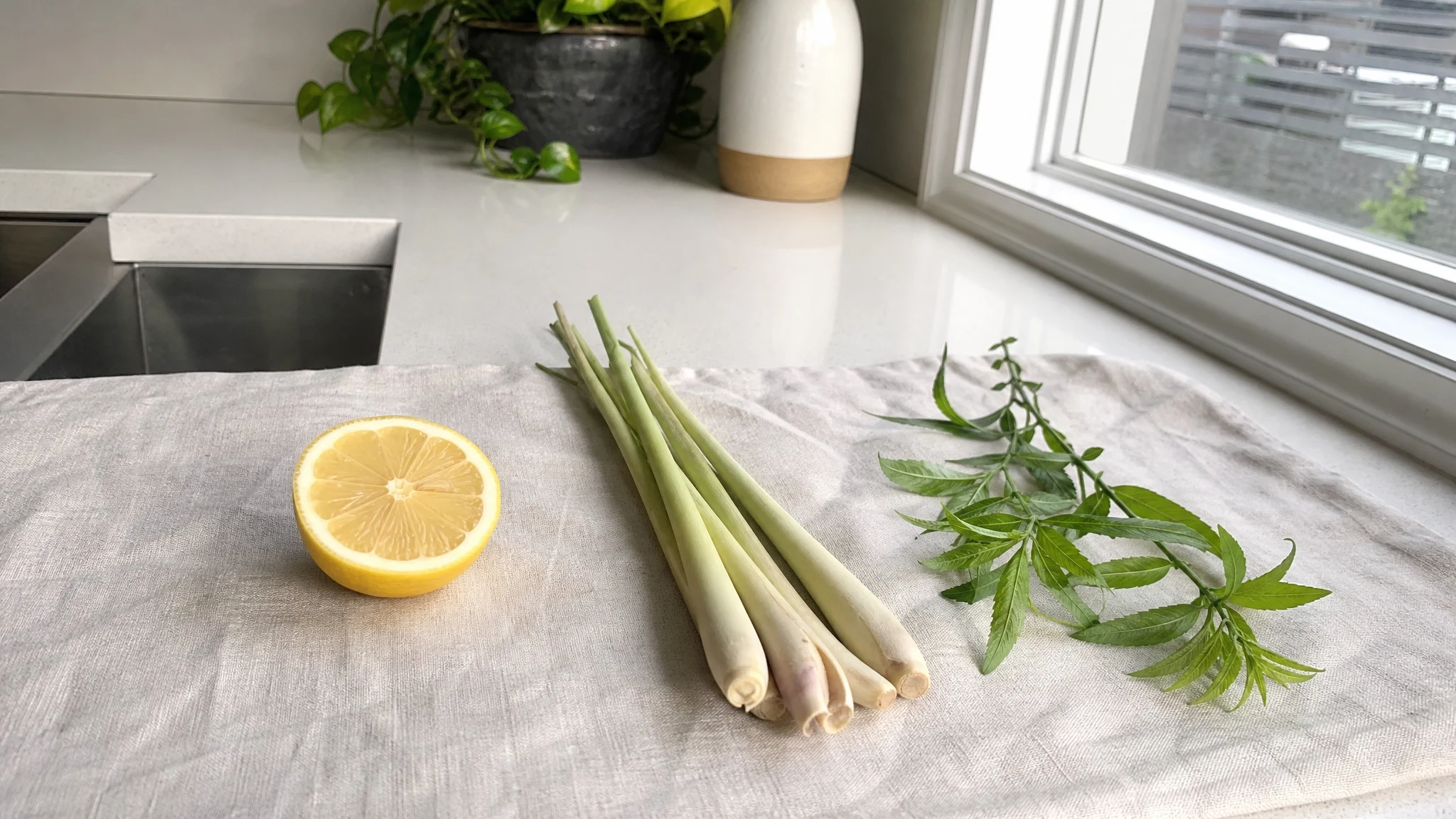
Six essential oils get sold as "lemon", and they do not share one chemistry. Lemongrass, litsea cubeba and lemon myrtle are mostly citral on the published data (about 80 to 96%). Cold-pressed lemon is mostly limonene. Melissa and lemon verbena sit between and vary a great deal by sample. The useful question is which chemistry your product needs, and the rest of this page sorts the six that way.
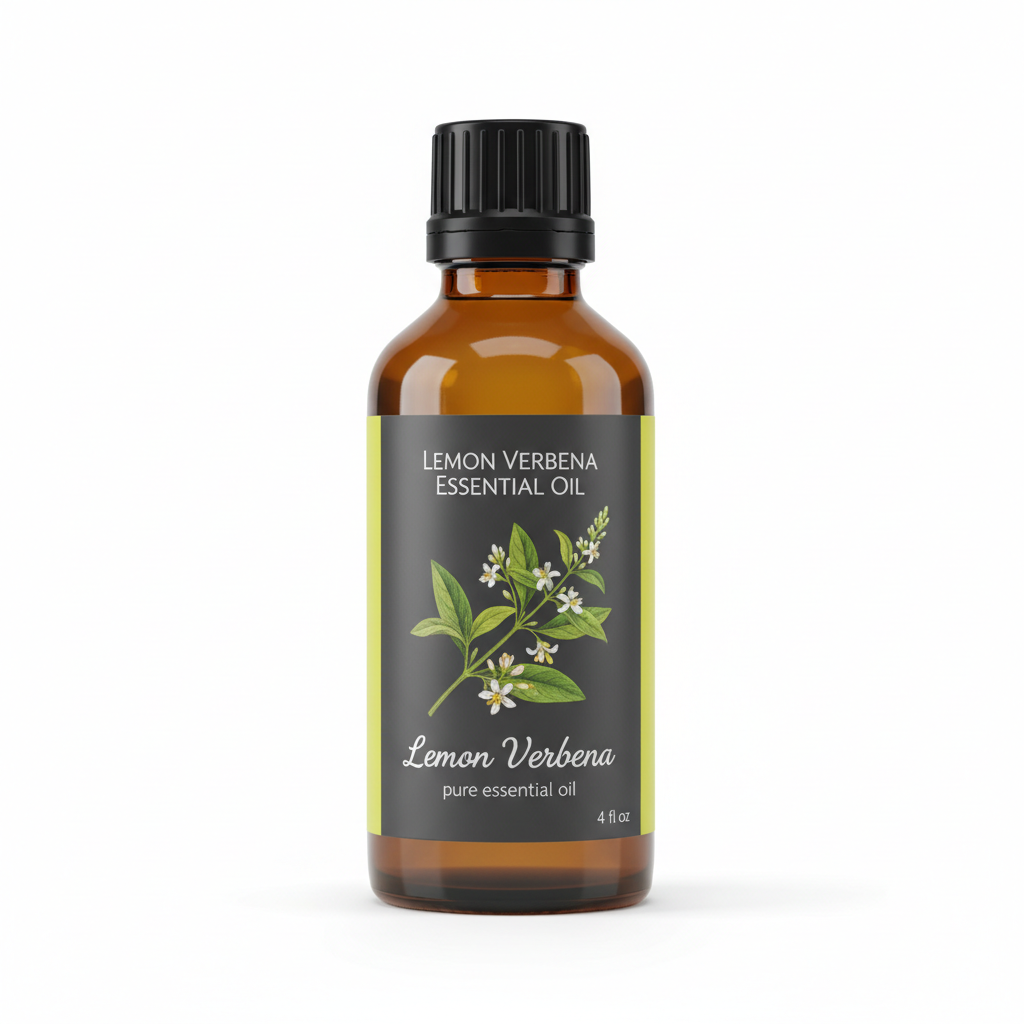
Lemon Verbena Essential Oil
Our own Lemon Verbena Essential Oil, in sizes from 0.5 oz to bulk.
From $12.99
Shop Now →One table, with the sources named
Every figure below is a percentage of the oil from the study or specification named in the last column, and those studies differ in plant part, origin and distillation method. Treat each cell as a reported range, not a promise about any bottle you buy. The yield column is the oil recovered from the plant material, on the basis each source used (fresh leaf, dried leaf or fruit), so compare it as a rough pointer to why some oils cost more, not as a ranking.
| Oil (plant) | Lemon-note constituents reported | Oil yield reported | Source |
|---|---|---|---|
| Lemon verbena (Aloysia citrodora) | Geranial about 12 to 40%, neral about 6 to 30%, limonene about 5 to 21%. Some samples are not citral-led: Moroccan oils with no geranial detected, a Peruvian oil led by caryophyllene. | 1.05 to 1.29% of dried leaf in one Portuguese lab study | Sprea et al., 2023; Mejia-Ramos et al., 2025 |
| Lemon myrtle (Backhousia citriodora) | Citral about 80 to 96% (geranial 44.0 to 60.7%, neral 32.0 to 40.9%) | 1.1 to 3.2% of fresh leaf | Southwell, 2021 (review) |
| Lemongrass (Cymbopogon citratus) | Geranial 53.1% and neral 36.1% in one Nepali collection, about 89% citral | Usually 1 to 2% on a dry basis (review) | Dangol et al., 2023; Food Chem X review, 2024 |
| Litsea cubeba (fruit) | Neral plus geranial 78.7 to 87.4% across eight Chinese regions; limonene 0.7 to 5.3% | 3.04 to 4.56% of fruit | Si et al., 2012 |
| Melissa (Melissa officinalis) | Geranial 6.22 to 51.21%, neral 4.28 to 35.02%, citronellal 0.4 to 20.3% across compiled studies; one Romanian sample had about 3% citral and was mostly beta-cubebene and caryophyllene | 0.01 to 0.72% across 28 accessions in one study | Petrisor et al., 2022; Radulescu et al., 2021 |
| Lemon, cold-pressed (Citrus limon) | Limonene 60 to 73%, citral only about 0.2 to 3.8% | Expressed from peel, not comparable | EFSA, 2021 |
Two readings come straight from the table. First, lemon verbena is the only oil here where the citral share can be under a fifth of the oil, so it is never the efficient way to buy citral. Second, melissa and verbena are the two where the sample you hold decides everything, which is why a composition report matters more for those two than for the rest. Our own oil's published certificate gives appearance, smell, a relative density of 0.869 and a refractive index of 1.472 for one batch, and no constituent figures, so it cannot be placed on the verbena range above.
What IFRA's own texts say about each
I read the IFRA Standards at Amendment 49 (2020). Later amendments may differ, and IFRA's implementation dates apply to the supply of fragrance mixtures, not to finished products on the shelf. Check the current library before you rely on any of this.
- Verbena: the IFRA Standard on verbena oil and absolute, 2020 is titled for Lippia citriodora Kunth (a synonym of Aloysia citrodora in the GBIF taxonomic backbone). It says verbena oils should not be used as a fragrance ingredient, citing sensitizing and phototoxic potential. Verbena absolutes are restricted instead, with limits from 0.037% to 4.8% by category. We sell the oil, not the absolute.
- Lemon, cold-pressed: IFRA, 2020 sets 2.0% in most product categories because of phototoxicity, and no restriction in a few categories (7A, 9, 10A, 11A and 12). The phototoxic agents are furocoumarins: IFRA's citrus standard recommends no more than 0.0015% (15 ppm) bergapten on skin exposed to light.
- Melissa: a restriction exists (IFRA, 2020), for example 0.60% in Category 4 and 0.15% in Category 5A.
- Lemongrass, litsea, lemon myrtle: none of these has a standard under its own name in the numbered series I read. That is not the same as unrestricted, because their main constituent has one (next section).
The citral ceiling, worked through
The IFRA Standard on citral, 2020 gives maximum acceptable citral in the finished product by category: 0.15% in Categories 5A, 5B and 5C, 0.60% in Category 4, 0.35% in Category 6, 1.2% in Category 9, and no restriction in Category 12. IFRA's category table tells you which row your product falls in. The standard says contributions from other sources are covered in an annex that I did not read, so use this as a planning ceiling and ask a regulatory consultant to confirm it. The arithmetic is the ceiling divided by the oil's citral fraction.
| Oil, citral share | Maximum oil at a 0.15% citral ceiling | At 0.60% |
|---|---|---|
| Lemon myrtle, 80 to 96% | 0.19% down to 0.16% | 0.75% down to 0.63% |
| Lemongrass, about 89% (one sample) | about 0.17% | about 0.67% |
| Litsea, 78.7 to 87.4% | 0.19% down to 0.17% | 0.76% down to 0.69% |
| Lemon verbena, about 18 to 68% | 0.83% down to 0.22% | 3.3% down to 0.88% |
| Cold-pressed lemon, about 0.2 to 3.8% | 75% down to 3.9% (its own 2.0% cap binds first) | not the limit that binds |
Two consequences. The three citral-rich oils reach the ceiling at roughly a sixth of a percent in a Category 5 product, so a jar that needs a strong lemon note has little room for anything else citral-bearing. And lemon verbena's wide range means the same dose can sit comfortably under the ceiling or well over it, depending on a number our certificate does not give. Our shop copy recommends 0.5% to 2% in a carrier for skin; at the citral-rich end of the reported range, 2% of oil carries about 1.4% citral. That is a reason to ask for a written composition report before you formulate to the upper end, and it is the sort of conflict between two documents that I would rather flag than average.
Choose by the job, in this order
- Does the product have to carry an IFRA-compliant fragrance formula? Then verbena oil is out on the text above, and the choice is among the others. We publish no IFRA certificate for our oil. The planned IFRA standards article goes through the verbena standard in full.
- Is the point citral punch at a low dose? Lemon myrtle, lemongrass or litsea. Our live comparisons cover lemongrass and litsea; the lemon myrtle comparison has the dose arithmetic.
- Is it a plain lemon-peel note? Cold-pressed lemon, with its 2.0% phototoxicity cap on skin products. The lemon comparison sets out the difference.
- Do you want an herbal-floral lemon with a wide-open composition? Melissa or verbena, and in both cases buy against a composition report. The melissa comparison is the place to start.
Where lemon verbena is the wrong tool
It is the wrong tool when the goal is only citral, when a customer or channel demands an IFRA-compliant fragrance formula, and when you cannot get a composition report for the batch. It is also the wrong tool for sun-exposed skin without careful dilution and a patch test: our own copy says verbena can be mildly photosensitising, and IFRA's verbena standard names phototoxicity. What it offers is the non-citral remainder of the oil, which in the samples read includes limonene, 1,8-cineole and spathulenol. Our copy describes the aroma as sparkling and sweet over a soft herbal-floral heart, less acidic than lemon peel oil. We have not run scent comparisons against the other five, so treat that as our description, not a test result.
For a small first bottle of lemon verbena oil, sizes start at 0.5 oz; see the shop page for the current price per size. If you are choosing between two of the six on this page, the table and the citral ceiling usually settle it faster than the smell does.
Lemon Verbena Essential Oil
Lemon Verbena Essential Oil from our own shop, in sizes from 0.5 oz to bulk.
From $12.99
Shop Now →Sources & Further Reading
- IFRA, 2020 (Amendment 49). Verbena oil and absolute (Lippia citriodora Kunth). ifrafragrance.org/standards/IFRA_STD_083
- IFRA, 2020 (Amendment 49). Citral. ifrafragrance.org/standards/IFRA_STD_021
- IFRA, 2020 (Amendment 49). Lemon oil cold pressed; Citrus oils and other furocoumarins containing essential oils; Melissa oil. ifrafragrance.org/standards/IFRA_STD_089 (see also STD 092 and STD 051 at the same address)
- Southwell I, 2021. Backhousia citriodora F. Muell. (Lemon Myrtle), an Unrivalled Source of Citral. Foods 10(7):1596. PMC8305781
- Sprea RM et al., 2023. Volatile Compounds and Biological Activity of the Essential Oil of Aloysia citrodora Palau. Molecules 28(11):4528. PMC10254266
- Mejia-Ramos C et al., 2025. Essential Oil of Aloysia triphylla Royle (Peru). Molecules 30(13):2849. PMC12251356
- Dangol S et al., 2023. Essential Oil Composition Analysis of Cymbopogon Species from Eastern Nepal. Molecules 28(2):543. PMC9863348
- Si L et al., 2012. Chemical Composition of Essential Oils of Litsea cubeba Harvested from Its Distribution Areas in China. Molecules 17(6):7057. PMC6268156
- Petrisor G et al., 2022. Melissa officinalis: Composition, Pharmacological Effects and Derived Release Systems. Int J Mol Sci 23(7):3591. PMC8998931
- Radulescu M et al., 2021. Chemical Composition of Melissa officinalis subsp. officinalis Essential Oil. Antioxidants 10(7):1081. PMC8301138
- EFSA FEEDAP Panel, 2021. Safety and efficacy of expressed lemon oil and its fractions from Citrus limon. EFSA Journal 19(5):6548. PMC8085978
- Food Chem X, 2024. Insights into chemistry, extraction and industrial application of lemon grass essential oil. PMC11215000
- GBIF Secretariat. GBIF Backbone Taxonomy: Aloysia citrodora Palau (accepted; Lippia citriodora (Lam.) Kunth listed as synonym). gbif.org/species/5667503