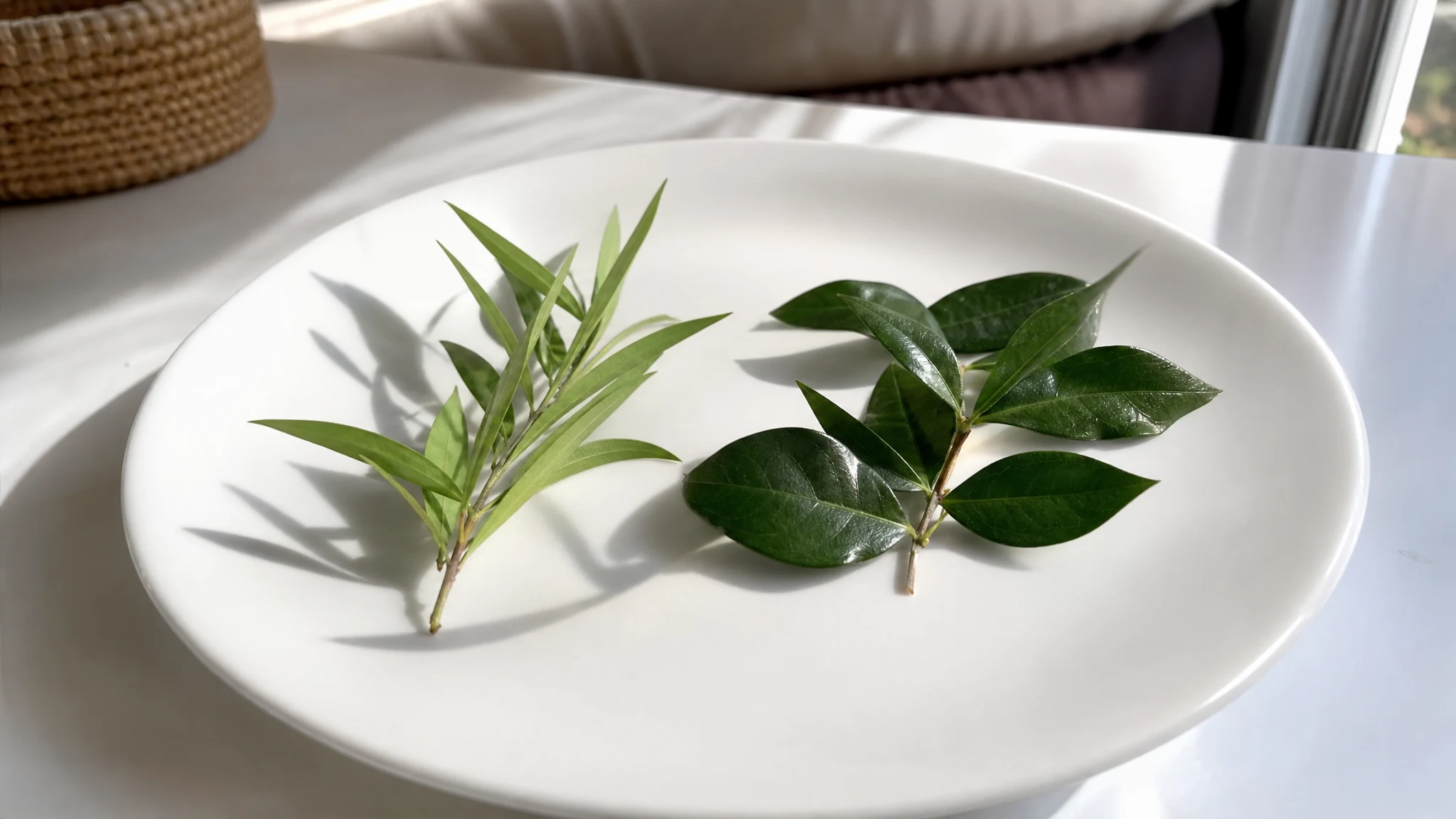
Lemon Verbena vs Lemon Myrtle Oil: Dose Maths and Fit
If the thing you want is citral, lemon myrtle is the better material and lemon verbena oil is not: the published figures put lemon myrtle's citral at about 80 to 96% of the oil, against roughly 18 to 68% for lemon verbena samples. We sell only the verbena, so this page makes the case against our own oil where the numbers do, and says what verbena keeps that myrtle's profile does not.
Lemon Verbena Essential Oil
Our own Lemon Verbena Essential Oil, in sizes from 0.5 oz to bulk.
From $12.99
Shop Now →The dose arithmetic first
Say a formulation needs 0.30 g of citral per 100 g of finished product (an illustration, not a recommendation). The oil needed is 0.30 g divided by the oil's citral fraction.
| Oil | Citral share | Oil needed per 100 g |
|---|---|---|
| Lemon myrtle | 80 to 96% | 0.31 to 0.38 g (about 0.34 g at the 88% midpoint) |
| Lemon verbena, citral-rich end of the range | about 68% | about 0.44 g (roughly 10 drops at 20 drops per ml and our batch's relative density of 0.869) |
| Lemon verbena, citral-poor end | about 18% | about 1.7 g (roughly 38 drops) |
So verbena needs between 1.3 and 4.9 times as much oil to deliver the same citral, depending on a figure our own certificate does not report. Turn that into a cost rule without any prices: verbena only wins on cost per unit of citral if its price per gram is below about 0.2 to 0.8 of lemon myrtle's (0.34 divided by 1.7, and 0.34 divided by 0.44). Since verbena is the rarer oil, it will rarely clear that bar. Buy verbena for what else it carries, not for citral.
What the sources report for each
Lemon myrtle. Southwell's 2021 review in Foods (Southwell, 2021) tabulates the citral chemotype: neral 32.0 to 40.9%, geranial 44.0 to 60.7%, total citral 80.0 to 96.0%, from 1.1 to 3.2% oil on fresh leaf. Its own text says 80 to 98% and its first table 80 to 97%, so the three do not agree to the point; I use 80 to 96% throughout. The minor components are small: geraniol 0.5 to 2.5%, E-isocitral up to 4.3%, 6-methyl-5-hepten-2-one up to 2.9%. A review is not a set of measurements of one bottle, and it reports no sample count.
The same paper describes a second, rare chemotype dominated by citronellal (62 to 89% in the reports it cites) that does not breed true. That is the trap in buying lemon myrtle: the name does not tell you which chemotype you have. An International Standard exists for the citral type (ISO 5093:2021), which sets out characteristics to help assess quality. I read only its catalogue entry, so I cannot tell you its limits.
Lemon verbena. Verbena has the opposite problem, a wide spread within one species. A Portuguese lab study (Sprea et al., 2023) found geranial 18.7 to 21.1%, neral 15.3 to 16.2%, limonene 5.0 to 5.4%, 1,8-cineole 4.2 to 4.5% and spathulenol 7.2 to 8.7% in dried leaf, by two distillation methods. Its literature summary cites earlier work with geranial up to about 38 to 39% and limonene up to about 21%, and another with limonene at 18.59% above geranial at 11.93%. It also notes Moroccan oils with no geranial detected, and at least four chemotypes in northwestern Argentina. Two sources about one plant, then, and a range wide enough that you should ask for the report for the batch.
Skin, labels and where IFRA stands
Citral is the reason a high-citral oil needs a lower dose, not a higher one. Southwell reports citral as irritating to skin and sensitizing to skin in guinea pigs, and cites a finding that neat lemon myrtle oil and citral were very toxic to human skin fibroblasts in a dish while a product with 1% oil was low in toxicity. The review's recommendation is topical use at less than 1% oil. It also states that oils high in citral should be restricted during pregnancy because of a possible teratogenic hazard; that is a reviewer's statement, so anyone pregnant should take the question to a doctor or midwife, not to a formulation page.
IFRA's numbers make the same point from the regulatory side. The IFRA Standard on citral (Amendment 49, 2020) allows 0.15% citral in Categories 5A, 5B and 5C and 0.60% in Category 4 (IFRA's category table says which row is yours). Dividing by the citral fraction gives a maximum oil dose of about 0.16 to 0.19% for lemon myrtle at 0.15%, and about 0.22 to 0.83% for verbena across its range. The standard points to an annex on contributions from other sources that I did not read, so treat these as planning ceilings and ask a regulatory consultant to confirm. I found no IFRA standard under the lemon myrtle name in the numbered series I read, so the citral standard is the one that bites.
Our own shop copy for verbena says 0.5% to 2% in a carrier for skin, roughly 3 to 12 drops per ounce, patch test first. At the citral-rich end of the reported verbena range, 2% oil is about 1.4% citral, and even at the citral-poor end it is about 0.36%, both above the 0.15% ceiling by that arithmetic. We have no citral figure for our batch, so we cannot say which end it is at. Verbena oil also has its own IFRA entry: the verbena standard says oils should not be used as a fragrance ingredient, citing sensitizing and phototoxic potential. For anything a customer will wear, read the skin basics article and start at the bottom of our range.
What verbena keeps
Reasoning from the composition figures, lemon myrtle's profile is almost entirely one aldehyde pair with the rest mostly minor terpenoids, while verbena's remainder (limonene, 1,8-cineole, spathulenol and, in some samples, caryophyllene-type compounds) is roughly a third to four fifths of the oil. That remainder is where a perfumer would look for the difference in character. Our copy describes our oil as sparkling, sweet and lemony over a soft herbal-floral heart, less acidic and more polished than lemon peel oil, and lists neroli, lavender, geranium, cedarwood and sandalwood as blends. We have not compared it with lemon myrtle side by side, so that remains a description of ours, not a test result.
Choosing
- Lemon myrtle fits when you want citral at a small dose, you can get a written chemotype and GC report (ask for the citral type, per ISO 5093), and the product can take a sub-1% oil dose. We do not sell it; a supply shop does.
- Lemon verbena fits when the herbal-floral remainder is the point, you will dilute to the low end of our range, and a composition report for the batch is in hand or you accept that our certificate gives only relative density 0.869 and refractive index 1.472 for the batch it covers.
- Neither when the product is for pregnancy, babies or pets: ask a doctor, midwife or veterinarian.
For lemongrass and litsea, the other two citral-rich options, see the lemongrass comparison; for all six lemon oils in one table, the pillar comparison; and for a job-first ranking, the substitutes ladder.
Lemon Verbena Essential Oil
Lemon Verbena Essential Oil from our own shop, in sizes from 0.5 oz to bulk.
From $12.99
Shop Now →Sources & Further Reading
- Southwell I, 2021. Backhousia citriodora F. Muell. (Lemon Myrtle), an Unrivalled Source of Citral. Foods 10(7):1596. PMC8305781
- ISO 5093:2021. Essential oil of lemon myrtle (Backhousia citriodora F. Muell.), citral type (catalogue entry). boutique.afnor.org/iso-5093
- Sprea RM et al., 2023. Volatile Compounds and Biological Activity of the Essential Oil of Aloysia citrodora Palau. Molecules 28(11):4528. PMC10254266
- IFRA, 2020 (Amendment 49). Citral. ifrafragrance.org/standards/IFRA_STD_021
- IFRA, 2020 (Amendment 49). Verbena oil and absolute (Lippia citriodora Kunth). ifrafragrance.org/standards/IFRA_STD_083