Lemon Verbena vs Lemon Oil: Chemistry and Skin-Light Rules
It is easy to assume that lemon verbena oil is a rarer cousin of lemon oil and that one can stand in for the other. On the published data they are different materials: one is pressed from fruit peel and is mostly limonene, the other is distilled from leaf and carries citral in widely varying amounts. They also face different rules about skin and light, and neither is a drop-in replacement for the other.
Lemon Verbena Essential Oil
Our own Lemon Verbena Essential Oil, in sizes from 0.5 oz to bulk.
From $12.99
Shop Now →Peel against leaf
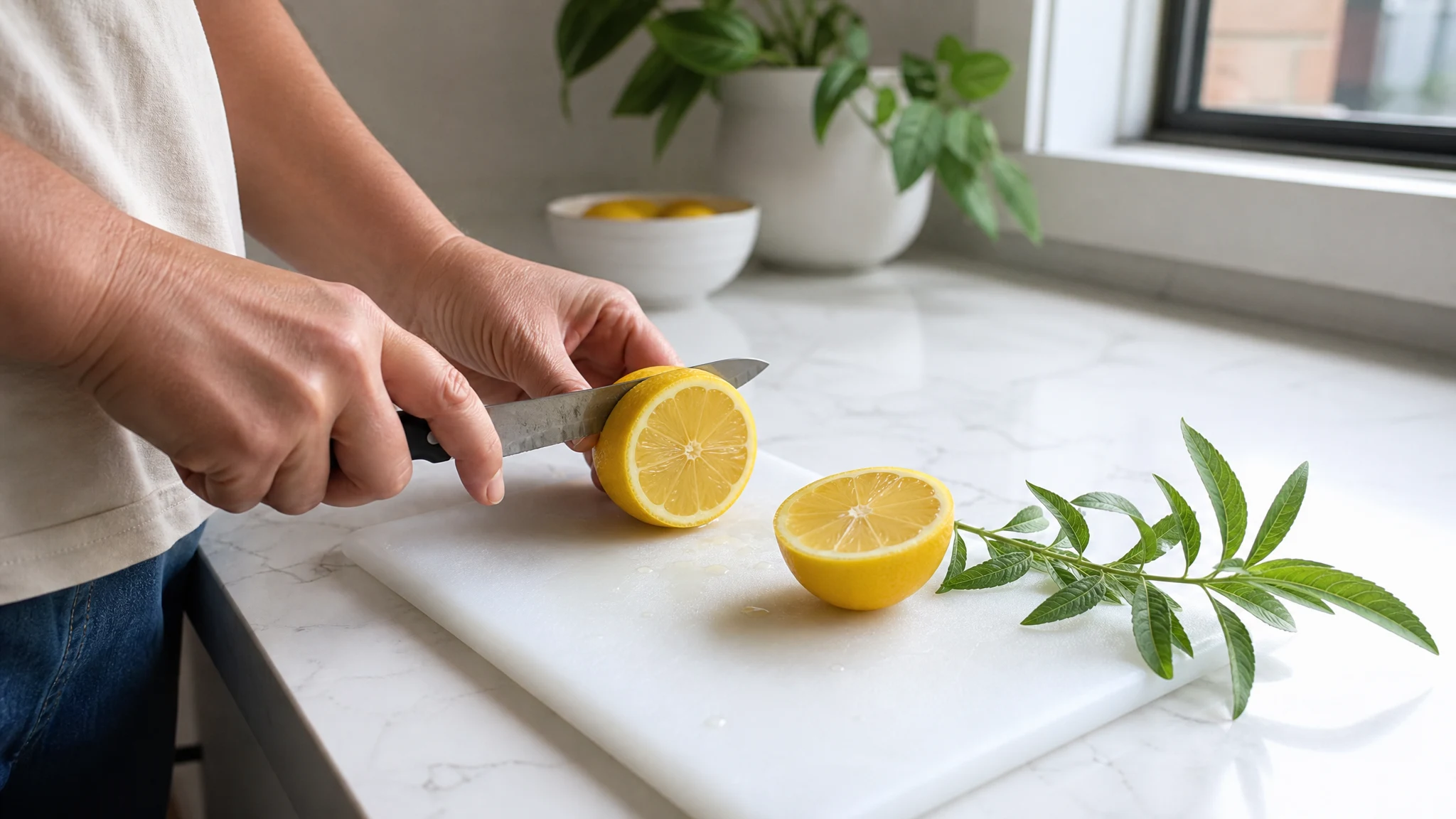
Lemon oil is obtained by mechanical pressing of the fruit peel without heat. The EFSA animal-feed panel describes the process as scarifying the peel, spraying water over the fruit and collecting the released oil, which is why it is called expressed or cold-pressed (EFSA, 2021). Our oil is steam-distilled from the leaves of Aloysia citrodora. That difference in method matters. Pressing carries the peel's non-volatile material into the oil, as EFSA's figures below show, and reasoning from that, compounds that cannot travel in steam will not be in a steam-distilled oil. The figures below are percentages of the oil from the sources named.
| Measure | Cold-pressed lemon (EFSA, 2021, citing the ISO 855 specification) | Lemon verbena leaf oil (citral-type samples) |
|---|---|---|
| Limonene | 60 to 73% | About 5 to 21% |
| Geranial plus neral (citral) | About 0.2 to 3.8% (geranial 0.1 to 2%, neral 0.1 to 1.8%) | Roughly 18 to 68% (geranial about 12 to 40%, neral about 6 to 30%) |
| Other main components reported | Beta-pinene 9 to 18%, gamma-terpinene 6 to 12% | Spathulenol 7.2 to 8.7% and 1,8-cineole 4.2 to 4.5% in one Portuguese study |
| Non-volatile residue | 1.8 to 3.6% of the oil | Not reported in the studies read |
| Spread between samples | Held to a specification | Wide: Moroccan oils had no geranial detected; one Peruvian oil was led by caryophyllene |
The verbena figures come from Sprea et al., 2023, which compares its own Portuguese sample with earlier Portuguese, Greek and Turkish analyses, and from Mejia-Ramos et al., 2025 for the Peruvian oil. The certificate we publish for our own batch gives appearance, smell, a relative density of 0.869 and a refractive index of 1.472, and says nothing about limonene or citral, so I cannot tell you where our oil sits in either column.
The skin-and-light question has two different answers
Lemon. The light problem is documented and traced to a named class of molecules. Expressed lemon oil's non-volatile fraction contains furocoumarins and methoxycoumarins, which together account for 0.5 to 0.8% of the oil, bergamottin being the largest at 0.12 to 0.4% (EFSA, 2021, quoting the European Pharmacopoeia commentary). The IFRA Standard on cold-pressed lemon oil (Amendment 49, 2020) limits it to 2.0% in most product categories because of phototoxicity, with no restriction in categories 7A, 9, 10A, 11A and 12. It also says that where the oil has been concentrated by removing the terpene fraction, the limit is reduced in proportion.
Worked through: 2.0% oil in 100 g of a leave-on product is 2 g of oil, and at 0.5 to 0.8% that oil brings 10 to 16 mg of furocoumarins and methoxycoumarins into the jar. That figure is arithmetic on EFSA's range, not a measured phototoxic dose, and IFRA's wording is the thing to follow.
Verbena. The IFRA Standard on verbena oil and absolute (Amendment 49, 2020, titled for Lippia citriodora Kunth) says verbena oils should not be used as a fragrance ingredient, based on sensitizing and phototoxic potential. Its category table of limits applies to absolutes, not to oils, and the prohibition sentence names no category exception. I found no furocoumarin analysis of verbena leaf oil in any of the composition studies I read, so I cannot tell you which compound IFRA's phototoxicity finding rests on. Our own safety copy says verbena can be mildly photosensitising and that treated skin should be kept out of strong sun for a while. That is a precaution with no number behind it, not a measured threshold.
So the two materials are not mirror images. Lemon has a measured furocoumarin load and a numeric cap. Verbena has an IFRA prohibition for fragrance use and no published load that I could find. If you hold a patch-test habit and a dilution table for lemon, they do not transfer to verbena. The skin basics article covers our own dilution range and patch-test steps.
Both carry labelled allergens, different ones
The EU's original list of 26 fragrance allergens requiring individual labelling includes citral and d-limonene, with thresholds of 0.001% in leave-on and 0.01% in rinse-off products (European Commission SCCS summary, opinion of 26 to 27 June 2012). A 2023 amendment extended the list, with sale of non-compliant new products allowed until 31 July 2026 and stock until 31 July 2028 (DHI, 2023); confirm current wording with a regulatory consultant.
The arithmetic is short. If a leave-on product contains 1% oil, a verbena oil that is 18 to 68% citral puts 0.18 to 0.68% citral in it, far above 0.001%. A lemon oil that is 60 to 73% limonene puts 0.6 to 0.73% limonene in it, also far above. The label trigger sits at roughly 0.0015 to 0.006% oil for the verbena range, so in practice both oils mean an allergen declaration for any product sold in the EU. Swapping one for the other changes which allergen you declare, not whether you declare one.
Matrix: which one for which job
| Job | Cold-pressed lemon | Our lemon verbena oil |
|---|---|---|
| Leave-on skin product, any sun exposure | Capped at 2.0% in most IFRA categories, plus the bergapten limit | IFRA says no verbena oil as a fragrance ingredient; our copy gives 0.5% to 2% in carrier, patch test first |
| Wash-off product | No IFRA restriction in category 9 | Prohibition wording has no category exception |
| Product with no skin contact (candle, room scent) | No IFRA restriction in category 12 | Prohibition wording has no category exception; ask a regulatory consultant how it applies to your channel |
| You need a plain peel note | This is the material | Not the answer: the citral-led leaf oil is a different smell |
| You need a written composition report | A specification exists (ISO 855, as quoted by EFSA) | Our published certificate has no GC-MS; ask in writing before ordering if you need one |
Our copy describes the verbena aroma as sparkling and sweet over a soft herbal-floral heart, less acidic and more polished than lemon peel oil. That is how we describe it, with no side-by-side test behind it. If you want to judge the difference yourself, a sample bottle of ours is the way, and the lemon oil comes from a supply shop, since we sell only lemon verbena oil.
Our myths article has a short version of the lemon-versus-verbena point. For the other lemon-smelling oils, see the six-oil comparison, and for a choice by job rather than by smell, the substitutes ladder.
Lemon Verbena Essential Oil
Lemon Verbena Essential Oil from our own shop, in sizes from 0.5 oz to bulk.
From $12.99
Shop Now →Sources & Further Reading
- EFSA FEEDAP Panel, 2021. Safety and efficacy of feed additives consisting of expressed lemon oil and its fractions from Citrus limon and of lime oil. EFSA Journal 19(5):6548. PMC8085978
- IFRA, 2020 (Amendment 49). Lemon oil cold pressed. ifrafragrance.org/standards/IFRA_STD_092
- IFRA, 2020 (Amendment 49). Verbena oil and absolute (Lippia citriodora Kunth). ifrafragrance.org/standards/IFRA_STD_083
- Sprea RM et al., 2023. Volatile Compounds and Biological Activity of the Essential Oil of Aloysia citrodora Palau. Molecules 28(11):4528. PMC10254266
- Mejia-Ramos C et al., 2025. Essential Oil of Aloysia triphylla Royle (Peru). Molecules 30(13):2849. PMC12251356
- European Commission, SCCS opinion summary on fragrance allergens (26-27 June 2012). Perfume allergies. ec.europa.eu/health/scientific_committees
- DHI, 2023. More allergenic fragrances to be labelled. tox.dhi.dk