Lemon Verbena Oil Substitutes: Choose by Job, Not by Smell
A substitute for lemon verbena oil should be picked by the job the verbena was doing, because "smells of lemon" covers at least three different chemistries. Our own oil is sold neat, from 0.5 oz, and we sell nothing else, so every substitute below comes from a supply shop. Where verbena is the wrong choice for your project, this page says so.
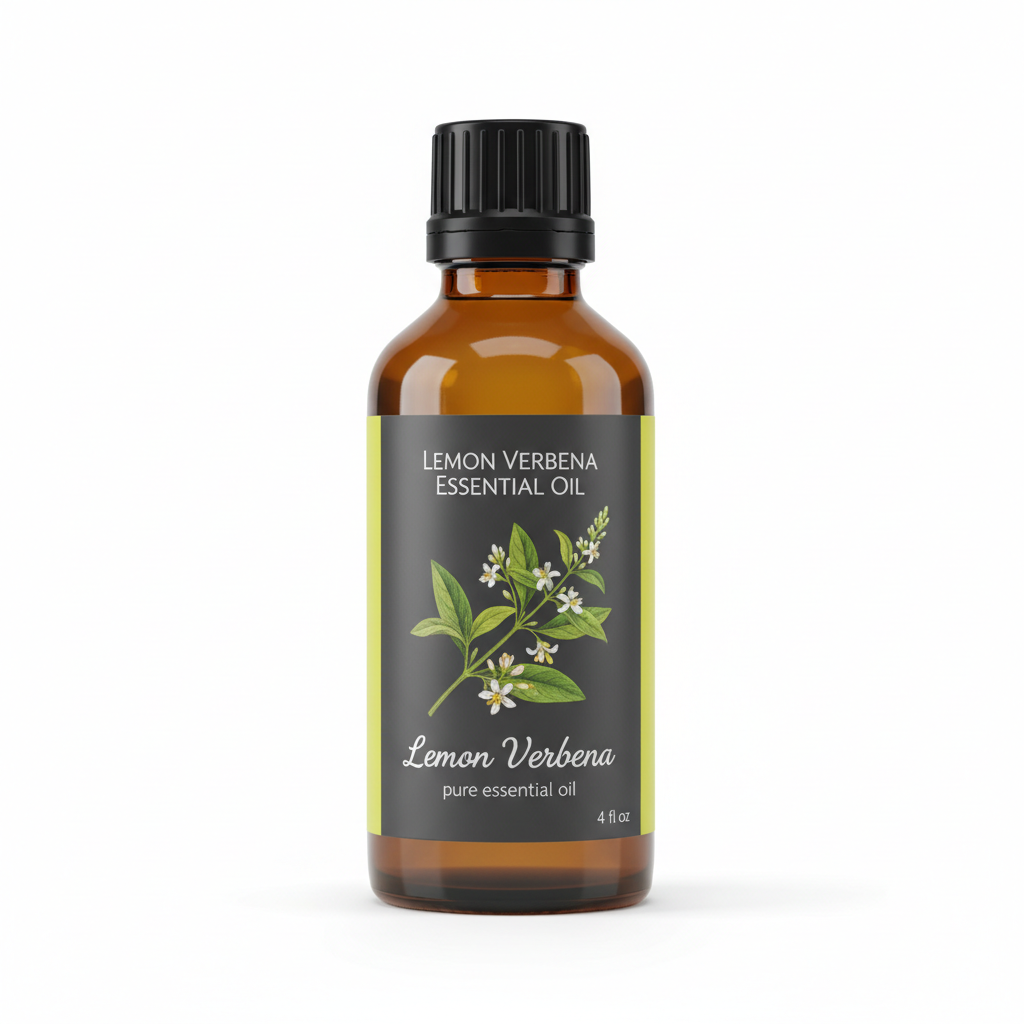
Lemon Verbena Essential Oil
Our own Lemon Verbena Essential Oil, in sizes from 0.5 oz to bulk.
From $12.99
Shop Now →Rung zero: do you need verbena at all?
Three situations argue against it. If the product must carry an IFRA-compliant fragrance formula, note that the IFRA verbena standard (Amendment 49, 2020, titled for Lippia citriodora Kunth) says verbena oils should not be used as a fragrance ingredient, citing sensitizing and phototoxic potential. We publish no IFRA certificate for our oil. If you only need citral, verbena is the inefficient source: on the published ranges it carries roughly 18 to 68% citral, against about 80 to 96% for lemon myrtle. And if you cannot get a composition report for the batch, you are formulating blind within a very wide range.
The cost arithmetic is a method you can run with your own supplier quotes, and I state no prices. Oil cost per batch is grams of oil times price per gram. For a 500 g batch, our copy's skin range of 0.5% to 2% is 2.5 g to 10 g of oil (about 58 to 230 drops, at 20 drops per ml and a relative density of 0.869, though you should weigh instead). To match a given citral dose, verbena needs 1.3 to 4.9 times the oil of a lemon myrtle oil at 88% citral, so verbena is cheaper per use only if its price per gram is under roughly 0.2 to 0.8 of the myrtle's. If verbena is the dearer oil per gram in your quotes, it loses on citral cost every time. The working is in the lemon myrtle comparison.
Rung one: you want citral sparkle at a small dose
Lemon myrtle. The review by Southwell (2021) gives a citral chemotype of 80.0 to 96.0% citral, and an International Standard for the citral type exists (ISO 5093:2021). Downside: a rare citronellal-dominated chemotype exists, so ask which you are buying; and the review recommends topical use under 1% oil.
Lemongrass. A hydrodistilled Cymbopogon citratus leaf oil from one March 2021 collection in eastern Nepal had geranial at 53.1% and neral at 36.1% (Dangol et al., 2023), about 89% citral. A 2024 review notes a hydrodistillation study with over 80% citral (Food Chem X, 2024). Downside: I have one sample, not a range. Our live comparison covers lemongrass directly.
Litsea cubeba. Fruit oils from eight Chinese regions had neral plus geranial of 78.7 to 87.4% and limonene of only 0.7 to 5.3% (Si et al., 2012), with the authors noting significant regional variation. Downside: its composition overlaps lemongrass and lemon myrtle closely enough that it features in adulteration discussions; buy it under its own name, not as verbena.
The shared limit for all three is citral. The IFRA citral standard allows 0.15% citral in Categories 5A to 5C and 0.60% in Category 4, which divided by about 89% gives a maximum oil of about 0.17% and 0.67%. IFRA's annex on contributions from other sources I did not read, so check with a regulatory consultant. Citral is also an unsaturated aldehyde that one study found degraded in water when soy protein or amino acids were present (Guo et al., 2022, a beverage model, not a soap or candle). Whether that matters in your base I cannot tell you; run a small test batch before committing.
Rung two: you want a clean peel note
Cold-pressed lemon. Limonene 60 to 73% and citral about 0.2 to 3.8% (EFSA, 2021). Downside: a measured furocoumarin load of 0.5 to 0.8% of the oil, and an IFRA limit of 2.0% in most categories (IFRA, 2020). It is a different smell from our citral-led leaf oil, and the lemon comparison has the numbers side by side.
Rung three: you want a round, soft top note, not citral
Bitter orange petitgrain. The ISO 8901:2003 specification, as adapted by EFSA, gives linalyl acetate 40 to 72%, linalool 10 to 32% and limonene 1 to 6% (EFSA, 2021). Citral is not among the main components in that specification, so this oil does not substitute for the citral sparkle; by the composition it is an ester-and-alcohol profile. Downside: "petitgrain" is not one oil. IFRA's furocoumarin note names a petitgrain from mandarin at about 50 ppm of phototoxic furocoumarins (IFRA, 2020), so ask which species and how it was made.
Rung four: you want an herbal-floral lemon
Melissa (lemon balm). The compiled ranges are geranial 6.22 to 51.21%, neral 4.28 to 35.02% and citronellal 0.4 to 20.3% (Petrisor et al., 2022), and a Romanian sample had about 3% citral and led with beta-cubebene and caryophyllene (Radulescu et al., 2021). Downside: it is as variable as verbena, with low yields reported (0.01 to 0.72% across 28 accessions in the review's summary of one study), and it has its own IFRA restriction. The live melissa comparison goes deeper.
Where verbena stays the answer
Verbena is still the answer when the soft herbal-floral remainder is what you are paying for. Our copy describes the aroma as sparkling and sweet over that heart, less acidic than lemon peel oil, and lists neroli, lavender, geranium, cedarwood, sandalwood, bergamot and petitgrain as partners. We have not blended or tested any of these, so that is our description only. One reason to leave verbena is a candle or soap where you doubt the scent will survive. I could not source that either way, and we have run no candle or soap tests; the honest course is a small batch with your base, weighed in grams.
If you do keep verbena, go to the low end of our 0.5% to 2% copy, patch test, and ask in writing for a composition report if you need one: our published certificate lists only appearance, smell, a relative density of 0.869 and a refractive index of 1.472 for one batch.
Lemon Verbena Essential Oil
Lemon Verbena Essential Oil from our own shop, in sizes from 0.5 oz to bulk.
From $12.99
Shop Now →Sources & Further Reading
- IFRA, 2020 (Amendment 49). Verbena oil and absolute (Lippia citriodora Kunth). ifrafragrance.org/standards/IFRA_STD_083
- IFRA, 2020 (Amendment 49). Citral; Lemon oil cold pressed; Citrus oils and other furocoumarins containing essential oils. ifrafragrance.org/standards/IFRA_STD_021 (see also STD 092 and STD 089 at the same address)
- Southwell I, 2021. Backhousia citriodora F. Muell. (Lemon Myrtle), an Unrivalled Source of Citral. Foods 10(7):1596. PMC8305781
- ISO 5093:2021. Essential oil of lemon myrtle, citral type (catalogue entry). boutique.afnor.org/iso-5093
- Dangol S et al., 2023. Essential Oil Composition Analysis of Cymbopogon Species from Eastern Nepal. Molecules 28(2):543. PMC9863348
- Food Chem X, 2024. Insights into chemistry, extraction and industrial application of lemon grass essential oil. PMC11215000
- Si L et al., 2012. Chemical Composition of Essential Oils of Litsea cubeba Harvested from Its Distribution Areas in China. Molecules 17(6):7057. PMC6268156
- Guo J et al., 2022. Interaction Mechanism Between Soybean Protein Isolates and Lemon Flavor: Isomerization and Degradation of Citral. Front Nutr 9:929023. PMC9355578
- EFSA FEEDAP Panel, 2021. Expressed lemon oil from Citrus limon (EFSA Journal 19(5):6548) PMC8085978; essential oil from the leaves of Citrus x aurantium, petitgrain bigarade (EFSA Journal 19:6624) PMC8193547
- Petrisor G et al., 2022. Melissa officinalis: Composition, Pharmacological Effects and Derived Release Systems. Int J Mol Sci 23(7):3591. PMC8998931
- Radulescu M et al., 2021. Chemical Composition of Melissa officinalis subsp. officinalis Essential Oil. Antioxidants 10(7):1081. PMC8301138