Lemon Verbena Oil Benefits: What the Studies Actually Tested
The human trials of lemon verbena that have a clear design were run on capsules of leaf extract, which is rich in a compound called verbascoside that is not part of the essential oil. The one inhaled-oil trial we found is small, has no blinded comparison, and was rated high risk of bias by a later review. So this page makes no claim that the oil does anything for your body, and below you can see exactly what each study did, with how many people.
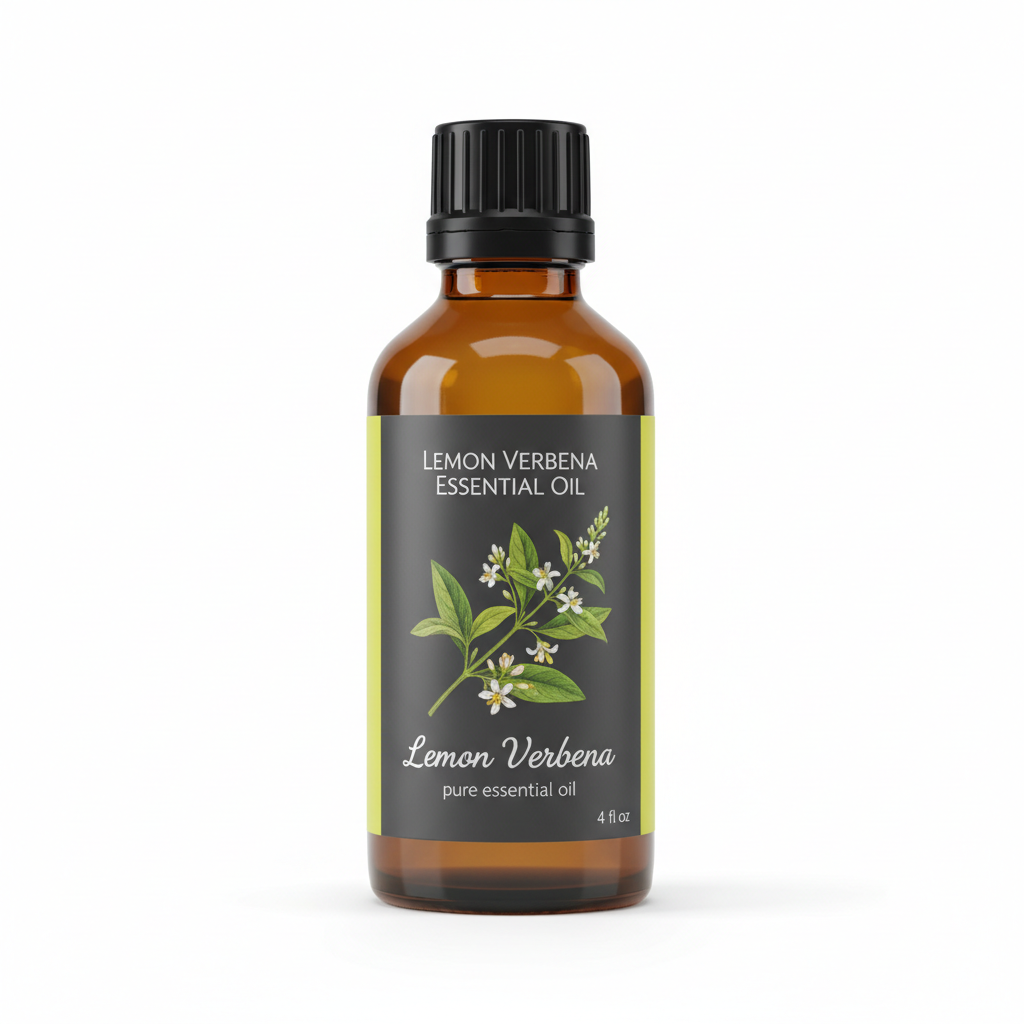
Lemon Verbena Essential Oil
Our own Lemon Verbena Essential Oil, in sizes from 0.5 oz to bulk.
From $12.99
Shop Now →Oil and extract are different materials
Aloysia citrodora Paláu is the botanical name used by the European Medicines Agency, which lists Aloysia triphylla, Verbena triphylla and Lippia citriodora among the synonyms, on its herbal page for the leaf. A 2018 review of the plant's chemistry and pharmacology (Bahramsoltani et al., 2018) reports that neral and geranial are the main components of the essential oil, while verbascoside is the most significant component of the extract. That one sentence explains most of the confusion online: a trial on an extract is not a trial on the oil, and the oil's own makeup varies. A Moroccan leaf oil in a 2017 paper listed spathulenol (15.61%), ar-curcumene (14.15%) and trans-caryophyllene oxide (14.14%) as predominant, with neral at 10.02% (Oukerrou et al., 2017; these are the highest single-sample values, not averages). Another leaf oil, from Jordan, had limonene, geranial and neral among its main constituents (Abuhamdah et al., 2015). Study results on one oil do not transfer to another, and none transfer to an extract.
The studies, side by side
| Study | Material | Design and n | What was measured | Main limit |
|---|---|---|---|---|
| Pérez-Piñero et al., 2024 | Extract capsule, 400 mg nightly, 90 days | Randomized, double-blind, placebo-controlled; 80 randomized, 71 analysed (33 extract, 38 placebo) | Sleep questionnaires, wrist actigraphy, melatonin, cortisol | Completers only; funder supplied the extract |
| Martínez-Rodríguez et al., 2022 | Extract capsule, 400 mg daily, 8 weeks plus 4-week washout | Randomized, double-blind, placebo-controlled; 40 (20 per arm) | Perceived stress, cortisol, sleep questionnaire, wearable tracker | Many results were within-group, not between-group |
| Lee et al., 2021 | Extract capsule, 400 mg daily, 10 days before exercise | Randomized, double-blind, placebo-controlled; 60 completers | Muscle-damage markers, soreness, strength | Young students, one exercise protocol |
| Alvarado-García et al., 2021 | Hydrodistilled oil, inhaled | Waiting-list control plus two inhalation groups; abstract says 95 participants | Anxiety questionnaire before and after | No blinded comparison; high risk of bias in a later review |
| Abuhamdah et al., 2015 | Leaf oil | Laboratory and cell assays | Receptor binding, antioxidant tests, cell protection | No human or animal data |
| Oukerrou et al., 2017 | Leaf oil | Laboratory assays | Composition, cell toxicity, bacterial growth in broth | Dish results only |
What the three extract trials found
In Pérez-Piñero et al. (2024), adults aged 29.5 on average, with a Pittsburgh Sleep Quality Index (PSQI) above 5 but no diagnosed insomnia, took the capsule or placebo. At day 90 the extract group scored 5.8 on the PSQI against 7.4 for placebo (p = 0.008), and 6.5 against 5.5 on a visual scale of sleep quality (p = 0.021). Two PSQI components, sleep duration (p = 0.722) and the subjective-quality item (p = 0.486), did not differ. Night melatonin was 199.7 against 174.7 pg/mL (p = 0.048), cortisol did not differ between groups (p = 0.370), and perceived stress did not differ. The authors state limits themselves: limited sample, 90 days, uncontrolled diet, a single cortisol time point. The funder, Monteloeder, supplied the extract and employs three of the authors. Reasoning from the design: with 9 of 80 randomized people lost and only completers analysed, the true effect could be smaller than the headline numbers.
Martínez-Rodríguez et al. (2022) gave a similar extract to 40 adults with high perceived stress and poor sleep. In the extract group, the perceived stress score went from 20.8 to 18.7 at month 2 and 17.1 after the washout, and PSQI from 6.7 to 5.9 to 5.0. Those are changes from the group's own baseline. The between-group comparison was often not significant, and the cortisol difference between groups was a trend (p = 0.08). The extract group was younger and heavier at baseline, and sleep was tracked with a consumer wearable. The paper's own title uses the word anxiolytic; one 20-per-arm trial cannot carry that.
Lee et al. (2021) is the odd one out: no sleep or mood outcome. Sixty students took 400 mg of extract (9% acteoside and isoacteoside) for 10 days before 100 countermovement jumps. Creatine kinase, interleukin-6, urinary 8-OHdG and soreness scores differed from placebo at some time points, but strength and jump performance did not differ between groups. Nine of 69 people withdrew, and the product came from the supplier Hänseler AG.
The next two articles in this series take sleep and stress one at a time: see lemon verbena oil and sleep and lemon verbena oil, stress and mood. They report the same trials with the same figures.
The one inhaled-oil trial
The abstract of Alvarado-García et al. (2021) describes a Lippia citriodora oil (geranial 39.8%) inhaled by one group, a Lippia alba oil by another, and a waiting-list control. Anxiety scores on the State-Trait Anxiety Inventory fell from before to after in the treated groups (p < 0.05). A waiting-list control means the control group knew it was waiting, so nobody was blinded. A later network meta-analysis (Tan et al., 2023) pooled 44 randomized trials of ten oils, listed this trial as 27 people on oil against 26 controls (the abstract says 95 in total, a mismatch we cannot resolve), and rated it high risk of bias. That review's estimate for the Lippia citriodora arm on state anxiety was a difference of -4.9 points with a 95% credible interval of -15.34 to 5.48, which includes zero. Across all 44 trials, 17 were rated high risk of bias, 11 unclear and 16 low, with heterogeneity (I-squared) of 93.2%. None of that proves the oil does nothing. It means this evidence cannot be leaned on.
What a dish result does and does not tell you
Abuhamdah et al. (2015) tested a leaf oil on rat brain membranes and a neuroblastoma cell line and reported effects in those assays; the authors call them worthy of further investigation and describe no human or animal work in the abstract. Oukerrou et al. (2017) reported minimum inhibitory concentrations of 2.84 to 8.37 mg/ml against three bacterial species, with P. aeruginosa resistant. For scale: a bench value of 2.84 mg/ml is 0.284% weight per volume in broth. Our oil weighs about 0.869 g per ml, so that is roughly 3.3 microlitres of oil per ml of broth. A number in a culture tube says nothing about skin, air or a person, and we do not claim it does.
What the regulators say
The European Medicines Agency's monograph on the leaf (EMA/HMPC/376770/2019, adopted 13 January 2021) is for a herbal tea of the leaf, by mouth, and is a traditional-use monograph, meaning it rests exclusively on long-standing use rather than on trials. It advises against use in children, says safety in pregnancy and lactation is not established, and says a doctor should be consulted if symptoms persist beyond two weeks. It does not cover the essential oil. For how tea and oil differ in mass, see lemon verbena tea vs essential oil.
In the United States, the FDA states that whether a product is a cosmetic or a drug turns on its intended use, and that claims that a product will help you sleep are drug claims (FDA, Aromatherapy, current as of 9 September 2023). That is why this site sells its oil as an aroma and craft material and says nothing about health effects. The NIH's National Center for Complementary and Integrative Health says that for insomnia, "we don't know whether it's helpful" about aromatherapy in general (NCCIH, Aromatherapy, last updated January 2020). Pages can change; check the current versions.
What we recommend
Our oil is lemon verbena essential oil sold neat, steam-distilled from the leaf, with a published certificate of analysis that records appearance, smell, a relative density of 0.869 and a refractive index of 1.472. It lists no constituent percentages and no biological activity. Use it for what it is, a scent for perfume, soap, candles and body care. For skin, our copy says dilute to 0.5% to 2% in a carrier (roughly 3 to 12 drops per ounce), patch test first, and keep it away from eyes, children and pets. The oil is not for internal use. Citral, a component of lemon verbena oil, is on the European list of 26 fragrance allergens that must be labelled (European Commission, SCCS summary), which is one more reason for the patch test. Our safety page is planned as lemon verbena oil safety.
If sleep or stress is the problem you want solved, a physician is the right first call, and a capsule trial on healthy volunteers does not replace one. If you are in distress now, call or text 988 in the United States (free, any hour, SAMHSA and the 988 Lifeline).
Interest in the plant is reasonable, and the honest summary is that the studies use a material we do not sell, in doses a perfume bottle does not resemble. We would rather say that than borrow their results.
Lemon Verbena Essential Oil
Lemon Verbena Essential Oil from our own shop, in sizes from 0.5 oz to bulk.
From $12.99
Shop Now →Sources & Further Reading
- Pérez-Piñero S et al., 2024. Dietary supplementation with an extract of Aloysia citrodora (lemon verbena) and sleep quality, Nutrients 16(10):1523. PMC11123999
- Martínez-Rodríguez A et al., 2022. Lippia citriodora extract, stress and sleep, Nutrients 14(1):218. PMC8747367
- Lee et al., 2021. Lemon verbena extract, oxidative stress and muscle damage, Int J Med Sci 18(12):2641. PMC8176190
- Alvarado-García PAA et al., 2021. Essential oils of Lippia alba and Lippia citriodora, Pharmacognosy Journal 13(6):1377 (abstract page only). phcogj.com/node/1672
- Tan L et al., 2023. Essential oils for treating anxiety: systematic review and network meta-analysis, Front Public Health. PMC10267315
- Abuhamdah S et al., 2015. Pharmacological and neuroprotective profile of an essential oil from Aloysia citrodora, J Pharm Pharmacol 67(9):1306 (abstract only). sure.sunderland.ac.uk/5865
- Oukerrou MA et al., 2017. Chemical composition and cytotoxic and antibacterial activities of Aloysia citriodora oil grown in Morocco, Adv Pharmacol Sci (abstract only). PMC5485486
- Bahramsoltani R et al., 2018. Aloysia citrodora Paláu (lemon verbena): a review of phytochemistry and pharmacology, J Ethnopharmacol 222:34-51 (abstract only). Europe PMC, PMID 29698776
- European Medicines Agency, 2021. Verbenae citriodorae folium, herbal medicinal product page and EU herbal monograph EMA/HMPC/376770/2019. ema.europa.eu
- FDA, 2023. Aromatherapy. fda.gov/aromatherapy
- NCCIH, 2020. Aromatherapy. nccih.nih.gov/health/aromatherapy
- European Commission, SCCS lay summary on perfume allergies. ec.europa.eu
- 988 Suicide & Crisis Lifeline. 988lifeline.org/get-help