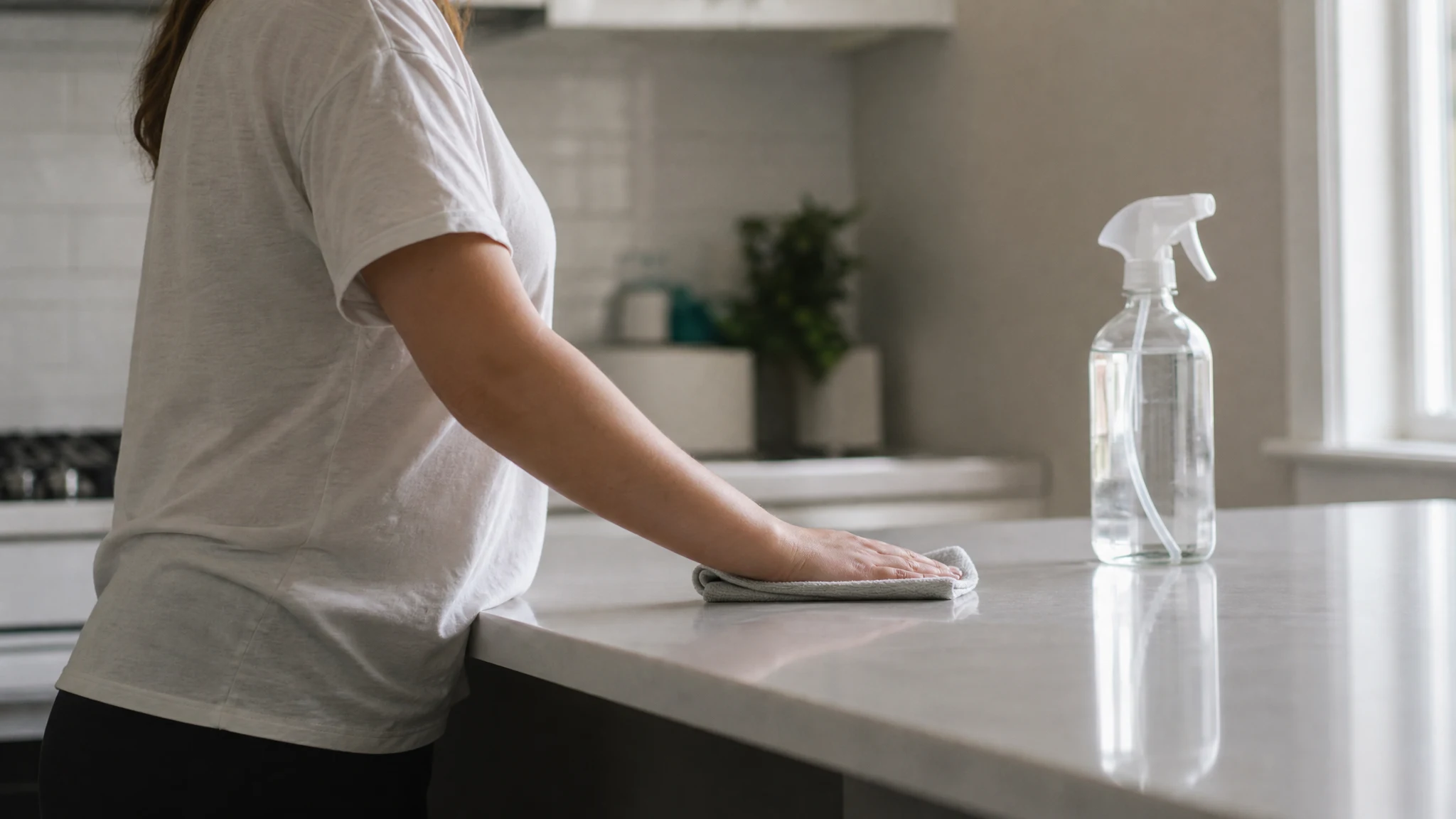
Lemon Verbena Oil Cleaning Sprays: Scent-Only Formulations
Lemon verbena oil is a poor choice for bulk cleaning and a reasonable one for scenting a small bottle of cleaner you were going to make anyway. The oil does not dissolve in water, it is a scent and not a disinfectant, and two popular add-ins, vinegar and castile soap, cancel each other out. Below are two formulations worked out by arithmetic and a list of what to leave out. We have not made or tested either one.
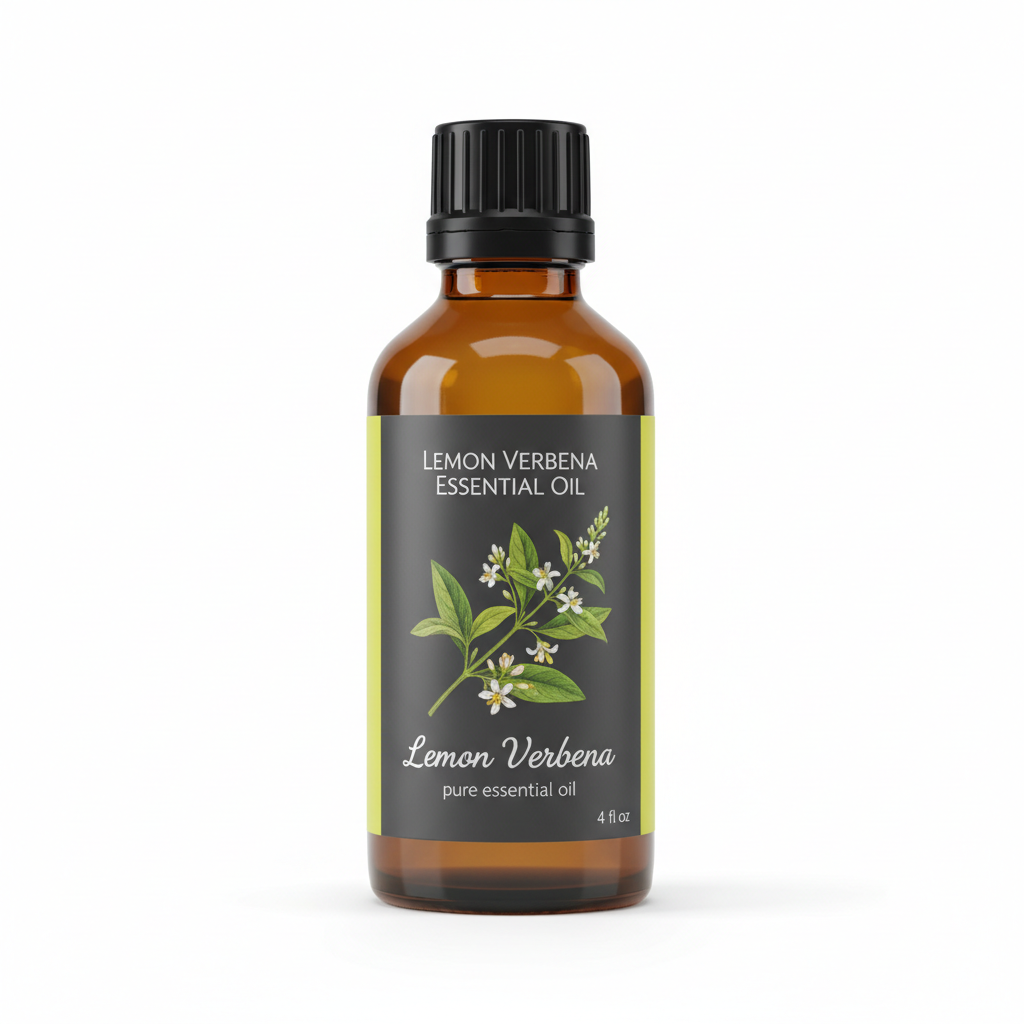
Lemon Verbena Essential Oil
Our own Lemon Verbena Essential Oil, in sizes from 0.5 oz to bulk.
From $12.99
Shop Now →Decide first: is this the right oil for the job?
The arithmetic is short. A 500 ml spray bottle holds about 500 g of water-based liquid. Scent levels are your choice, since no authority sets one for a household cleaner. With the oil at a relative density of 0.869 (the batch on our published COA) and about 20 drops per ml (weigh instead if you can, since droppers vary), the amounts per bottle are:
| Oil in the bottle | Grams | Millilitres | Drops (about) | Bottles from 1 oz (about 25.7 g) |
|---|---|---|---|---|
| 0.1% | 0.5 | 0.58 | 12 | 51 |
| 0.2% | 1.0 | 1.15 | 23 | 26 |
| 0.5% | 2.5 | 2.88 | 58 | 10 |
So an ounce goes a long way at a scent-only level, and the cost question is whether you want a costly leaf oil spread across a spray that spends most of its life on a kitchen counter. Our oil is sold neat, in sizes from 0.5 oz up; see the shop page for current prices, and judge the arithmetic against your own bottle count. If what you want is a loud lemon cleaner for a whole house, a different lemon-scented oil from a craft or soap supply shop is the practical answer, and we sell only lemon verbena. The substitutes guide covers what to pick instead; the uses guide has the smaller jobs this oil suits better.
Problem one: oil and water separate
Essential oil floats on water and, shaken, breaks into droplets that rejoin. A solubiliser such as polysorbate 20 holds the oil in the water. The polysorbate and the amount are not ours to supply: buy it from a soap or cosmetic supply shop and ask the seller for the ratio of solubiliser to essential oil they recommend, because no authority was found that sets one. The table below runs the grams at two illustrative ratios by weight and is not a sourced recommendation.
| Oil per 500 g bottle | Polysorbate at 1:1 | Polysorbate at 4:1 |
|---|---|---|
| 0.5 g (0.1%) | 0.5 g | 2.0 g |
| 1.0 g (0.2%) | 1.0 g | 4.0 g |
You need a scale that reads to 0.1 g or better. Mix the oil and polysorbate first, stir until uniform, then add water slowly. If the bottle is cloudy, the oil is not held and the ratio needs to go up. Small test bottle first.
Formulation A: a detergent-water spray (stone-safe, scent only)
This is the lower-risk base, and the choice is made on sourced guidance. The Natural Stone Institute recommends, for routine cleaning of natural stone, "a neutral cleaner, stone soap, or a mild liquid dishwashing detergent and warm water."
- About 495 ml warm water in a clean 500 ml spray bottle.
- About 5 ml mild liquid dishwashing detergent (our choice for a starting point; no source gives a ratio, so use less if it foams or streaks).
- 0.1% to 0.2% lemon verbena oil premixed with polysorbate (the table above), about 12 to 23 drops.
We have not made this formulation. Spray a hidden corner first, wipe with a damp cloth and look at it dry. The detergent does the cleaning; the oil is only the scent, and no cleaning-power claim comes from it.
Formulation B: a vinegar-water spray, for non-stone surfaces only
Vinegar is the one many people want and the one with the most rules. Equal parts water and white vinegar with the same premix is a common pattern, and this is a formulation for scenting it, not an endorsement of its power.
- 250 ml water and 250 ml white vinegar in a spray bottle.
- 0.1% oil (about 12 drops), premixed with polysorbate as above.
Three rules attach to it.
- Keep it off stone. The Natural Stone Institute says calcium carbonate is sensitive to acidic solutions, that "products containing lemon, vinegar or other acids may dull or etch calcareous stones," and that etched areas call for a stone dealer or a professional restorer. The page defines calcareous stone by its calcium carbonate and does not list marble by name, but the stone you own decides the question, so keep acids away unless you know it is not calcareous.
- Never combine it with bleach. The National Capital Poison Center says: "You should never mix vinegar with chlorine bleach," and the combination releases chlorine gas, which is very irritating to airways, eyes, nose and throat. The same hazard is why a spray bottle left half full of one product must not be topped up with another. A CDC report (MMWR, June 2020) on an online survey of 502 US adults found 35% responding that bleach should not be mixed with vinegar and 58% that it should not be mixed with ammonia, which suggests the rule is less well known than it should be.
- Never combine it with castile soap. A castile soap maker explains that soap is a base and vinegar an acid, so they neutralise each other and the vinegar "unsaponifies" the soap into a curdled, oily mixture (Bronner, undated). Reasoning from that explanation, the curd is the free fatty acid the acid releases. Pick the detergent version or the vinegar version, not both.
What these are not
These are scent formulations. EPA (updated 24 August 2026) says it registers disinfectants and approves their label language, and that a product may not claim efficacy against specific pathogens unless EPA has reviewed supporting data and approved the claim. Nothing here has had that review, so use a product with an EPA registration number and follow its directions when a surface genuinely needs disinfecting, and see the lab-dish evidence summary for why a lab number about oil is not the same thing.
The oil also touches skin. Our own copy says verbena can be mildly photosensitising, so keep treated skin out of strong sun for a while afterwards, and that the oil belongs away from children and pets. Wipe sprayed surfaces and let the room air before pets or children come back, and for animals ask a veterinarian; this page covers the pet question and the safety guide the rest.
Two further cautions come from reasoning, not from a source. Water-based mixtures can grow microbes, and we have no sourced shelf life for these, so make a bottle at a time and throw out any that turns cloudy, smells off or grows film. And the 0.1% to 0.5% range is a scent choice, not a safe level.
Lemon Verbena Essential Oil
Lemon Verbena Essential Oil from our own shop, in sizes from 0.5 oz to bulk.
From $12.99
Shop Now →Sources & Further Reading
- Natural Stone Institute. Learn About Cleaning Products for Natural Stone. naturalstoneinstitute.org/consumers/care
- National Capital Poison Center. No, vinegar is not always safe. poison.org/articles/vinegar-164
- CDC, 2020. Knowledge and Practices Regarding Safe Household Cleaning and Disinfection for COVID-19 Prevention, United States, May 2020. MMWR 69(23):705-709. cdc.gov/mmwr/mm6923e2
- Bronner L, undated. Why Vinegar & Castile Soap Don't Mix Well. lisabronner.com
- US EPA, 2026. Selected EPA-registered disinfectants. epa.gov