
Lemon Verbena Oil in the Lab Dish: What MIC Studies Show
Lab papers on lemon verbena essential oil report that it stopped bacterial growth in a dish at concentrations ranging from about 3 micrograms to 25 milligrams per millilitre, a spread of roughly a thousand-fold. That spread, more than any single figure, is what the literature shows. None of it turns a bottle of oil into a disinfectant or a remedy, and we make no claim of that kind for ours.
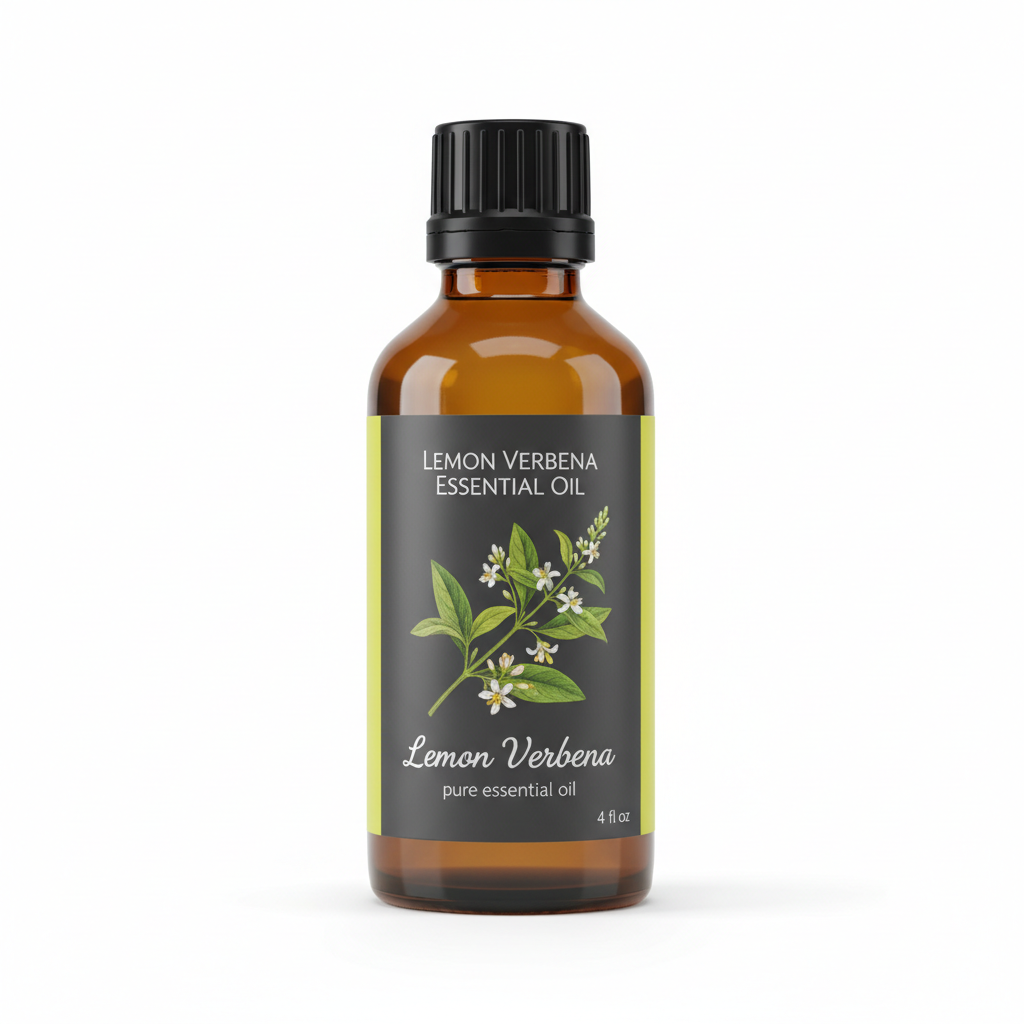
Lemon Verbena Essential Oil
Our own Lemon Verbena Essential Oil, in sizes from 0.5 oz to bulk.
From $12.99
Shop Now →Start with the unit: what a MIC is and how to read it
A minimum inhibitory concentration (MIC) is the lowest concentration in a test series at which no growth is visible. Al-Maharik and colleagues (2024) define it exactly that way for their 96-well plates: two-fold dilutions of oil in broth, bacteria incubated at 35 °C for 18 to 24 hours, then read by eye. Oukerrou and colleagues (2017) add the companion figure, the minimum bactericidal concentration (MBC), the lowest concentration that completely killed the organisms. An MBC is always equal to or higher than the MIC, and in their data it was between about 1.5 and 3.5 times higher.
Papers mix units, so convert before comparing. One milligram per millilitre of a water-based broth is about 0.1% (weight per volume). That single conversion is enough to line the studies up.
The three oil studies, as written
Morocco, 2017: weak and uneven
Oukerrou et al., 2017 (Advances in Pharmacological Sciences) hydrodistilled leaves from five Moroccan sites, harvested July to August 2015, and tested three reference strains: E. coli ATCC 25922, S. aureus ATCC 25923 and P. aeruginosa ATCC 27853. In disc diffusion (6 µl of oil on a 6 mm disc) the clear zones were 8 to 11 mm for E. coli and S. aureus, against 25 to 32 mm for the antibiotic discs ceftriaxone and ofloxacin. For P. aeruginosa the zone was 6 mm, which is the disc itself: no inhibition. In broth microdilution, MICs ran from 2.84 to 8.37 mg/ml for E. coli and 3.51 to 6.42 mg/ml for S. aureus, with MBCs of 7.4 to 12.5 mg/ml. P. aeruginosa was not affected by any oil. The main constituents were trans-caryophyllene oxide (13 to 14%), spathulenol (9 to 16%) and ar-curcumene (11 to 14%), with neral at 6 to 10%.
The paper has internal slips: the abstract and results text give different E. coli MIC ranges, and the authors' own conclusion calls the activity "moderate" where the abstract says "significant". Three reference strains and one harvest season is also a narrow base.
Palestine, 2024: strongest against two organisms, weak against the rest
Al-Maharik et al., 2024 (BMC Complementary Medicine and Therapies) hydrodistilled leaves collected in June 2022 from Jericho, Jerusalem, Hebron and Qalqilya. Geranial ran from 10.8% (Jericho) to 37.2% (Hebron), and neral from 7.6% to 29.0%, so four oils from one small region differed several-fold in their main pair. MICs by broth microdilution (five ATCC reference strains plus a clinical MRSA isolate with no strain number given):
| Organism | Lowest MIC (mg/ml) | Highest MIC (mg/ml) | As a percentage |
|---|---|---|---|
| MRSA (clinical isolate) | 0.39 (Jerusalem) | 3.125 | 0.039% to 0.31% |
| S. aureus ATCC 25923 | 0.39 (Jerusalem) | 3.125 | 0.039% to 0.31% |
| E. coli ATCC 25922 | 12.5 | 25 | 1.25% to 2.5% |
| P. aeruginosa ATCC 9027 | 12.75 to 25 (Jerusalem oil: resistant) | 25 | about 1.3% to 2.5% |
| C. albicans ATCC 90028 | 0.048 (Jericho, Jerusalem) | 3.125 | 0.0048% to 0.31% |
Controls were ciprofloxacin, ampicillin and fluconazole. The paper has no limitations section and carries visible inconsistencies (a melanoma claim in the abstract against colon-cancer cells in the experiments, replicate counts stated as both "twice" and "triplicate", and a fluconazole MIC printed as 1.56 mg/ml). Treat the very low Candida values as an unreplicated outlier until someone repeats them.
A 2023 thesis, abstract only
Only the abstract of a 2023 Palestinian master's thesis (Abu Alrub) was read. It reports MICs of 3.125 to 25 µg/ml for A. citrodora oil against most organisms tested and 3.125 µg/ml against Candida, with P. aeruginosa resistant. Those are micrograms, so about a thousand times lower than the 2017 and 2024 papers. Its oil profile is also odd: trans-anethole (18.9%) was the largest listed component, with geranial at 10.4% and neral at 8.1%, while the same thesis's fennel oil was 93.7% trans-anethole. A thesis is not peer reviewed and its methods were not available, so this figure gets no weight beyond showing how wide the reported range is.
Why the numbers disagree, and what stays unresolved
Three things differ between the papers at once: the oil (the three studies list different main constituents, from sesquiterpene-heavy to geranial-heavy), the test (disc versus broth, solvent, strains, endpoint) and the units. The papers do not isolate which factor drives the gap, so any single explanation would be reasoning rather than a finding. What the evidence does support is narrower: activity in these assays varied with the oil, the organism and the lab, and a Gram-negative such as P. aeruginosa was the organism that most often was not inhibited.
This matters for the oil we sell because our published certificate of analysis (batch LMVAIULCCLC005A) reports appearance, smell, a relative density of 0.869 and a refractive index of 1.472. It carries no constituent profile, so there is no basis for saying which of these studies, if any, our oil resembles. Do not read any MIC above as a property of it.
From dish to bottle: the arithmetic
The conversions are easy, which is exactly why they mislead. Using our skin guidance (0.5% to 2% in a carrier, about 3 to 12 drops per ounce, from 591 drops of oil per ounce of liquid at about 20 drops per ml), the study concentrations translate like this:
| MIC or MBC reported | Percent | Drops of oil per ounce of liquid |
|---|---|---|
| 0.39 mg/ml (lowest MRSA MIC, 2024) | 0.039% | about 0.2 |
| 2.84 mg/ml (lowest E. coli MIC, 2017) | 0.284% | about 1.7 |
| 12.48 mg/ml (highest E. coli MBC, 2017) | 1.25% | about 7.4 |
| 25 mg/ml (highest MIC, 2024) | 2.5% | about 15 |
Several of those sit inside or below the 0.5% to 2% skin range. That does not mean a product at that strength acts on microbes, because a MIC describes a closed well of broth. In it the oil was dispersed through broth (with DMSO in both studies as a carrier), it could not evaporate, it met 105 colony-forming units per ml and it was read after one night. Oil sitting in a carrier oil, on skin or on a countertop meets none of those conditions. Reasoning from that, the safest reading of a MIC is as a ranking tool between oils inside one laboratory, not a dose.
Where regulators draw the line
For surfaces, EPA (page updated 24 August 2026) says it registers disinfectants and approves their label language, and that a product may not claim efficacy against specific pathogens unless EPA has reviewed supporting data and approved the claim. An essential oil in a spray bottle has no such review. For the body, FDA (content current as of 11 September 2024) says intended use decides whether a product is a cosmetic or a drug, and that labels, advertising, online claims, consumer perception and well-known therapeutic ingredients can all establish intended use. That is why this shop sells the oil for fragrance and craft work and says nothing medical. Rules can change, so confirm current text.
If you have a wound, a rash that is spreading, or any suspected infection, see a physician or pharmacist, and use an EPA-registered product, following its label directions, where a surface genuinely needs disinfecting.
The short version
The literature is a record of how this oil behaves in assay plates, with unusually wide disagreement, three small data sets, and no human outcome. For related ground, see the evidence summary on benefits, the antioxidant evidence for oil versus extract, the safety guide and the cleaning formulations, which are scent-only.
Lemon Verbena Essential Oil
Lemon Verbena Essential Oil from our own shop, in sizes from 0.5 oz to bulk.
From $12.99
Shop Now →Sources & Further Reading
- Oukerrou MA et al., 2017. Chemical Composition and Cytotoxic and Antibacterial Activities of the Essential Oil of Aloysia citriodora Palau Grown in Morocco. Adv Pharmacol Sci 2017:7801924. Full text read. PMC5485486
- Al-Maharik N et al., 2024. Chemical composition, [...] antimicrobial activity of Aloysia citriodora Palau essential oils from four different locations in Palestine. BMC Complement Med Ther 24:94. Full text read. PMC10870676
- Abu Alrub M, 2023. Unveiling the Chemical Profiling, Antioxidant, [...] Activities of Essential Oils Derived from Fennel, M. fruticosa and Aloysia citrodora (thesis). Abstract only. repository.najah.edu
- US EPA, 2026. Selected EPA-registered disinfectants. epa.gov
- US FDA, 2024. Is It a Cosmetic, a Drug, or Both? (Or Is It Soap?). fda.gov