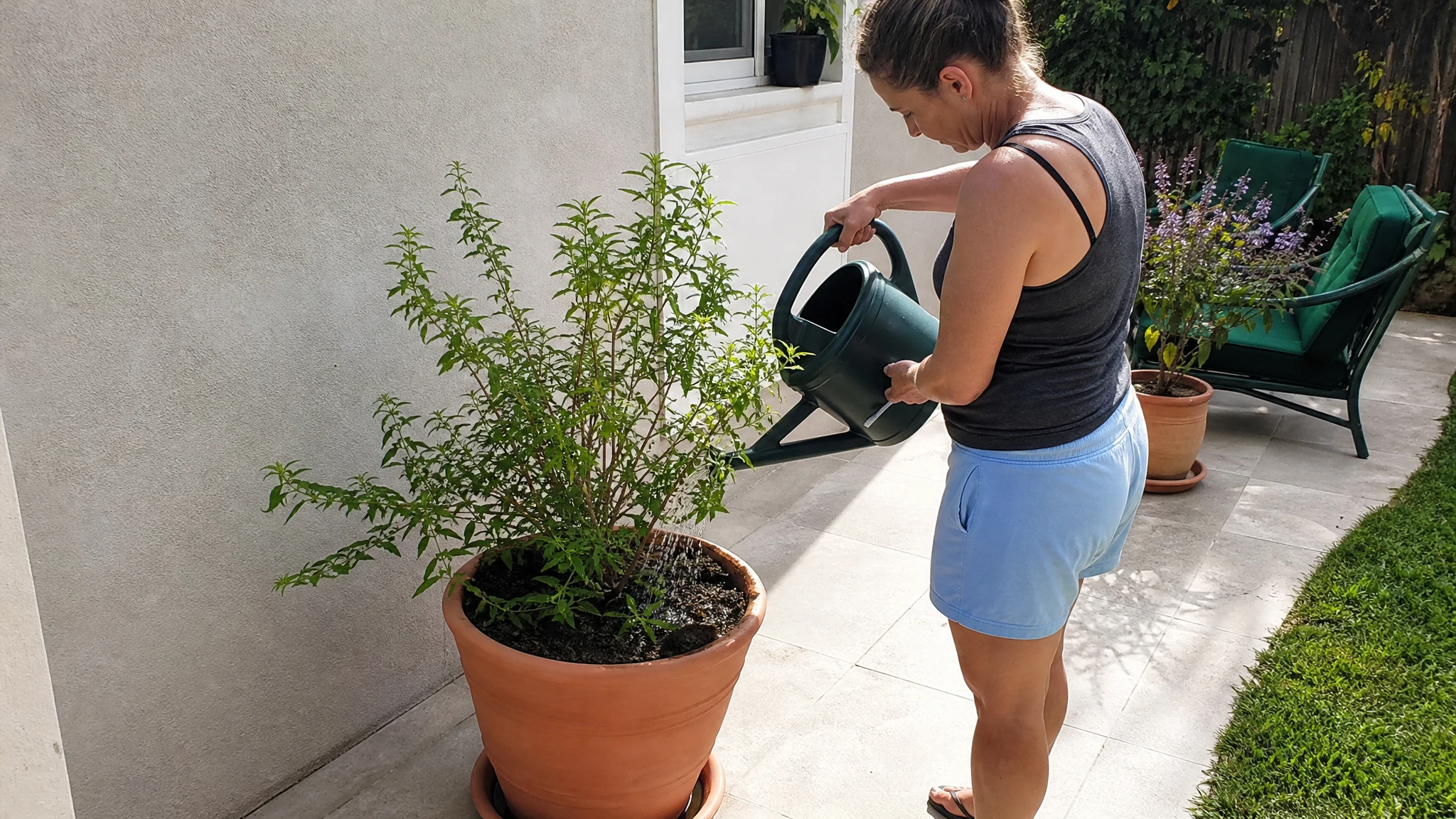
How to Grow Lemon Verbena: Winter, Pruning, Harvest
Lemon verbena is easy to keep alive if your winter minimum allows it and hard to keep if it does not, so the first decision is where it will spend January. We sell the distilled oil, not plants, and we have grown nothing, so this guide is assembled from university and horticultural society sources, and where they disagree it says so. One caution up front: a home plant is a source of leaf, not of oil.
Lemon Verbena Essential Oil
Our own Lemon Verbena Essential Oil, in sizes from 0.5 oz to bulk.
From $12.99
Shop Now →Decide the winter first
The sources do not agree on hardiness, and the gap is wide enough to change what you do.
| Source | What it says |
|---|---|
| NC State Extension Plant Toolbox | USDA zones 8a to 10b; "in zones 8 and higher, it can be grown outdoors"; in colder places, grow in a pot and bring it indoors, where it loses its leaves |
| Herb Society of America | Root hardy in zone 8 with good drainage, meaning it freezes to the ground in winter; reliably hardy in zones 9 to 11 |
| Royal Horticultural Society | Rated H3, "hardy in coastal and relatively mild parts of the UK" with a range of -5 to 1 °C; may need winter protection in northern Britain; mulch in autumn |
| University of Illinois Extension | Frost sensitive; best in a container that can come indoors for winter |
| UC Marin Master Gardeners | Evergreen only where there is no frost; cold causes leaf drop and branch dieback |
Read together: NC State counts zone 8 as outdoor territory, while the Herb Society says that in zone 8 the top dies and the roots may survive. Those are different outcomes. The RHS range of -5 to 1 °C is 23 to 34 °F, a mild-winter rating on a British scale that does not map onto USDA zones. USDA's map is built on the average annual extreme minimum winter temperature in 5 °F half zones, from the 1991 to 2020 period, and USDA cautions that it is an average of past extremes, not the lowest temperature that has occurred (USDA Plant Hardiness Zone Map).
My recommendation, reasoned from that spread: in zone 9 or warmer, plant it out. In zone 8, treat an outdoor plant as one that may die back to the ground, mulch it, and root a cutting indoors as insurance. Colder than that, grow it in a pot from the start.
Site and planting
NC State defines full sun as six or more hours of direct sun a day and lists well-drained, moist, fertile, light soils. The Herb Society says full sun, or afternoon shade, in well-drained soil. UC Marin says to start with a potted plant rather than seed, plant after the last frost, protect it from wind or stake it, and consider a spot near a warm wall. NC State adds that seed set is variable in North America, so cuttings are the usual way to get a plant.
The plant's native habitat is a hint about drainage. ColPlantA places it in dry inter-Andean valleys at roughly 2,300 to 3,250 m in north-western Argentina and southern Bolivia (ColPlantA). Reasoning from that, a pot with drainage holes and a coarse mix suits it better than a heavy, wet bed. The plant profile has the botany, and the origin article sets out a disagreement over its native range.
Size to plan for
The sources give very different final sizes, which depends on climate and on pot against ground. NC State gives 6 to 8 feet tall and wide in the ground and 2 to 4 feet in a pot. The RHS gives 1.5 to 2.5 metres for both height and spread. The Herb Society says 6 to 8 feet in zones 9 to 11 but 2 to 4 feet in a season in zone 8. UC Marin says it can reach about 15 feet in the tropics and notes up to 10 feet as a mature size. If you are planting in the ground, leave room for the larger numbers.
Water and feeding: where the advice splits
Illinois Extension says to keep the soil uniformly moist without overwatering and calls the plant a heavy feeder, suggesting a general-purpose liquid fertilizer about every two weeks, less often once indoors. UC Marin says moderate water in warm summer months and that fertilizer is unnecessary if the soil was well prepared before planting. Those two do not fit together. A container plant has only the potting mix to draw on, so Illinois's advice is the more plausible one for pots; UC Marin's is written for ground planting, and I am inferring that reconciliation, not quoting either source.
Pruning: early spring or late summer
NC State says pruning branches in early spring encourages a bushier form. UC Marin says to prune often to avoid legginess, and to prune in mid to late summer to hold size, then to remove dead branches in spring once new leaves show. The two schedules are compatible if you separate jobs. Cut dead wood in spring after new leaves appear, shape in early spring, and use summer harvest as the trimming that holds the size down. Illinois says occasional pruning or frequent harvest keeps the plant in good form.
Overwintering as dormancy
A pot brought indoors will drop its leaves, which is expected: NC State says so, the Herb Society says it "may lose its leaves," and UC Marin ties leaf drop to cold. The Herb Society advises watering sparingly in winter. A bare stick in January is therefore not a verdict. In spring, UC Marin's rule applies: wait for new leaves, then remove the dead branches. Illinois advises moving the plant to a bright indoor spot before frost.
Making more plants
NC State calls stem cuttings the best method. The Herb Society specifies softwood cuttings in spring and summer, and Illinois says tip cuttings root easily and that older plants become woody with declining foliage, so it suggests discarding them after taking cuttings. Reasoning from that, a rolling supply of young plants is a sensible pattern in a cold climate, more so than keeping one old shrub.
Harvest and drying
UC Marin says to pinch tips for the newest leaves any time through summer, and to harvest branches for drying in August, which also shapes the plant. It says to dry the leaves at room temperature and store them in an airtight container. Illinois says leaves can be used fresh or dried and stored in sealed containers. The Herb Society says the dried leaves retain their lemon aroma for many years; I could not verify that against a measurement, so treat it as a society's statement.
What a home plant will not give you
People ask whether a few shrubs make oil. Use published yields. A Portuguese laboratory distilled dried leaf with two methods and got 1.05% and 1.29% of the leaf weight (Sprea et al., 2023); five Moroccan regions gave 0.1% to 0.2% (Oukerrou et al., 2017). From 100 g of dry leaf, the Portuguese figures are 1.05 to 1.29 g of oil, which at our COA batch's relative density of 0.869 is about 1.2 to 1.5 ml, or 24 to 30 drops at 20 drops per ml. The Moroccan range is 0.1 to 0.2 g, about 2 to 5 drops. I found no source for how much dry leaf a pot-grown plant gives in a season, so I will not guess. The yield post covers why commercial oil costs what it does, and this is not a distillation guide. A home still is a different project, and if you want its water, read the hydrosol article first for what spoils.
Pests, pets and caution
NC State says the plant has no serious problems, with aphids, whiteflies, mealybugs and spider mites occasional; the RHS calls it generally pest-free. NC State also tags the plant as a problem for dogs, horses and cats without giving detail. If animals chew your plant, call a veterinarian instead of relying on a web page, and note that our oil safety copy keeps the oil away from pets. See the pets article for the oil.
The leaf you grow can be a leaf for tea or for drying. The oil in a bottle is a separate product with its own handling rules, and our oil is not for internal use.
Lemon Verbena Essential Oil
Lemon Verbena Essential Oil from our own shop, in sizes from 0.5 oz to bulk.
From $12.99
Shop Now →Sources & Further Reading
- NC State Extension. Aloysia citriodora (Lemon Beebrush, Lemon Verbena), Plant Toolbox. plants.ces.ncsu.edu
- Royal Horticultural Society. Aloysia citrodora. rhs.org.uk/plants/284648
- Herb Society of America. Aloysia citriodora. herbsocietypioneer.org
- University of Illinois Extension. Lemon Verbena. extension.illinois.edu/herbs
- UC Marin Master Gardeners. Lemon Verbena. ucanr.edu/lemon-verbena
- USDA ARS. USDA Plant Hardiness Zone Map, How to Use the Maps. planthardiness.ars.usda.gov
- ColPlantA. Aloysia citrodora Paláu. colplanta.org
- Sprea RM et al., 2023. Molecules 28(11):4528. PMC10254266
- Oukerrou MA et al., 2017. Adv Pharmacol Sci. PMC5485486