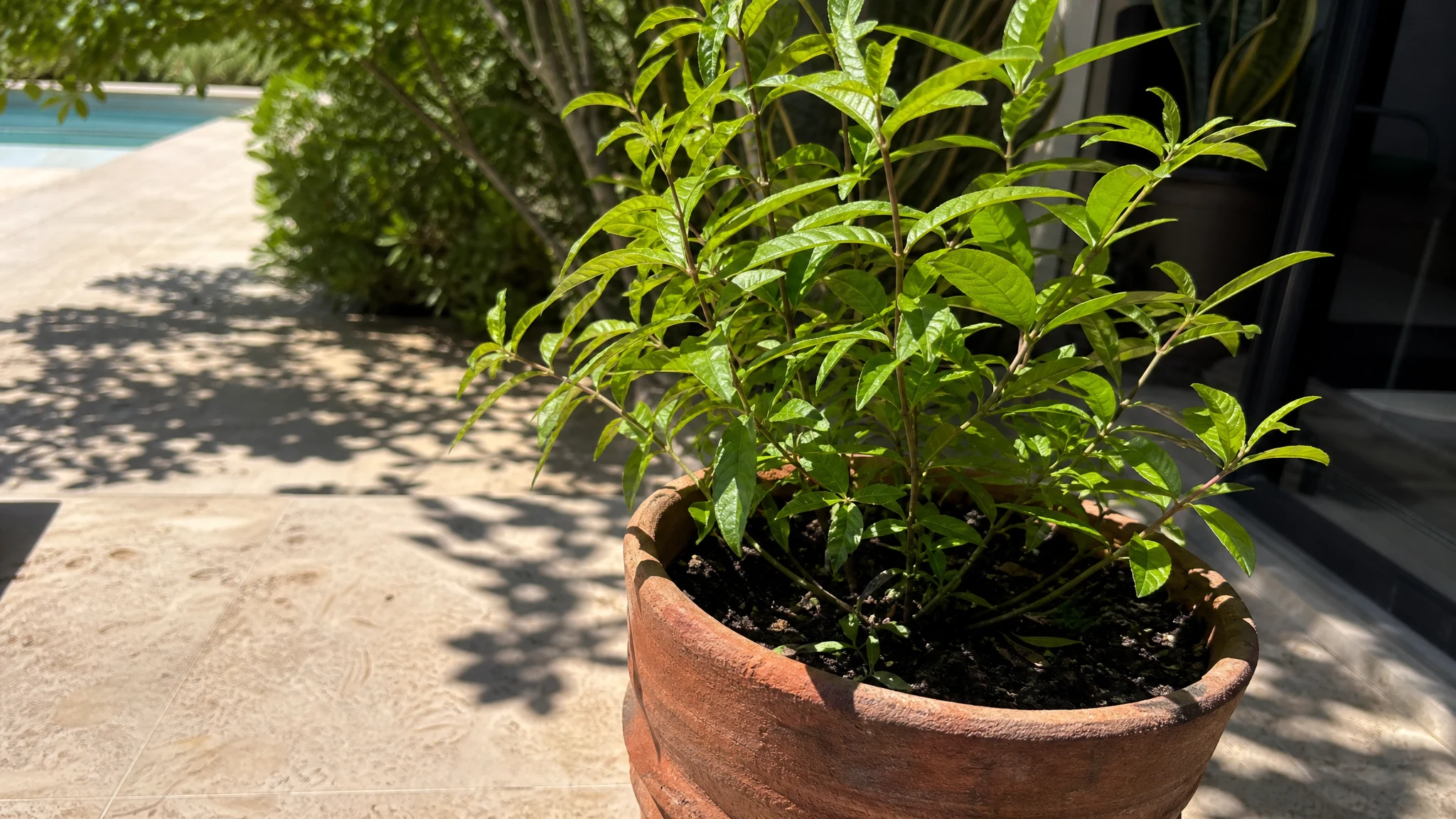
Where Lemon Verbena Oil Comes From, and Why It Matters
The plant comes from South America. The oil on your desk could come from almost anywhere, and the papers I could read show that the country matters less to a buyer than the fact that nobody has named it. Our own pages name no country, farm or harvest for our oil, so this article cannot tell you where it grew; it shows what a named origin would and would not tell you.
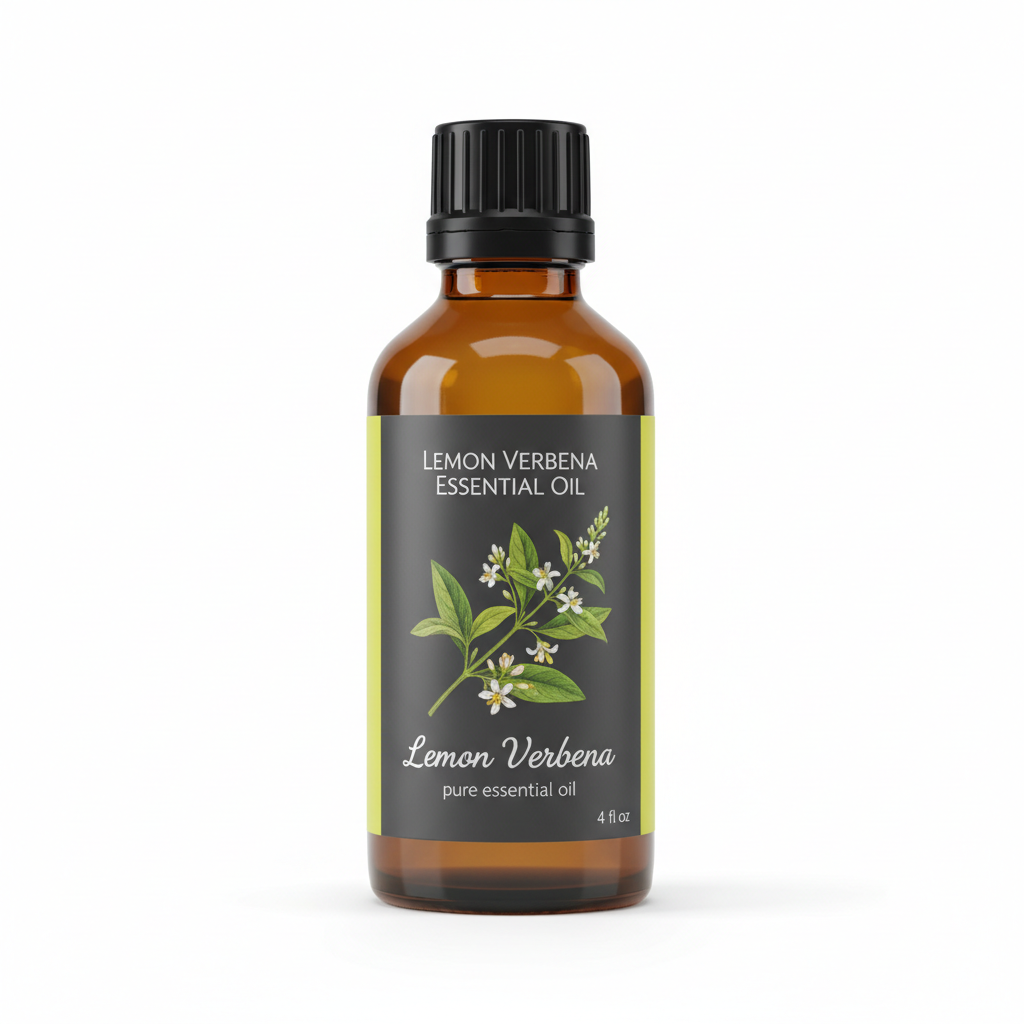
Lemon Verbena Essential Oil
Our own Lemon Verbena Essential Oil, in sizes from 0.5 oz to bulk.
From $12.99
Shop Now →Where the plant is native, and where sources disagree
The accepted name is Aloysia citrodora Paláu, family Verbenaceae, according to the GBIF species match (GBIF, usage key 5667503); older names such as Lippia citriodora and Aloysia triphylla are synonyms. For the native range, ColPlantA's species page gives north-western Argentina (Salta, Jujuy, La Rioja, Catamarca) and southern Bolivia (Chuquisaca, Cochabamba, Potosí, Tarija), in dry inter-Andean valleys at roughly 2,300 to 3,250 m, and calls it widely cultivated elsewhere in tropical and subtropical America (ColPlantA). The University of California's Marin Master Gardeners say it is "a native of Chile and Argentina" (UC Marin Master Gardeners). Kew's Plants of the World Online blocked my automated request, so I could not read it directly.
The two statements do not match. Chile appears in the second and not the first. A 2025 Chilean study collected the plant in Olmué, in the Valparaíso Region, but says nothing there about whether it is wild or planted, so a plant found in Chile is not proof of a native range. I would not print "native to Chile and Peru" without a source, and none that I could read says Peru.
Where the oil in the literature was actually made
I found no trade statistic or production survey naming the countries that supply lemon verbena oil. What exists is papers in which someone distilled leaves from a named place. Taken together they show what "lemon verbena oil" can be:
| Where the leaves came from | What was distilled | Yield | Main components reported |
|---|---|---|---|
| Ecuador, Intag Valley (cultivated, agroforestry, 900 to 1,200 m) | Dried, ground leaf; Clevenger apparatus | 0.18% of dry weight | Geranial 26.8%, neral 21.0%, limonene 7.2% |
| Chile, Olmué, Valparaíso Region (spring 2024) | Fresh cut leaf; hydrodistillation, 4 h | 1.25% on dry weight | Spathulenol 38.84%, caryophyllene oxide 17.80%, citral 3.16% |
| Morocco, five regions (one oil per region, July to August 2015) | Shade-dried leaf; hydrodistillation | 0.1% to 0.2% | Caryophyllene oxide 13.25% to 14.22%, spathulenol 9.42% to 15.61%, neral 6.37% to 10.02% |
| Portugal, commercially supplied dried leaf | Two hydrodistillation methods | 1.05% and 1.29% | Geranial 18.7% to 21.1%, neral 15.3% to 16.2% |
| Argentina, 36 collections from ten wild populations | Leaf collections, hydrodistillation | 0.16% to 1.93% | Five chemotypes; citral main in only 2 of 36 |
Sources for each row: Parichanon et al., 2025 (Ecuador); Silva et al., 2025 (Chile); Oukerrou et al., 2017 (Morocco); Sprea et al., 2023 (Portugal); Elechosa et al., 2017 (Argentina). Each reported a different sample set, so none of the numbers is a country average.
Two more places show up in the Chilean paper's discussion of earlier work, which I read only as quoted there: Tunisian plants from sub-humid regions with spathulenol and caryophyllene oxide leading and arid regions dominated by citral, and a Palestinian oil from Jericho with 77.4% sesquiterpenes, led by alpha-curcumene at 26.94%. The Palestinian paper itself names geranial, neral and alpha-curcumene as the main components across its four sites (Al-Maharik, 2024, abstract page).
What the table does and does not prove
Look at the ends of it. The Ecuadorian oil is 47.8% geranial plus neral. The Chilean oil lists citral at 3.16% and is mostly sesquiterpene alcohols and oxides. Both are "Aloysia citrodora". Argentine collections from the plant's own native range split into five chemotypes, and the authors call the low number of citral-led samples curious, given the species' reputation.
The studies cannot separate origin from everything else. Fresh versus dried leaf, distillation time, season and the plant's genetics all differ between rows, and Sprea et al. cite earlier literature that genotype is a major factor and that chemotypes differ by region, as in Argentina and Morocco. A Greek study cited there found citral isomers tended to fall from May to September while limonene rose. Moroccan authors attribute their regional differences to drying, extraction and harvest conditions, and did not measure soil or climate. So the honest reading is that origin and composition vary together, not that country A makes oil B.
Yield varies as much. On 100 g of dry leaf, the Ecuadorian figure is 0.18 g of oil, about 0.21 ml at our COA batch's relative density of 0.869, or roughly 4 drops at 20 drops per ml. The Chilean figure of 1.25% is 1.25 g, about 1.44 ml and nearly 29 drops, about seven times as much from the same leaf weight. The bases and methods differ, so treat this as scale, not a ranking. Within Argentina alone, 0.16% to 1.93% is a twelve-fold spread, and the authors report the highest yields from the Mutquín population. It is one reason the distillation yield post avoids a single number.
What follows for a buyer
- Do not infer chemistry from a country. If a listing says only "South America", you know the continent of the plant, not of the sample.
- Do not infer a country from your nose. Our wholesale page offers sample bottles so you can evaluate the oil in your own product, which is a fair test of scent in a formula. It is not a test of provenance: the Ecuadorian study describes its single oil as citral-like in aroma, and that one description does not let you place an unlabelled bottle.
- Do not infer a country from a COA. The COA we publish for the batch shown has appearance, smell, relative density 0.869 (standard 0.862 to 0.905) and refractive index 1.472 (standard 1.465 to 1.485). It names no origin. I found no density or refractive index values published for the oils above, so I cannot say whether those two measurements could tell any of them apart.
- Ask in writing, and keep the answer in writing. Useful questions: country and region of growth, harvest year, wild or cultivated, plant part, distillation type, and a GC-MS report for the lot. We name no origin for our oil, so a buyer who needs one should ask before ordering, not assume. The label and GC-MS reading guide shows what to look for in the reply.
- Ask a different question if the aim is a claim. If you want to print "organic" or a country on a product, the organic post explains why the document, not the word, is what counts.
The botanical background of the shrub, including the plant itself, is in our Aloysia citrodora profile. We cannot add a producing country to it, because none of our pages names one.
Lemon Verbena Essential Oil
Lemon Verbena Essential Oil from our own shop, in sizes from 0.5 oz to bulk.
From $12.99
Shop Now →Sources & Further Reading
- GBIF. Aloysia citrodora Paláu, species match, usage key 5667503. gbif.org/species/5667503
- ColPlantA. Aloysia citrodora Paláu, general information. colplanta.org
- UC Marin Master Gardeners. Lemon Verbena. ucanr.edu/lemon-verbena
- Parichanon P et al., 2025. Essential oils from Aloysia citrodora and Bursera graveolens Ecuadorian plants. Insects 16(2):202. PMC11857052
- Silva V et al., 2025. Chilean Aloysia Essential Oils. Plants 14. PMC12566967
- Oukerrou MA et al., 2017. Essential oil of Aloysia citriodora grown in Morocco. Adv Pharmacol Sci. PMC5485486
- Sprea RM et al., 2023. Volatile Compounds and Biological Activity of the Essential Oil of Aloysia citrodora. Molecules 28(11):4528. PMC10254266
- Elechosa MA et al., 2017. Essential oil chemotypes of Aloysia citrodora in Northwestern Argentina. Biochem Syst Ecol 74:19-29. repositorio.inta.gob.ar/3738
- Al-Maharik N et al., 2024. Aloysia citriodora essential oils from four locations in Palestine. BMC Complement Med Ther 24:94. staff.najah.edu/17918