Lemon Verbena Oil and Sleep: What Two Trials Tested
No trial we could find tested lemon verbena essential oil, inhaled or otherwise, on sleep. The two sleep trials that exist gave people a capsule of leaf extract to swallow, and they say nothing about the bottle of oil on your shelf. Here is what each trial did, how many people it had, and what it did not show, so you can judge the claims you meet online.
Lemon Verbena Essential Oil
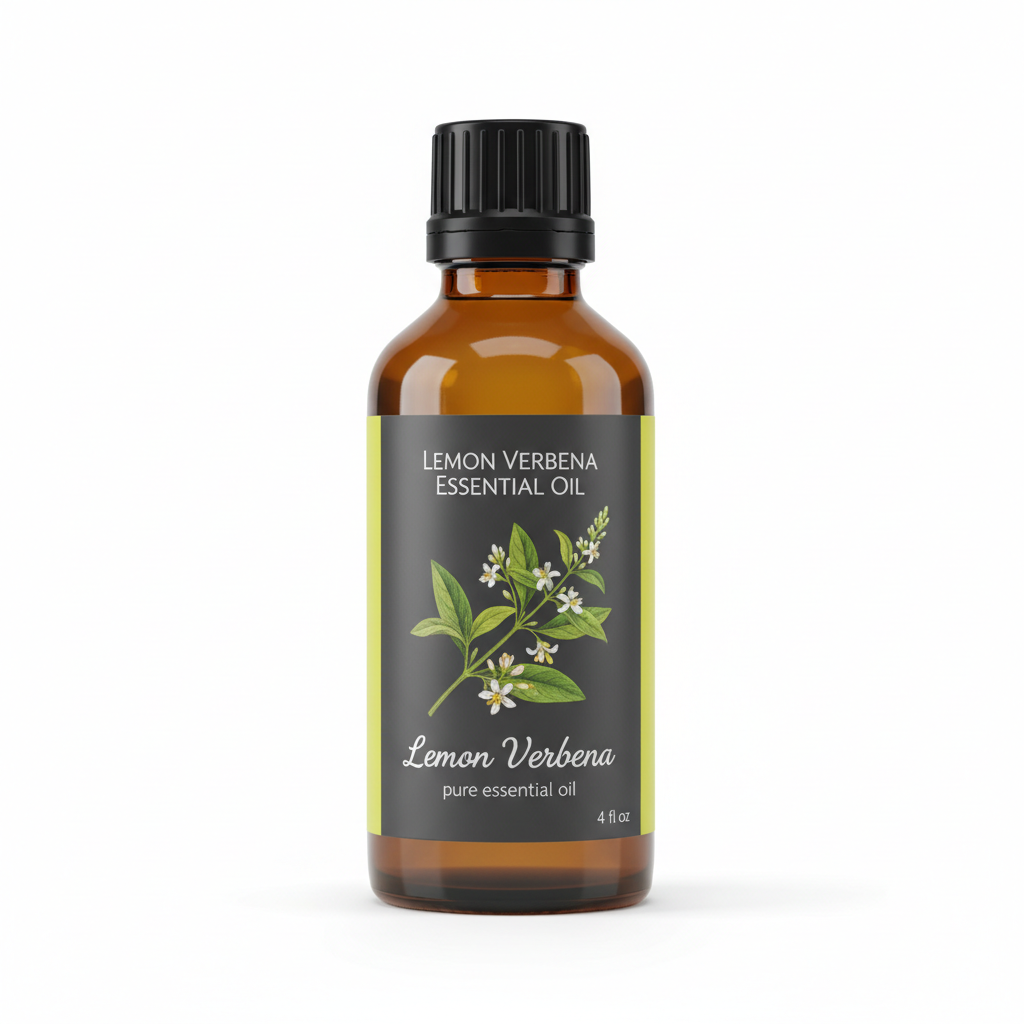
Our own Lemon Verbena Essential Oil, in sizes from 0.5 oz to bulk.
From $12.99
Shop Now →First, which preparation was it?
Both sleep trials used a purified leaf extract standardized to at least 24% verbascoside and at least 28% total phenylpropanoids, in a 400 mg capsule. Do the arithmetic and one capsule carries at least 96 mg of verbascoside (400 mg x 0.24). A 2018 review of the plant's chemistry reports that verbascoside is the most significant component of the extract, while neral and geranial are the main components of the essential oil (Bahramsoltani et al., 2018). So the question "does lemon verbena help sleep" has to be split in two: the extract has trial data, and the oil has none that we found. Swallowing essential oil is not something we advise, and our oil is not for internal use.
Trial one: 71 analysed adults, 90 days
Pérez-Piñero et al. (2024) ran a single-centre, randomized, double-blind, placebo-controlled trial in Murcia, Spain. Eighty adults were randomized, 40 per arm. Nine were lost (7 on extract, 2 on placebo), and the 71 who finished were analysed: 33 on extract, 38 on placebo. They were about 29.5 years old on average. To enter, they needed a Pittsburgh Sleep Quality Index (PSQI) score above 5 and moderate anxiety on a standard scale, and the paper does not report a diagnosis of insomnia. The extract group took the capsule one hour before bed.
| Measure at day 90 | Extract | Placebo | Between-group result |
|---|---|---|---|
| PSQI total (lower is fewer complaints) | 5.8 | 7.4 | p = 0.008 |
| Visual scale of sleep quality | 6.5 | 5.5 | p = 0.021 |
| PSQI sleep latency | 1.6 | 1.9 | p = 0.027 |
| PSQI sleep efficiency (%) | 84.5 | 79.8 | p = 0.023 |
| PSQI sleep duration | no difference | p = 0.722 | |
| Night melatonin (pg/mL) | 199.7 | 174.7 | p = 0.048 |
| Cortisol | no difference | p = 0.370 | |
Read the table for what is absent as well as what is there. Sleep duration on the questionnaire did not differ, and neither did cortisol or perceived stress. Wrist actigraphy was reported to favour the extract on several variables, but the paper's table makes matching each p-value to each variable hard, so we quote only the questionnaire figures above. The authors list their own limits: limited sample, 90 days, diet not controlled, cortisol measured once. Two more points are ours. Only completers were analysed, so the 9 dropouts are not counted, and the funder, Monteloeder, supplied the extract and employs three of the authors.
Trial two: 40 adults, 8 weeks plus a washout
Martínez-Rodríguez et al. (2022) randomized 40 adults (20 per arm) with a perceived stress score above 15 and a PSQI above 5 to the same 400 mg capsule or placebo, 1 to 2 hours before bed, for 8 weeks, then 4 weeks without it. In the extract group the PSQI went from 6.7 to 5.9 at month 2 and 5.0 after the washout. Those are changes against the group's own start. The placebo group showed no significant change, but the paper's between-group differences were often not significant. Sleep stages came from a consumer wrist tracker (Fitbit Charge 2), which the authors note may be less accurate than laboratory polysomnography. The group split by sex was not powered to answer a sex question, so the finding in women should not be repeated as a rule. The extract was again supplied by Monteloeder, with three Monteloeder-affiliated authors.
What neither trial can say about a scent
Even if you set the funding aside, these were capsules. Reasoning from the design: a capsule can be matched with a look-alike placebo, a scent cannot be hidden from the person smelling it, and a trial of an inhaled oil would face that problem. The only inhaled lemon verbena oil trial we know of, Alvarado-García et al. (2021), measured anxiety rather than sleep and used a waiting-list control, which is not blinded. It is covered in lemon verbena oil, stress and mood, and the wider picture is in what the research says about lemon verbena.
For aromatherapy in general, the National Center for Complementary and Integrative Health (NCCIH, updated May 2024) cites a 2021 review of 16 studies with 1,346 participants that found aromatherapy may improve sleep quality and says larger, more rigorous studies are needed. Lemon verbena is not mentioned on that page. Its aromatherapy page says that for insomnia "we don't know whether it's helpful" (NCCIH, last updated January 2020). Those statements concern other oils and are not evidence about ours.
What the European regulator says about the leaf tea
The European Medicines Agency has a traditional-use monograph for lemon verbena leaf as a herbal tea (EMA/HMPC/376770/2019, adopted 13 January 2021). For its sleep wording the dose is 1 to 2 g of comminuted leaf in 200 ml of boiling water as an infusion, half an hour before bedtime. Traditional use means the monograph rests exclusively on long-standing use, not on trials. It says the use in children has not been established, that use in pregnancy and lactation is not recommended because safety is not established, that a doctor should be consulted if symptoms persist longer than 2 weeks, and that it may impair the ability to drive. That is a tea, a different material from the oil; lemon verbena tea vs essential oil works through the difference in mass.
Four questions to ask of any lemon verbena sleep claim
- Which material was tested: oil, extract, or tea? In the two trials above the answer was extract in a capsule.
- How many people, and compared with what? Here, 71 analysed and 40 randomized, against a placebo capsule.
- Which result was between-group and which was against the group's own baseline? A fall from the group's own starting score is weaker than a difference from placebo.
- Who paid and who supplied the material? In both trials the extract maker supplied it and had authors on the paper. That does not make the data wrong, and it does call for independent replication, which we did not find.
Where that leaves the bottle
In the United States, the FDA says that claims a product will "help you sleep" are drug claims (FDA, Aromatherapy, current as of 9 September 2023). We sell lemon verbena essential oil, steam-distilled from the leaf and sold neat, as a scent and craft material, and we make no sleep claim for it. The published certificate of analysis records appearance, smell, a relative density of 0.869 and a refractive index of 1.472, and nothing about sleep. If you simply like a lemon-herbal scent in the evening, that is a personal preference, and you decide it for yourself. Keep the practical limits in view: never apply it undiluted (our copy says 0.5% to 2% in a carrier, roughly 3 to 12 drops per ounce, patch test first), keep it away from children and pets, and see how to diffuse lemon verbena oil safely and the safety guide before using a diffuser.
Trouble sleeping that lasts is a question for a physician, who can look for causes that no fragrance or capsule will address. The tea monograph itself uses a two-week mark for seeing a doctor.
Lemon Verbena Essential Oil
Lemon Verbena Essential Oil from our own shop, in sizes from 0.5 oz to bulk.
From $12.99
Shop Now →Sources & Further Reading
- Pérez-Piñero S et al., 2024. Dietary supplementation with an extract of Aloysia citrodora (lemon verbena) and sleep quality, Nutrients 16(10):1523. PMC11123999
- Martínez-Rodríguez A et al., 2022. Lippia citriodora extract, stress and sleep quality, Nutrients 14(1):218. PMC8747367
- Alvarado-García PAA et al., 2021. Essential oils of Lippia alba and Lippia citriodora, Pharmacognosy Journal 13(6):1377 (abstract page only). phcogj.com/node/1672
- Bahramsoltani R et al., 2018. Aloysia citrodora Paláu (lemon verbena): a review of phytochemistry and pharmacology, J Ethnopharmacol 222:34-51 (abstract only). Europe PMC, PMID 29698776
- European Medicines Agency, 2021. EU herbal monograph on Aloysia citrodora folium, EMA/HMPC/376770/2019. ema.europa.eu
- NCCIH, 2024. Sleep disorders and complementary health approaches. nccih.nih.gov
- NCCIH, 2020. Aromatherapy. nccih.nih.gov/health/aromatherapy
- FDA, 2023. Aromatherapy. fda.gov/aromatherapy