
Lemon Verbena Oil, Stress and Mood: Why the Evidence Is Thin
Scent studies are weak evidence by construction, and lemon verbena is no exception: the person sniffing an oil knows it, so a trial cannot easily hide who got what. On top of that, the stress and mood data for lemon verbena are mostly from a leaf extract in capsules, not from the oil. This page lays out each study, its size and its limits, and makes no claim that our oil affects anyone's stress, mood or anxiety.
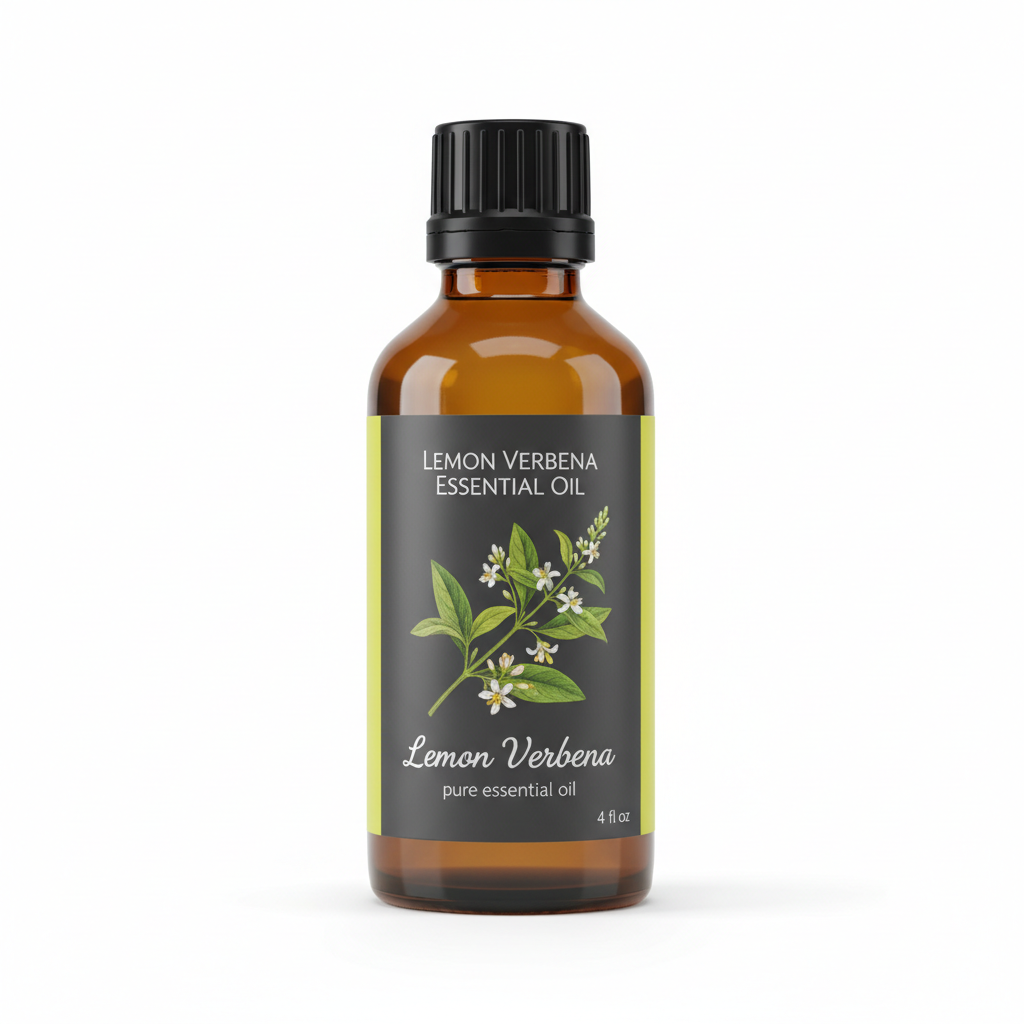
Lemon Verbena Essential Oil
Our own Lemon Verbena Essential Oil, in sizes from 0.5 oz to bulk.
From $12.99
Shop Now →Why aroma trials are hard to trust
Reasoning from design, not from a source: if one group smells lemon verbena and the other smells nothing, both groups know which they are in, and a scale that asks "how anxious do you feel" is easily moved by expectation. The one inhaled lemon verbena oil trial we found shows the problem in practice. Alvarado-García et al. (2021) compared two inhaled oils (Lippia citriodora, which is lemon verbena, and Lippia alba) with a waiting-list control. A waiting-list group is told it will get the intervention later, so nobody is blinded. The measure was the State-Trait Anxiety Inventory before and after, and scores fell from pre to post in the treated groups (p < 0.05). The abstract reports 95 participants. A later network meta-analysis (Tan et al., 2023) listed the same trial as 27 on oil against 26 controls, using 2 drops for 30 minutes, and rated it high risk of bias. We cannot reconcile 95 with 53.
The scale of that dose is easy to work out for our oil: 2 drops at about 20 drops per ml is 0.1 ml, and at a relative density of 0.869 that is roughly 87 mg. That is arithmetic about our oil, offered only to give a sense of scale. The trial's oil was a different, lab-distilled sample with geranial at 39.8%.
What the pooled data say about this oil
Tan et al. (2023) pooled 44 randomized trials of ten oils, 3,419 patients in all, in a network meta-analysis. Across the full set, 17 trials were rated high risk of bias, 11 unclear and 16 low, and heterogeneity was very high (I-squared 93.2% for state anxiety). Most comparisons were rated low or very low certainty. For the Lippia citriodora arm on state anxiety, the estimate was a difference of -4.9 points with a 95% credible interval of -15.34 to 5.48. An interval that spans zero means the data do not rule out no effect. It also does not rule out a large one; it is simply too uncertain. The authors themselves call for more high-quality trials.
The capsule trials: stress and mood outcomes
| Trial | Material and n | Stress or mood outcome | Between-group? |
|---|---|---|---|
| Martínez-Rodríguez et al., 2022 | Extract, 400 mg daily, 8 weeks + 4-week washout; 40 adults (20 per arm) | Perceived stress score in extract group 20.8, then 18.7 at month 2, then 17.1 after washout | Often not significant; cortisol trend p = 0.08 |
| Martínez-Rodríguez et al., 2022 | Same trial | Cortisol in extract group 15.1, then 12.6 at month 2 | Within-group only |
| Pérez-Piñero et al., 2024 | Extract, 400 mg nightly, 90 days; 71 analysed (33 extract, 38 placebo) | Perceived stress; state anxiety scale; cortisol | Perceived stress no; state anxiety scale p = 0.037; cortisol p = 0.370 |
Details are in Martínez-Rodríguez et al. (2022) and Pérez-Piñero et al. (2024). The first enrolled adults with a perceived stress score above 15 and poor sleep, and the paper reports the cortisol change within the extract group (p < 0.001), about 15.6% by the authors' figure, while the placebo group did not change significantly. The authors also reported the extract group as younger and heavier at the start. The second found no between-group difference in perceived stress or cortisol, and one favourable result on a state anxiety scale among several measured, which is the kind of finding that needs a second trial before anyone leans on it. In both, the extract was supplied by Monteloeder and three authors were affiliated with it. The first paper's title uses the word anxiolytic; with 20 people per arm, we treat that as a hypothesis, not a result.
One more caution about cortisol, since it is often quoted as proof. Pérez-Piñero et al. list as a limit that cortisol was measured at a single time point, which cannot capture its daily rhythm. A single morning or evening value moves with sleep, waking time and the day before. A within-group fall from 15.1 to 12.6, as in the 2022 trial, is a description of that group's two samples, and the placebo group in the same paper dipped at month 1 (p < 0.001) before returning near its baseline. That is a reason to wait for replication, and it is a fair reading of what the authors reported, not a verdict on the extract.
The same trials are discussed for sleep in lemon verbena oil and sleep, and the whole map is in what the research says about lemon verbena.
Another scent trial, a different oil
The National Center for Complementary and Integrative Health describes a study of people under stress that compared lemon and lavender scents: lemon improved mood, but neither scent affected stress indicators (NCCIH, Aromatherapy, last updated January 2020). That is citrus lemon, not lemon verbena, and one study, so we cite it only to show that mood and measured stress markers can move differently. NCCIH adds that for insomnia, "we don't know whether it's helpful".
What the leaf tea monograph says
The European Medicines Agency's traditional-use monograph for lemon verbena leaf (EMA/HMPC/376770/2019) lists a herbal tea with the wording "relief of mild symptoms of mental stress", at 5 g of leaf in 100 ml of boiling water as a decoction, 3 times daily, for adolescents, adults and the elderly. It rests exclusively on long-standing use, it does not recommend use in children or in pregnancy and lactation, it says a doctor should be consulted if symptoms persist longer than 2 weeks, and it notes that use may impair the ability to drive. It is about the leaf by mouth. It is not a statement about the essential oil, which is a different material; see lemon verbena tea vs essential oil.
What we say, and where to go instead
We sell lemon verbena essential oil, steam-distilled from the leaf and sold neat, as a scent and craft material, and we make no stress, mood or anxiety claim for it. The FDA says the cosmetic-or-drug question turns on how a product is marketed and intended to be used (FDA, last updated 11 September 2024), which is why this page reports studies and stops there. If you enjoy the smell of lemon verbena, that is your preference. For skin, our copy says dilute to 0.5% to 2% in a carrier (roughly 3 to 12 drops per ounce), patch test first, and keep it away from eyes, children and pets. See how to diffuse lemon verbena oil safely before using one.
If worry, low mood or tension is getting in the way of your days, a physician or other clinician is the right person to speak to, and a scented oil is not a replacement. If you are in crisis or thinking about harming yourself, call or text 988 in the United States, or chat at chat.988lifeline.org; the service is free and open at any hour (988 Suicide & Crisis Lifeline).
The studies are interesting, and they are also small, mostly on a capsule, and mostly funded by its maker. That is the whole of what we can honestly say.
Lemon Verbena Essential Oil
Lemon Verbena Essential Oil from our own shop, in sizes from 0.5 oz to bulk.
From $12.99
Shop Now →Sources & Further Reading
- Alvarado-García PAA et al., 2021. Anxiolytic-like effect of essential oils from Lippia alba and Lippia citriodora, Pharmacognosy Journal 13(6):1377 (abstract page only). phcogj.com/node/1672
- Tan L et al., 2023. Essential oils for treating anxiety: systematic review and network meta-analysis, Front Public Health. PMC10267315
- Martínez-Rodríguez A et al., 2022. Lippia citriodora extract, stress and sleep quality, Nutrients 14(1):218. PMC8747367
- Pérez-Piñero S et al., 2024. Dietary supplementation with an extract of Aloysia citrodora (lemon verbena), Nutrients 16(10):1523. PMC11123999
- NCCIH, 2020. Aromatherapy. nccih.nih.gov/health/aromatherapy
- European Medicines Agency, 2021. EU herbal monograph on Aloysia citrodora folium, EMA/HMPC/376770/2019. ema.europa.eu
- FDA, 2024. Is it a cosmetic, a drug, or both? (Or is it soap?). fda.gov
- 988 Suicide & Crisis Lifeline. Get help. 988lifeline.org/get-help