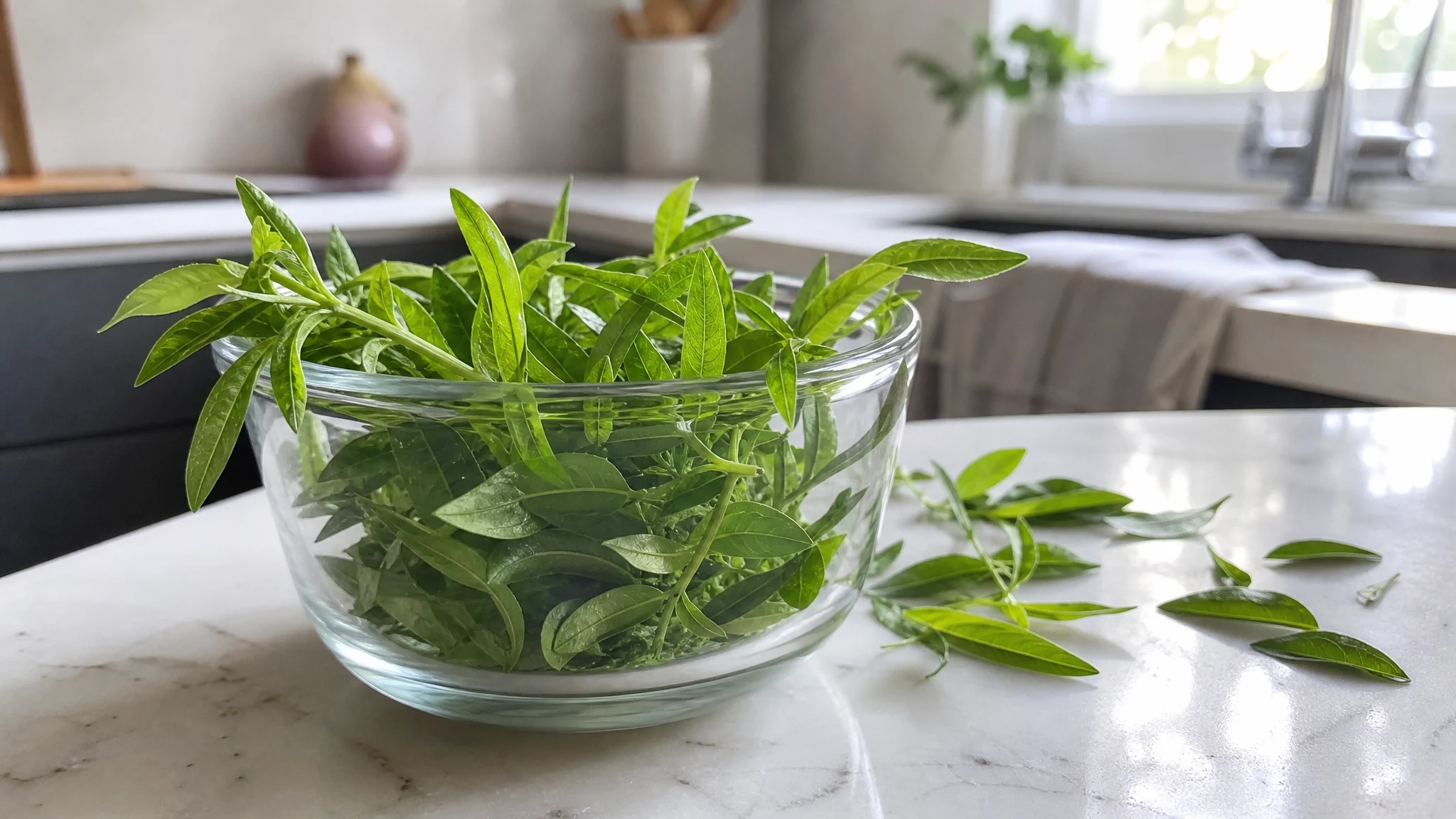
Lemon Verbena Antioxidant Research: Leaf Extract vs the Oil
Most of the antioxidant research with "lemon verbena" in its title was done on leaf extract, a water or methanol preparation whose main compound is verbascoside. The steam-distilled oil is a different material with a different chemistry, so those results do not transfer to a bottle of essential oil, ours included. This page sorts out which paper studied which material and what the lab assay behind the number actually measures.
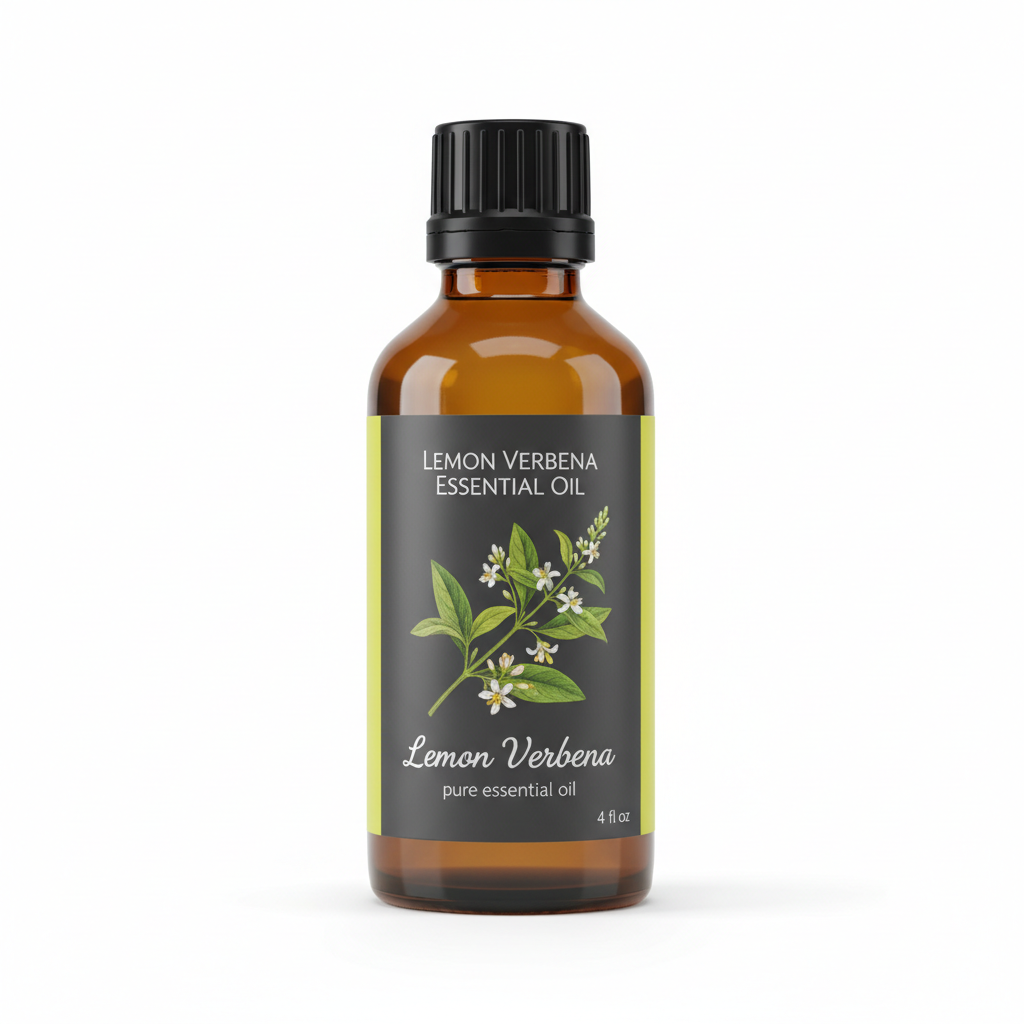
Lemon Verbena Essential Oil
Our own Lemon Verbena Essential Oil, in sizes from 0.5 oz to bulk.
From $12.99
Shop Now →Two materials that share a name
The 2018 review by Bahramsoltani and colleagues in the Journal of Ethnopharmacology (searching databases through October 2017) says it directly: neral and geranial are the main components of the essential oil, whereas verbascoside is the most significant component of the extract. They also report that antioxidant, anxiolytic, neuroprotective and other effects were shown in cell and animal studies, and they conclude that safety and efficacy in humans are not well established. Only the abstract record was available to read here, not the full review.
| Question | Leaf extract | Essential oil |
|---|---|---|
| How it is made | Solvent (methanol or water, often with ultrasound) pulls compounds from dried leaf | Steam or water distillation carries volatile compounds out of the leaf |
| Main compound reported | Verbascoside (acteoside), 76% to 84% of peak area in one Tunisian study | Geranial and neral in two of three oil studies; sesquiterpenes in the third |
| Typical result unit | IC50 in µg/ml of dry extract | IC50 in µg/ml of oil |
Why verbascoside is not a reasonable thing to expect in the oil
This section is reasoning from chemistry, not a measurement of any oil. The PubChem computed properties for verbascoside (CID 5281800) are a formula of C29H36O15, a molecular weight of 624.6, a calculated XLogP of -0.5, a topological polar surface area of 245 and nine hydrogen-bond donors. For citral (CID 638011), the geranial and neral pair that leads two of the oil analyses, the same record gives C10H16O, a molecular weight of 152.2, an XLogP of 3, a polar surface area of 17.1 and no hydrogen-bond donors. Limonene (CID 22311) is 136.2, XLogP 3.4, polar surface area 0.
A sugar-bearing molecule four times heavier than citral, with nine donors and a negative XLogP, is water-loving and non-volatile. Distillation moves compounds that evaporate with steam. The oil studies' GC-MS tables list volatile terpenes and not verbascoside, but that alone proves little, since gas chromatography is built for volatiles. The inference that verbascoside does not distil over is a standard one that rests on its structure, and no paper fetched for this page tested a lemon verbena oil for it. For the same reason, no published verbascoside content figure belongs to our oil, whose published certificate of analysis reports appearance, smell, relative density 0.869 and refractive index 1.472 and nothing about constituents.
What a DPPH number measures
DPPH is a stable free radical, deep violet in solution with absorbance near 517 nm. Kedare and Singh (2011) describe the reaction: the radical takes a hydrogen atom from an antioxidant and the colour fades, in proportion to how much was donated. The result is usually reported as IC50, the concentration that removes half the radical, so a lower IC50 means a stronger result in that tube. The same review lists the limits: DPPH dissolves only in organic solvents, sample colour can interfere, light changes the reading, the radical reacts with other radicals, and it does not reflect how antioxidants partition in emulsions or work in plasma.
A tube of violet solvent is not skin, a cell or a person. The authors of one of the extract studies say so themselves: Alvarez Cortes et al. (2025, PeerJ) note that in vitro antioxidant results are not always directly extrapolable to in vivo conditions. Nothing on this page is a statement about what lemon verbena does in the body.
The three IC50s, placed side by side
Here is what each paper measured and which reference compound it ran next to its sample.
| Study | Material | DPPH IC50 (µg/ml) | Reference run alongside |
|---|---|---|---|
| Tammar et al., 2021 (Foods), four Tunisian sites, October 2019 harvest | Methanolic leaf extract | 12.71 (Boussalem, best site); 14.90 (Gabes) | BHT 17.00 |
| Alvarez Cortes et al., 2025 (PeerJ), Morelia, Mexico | Ultrasound leaf extract, best of 27 treatments | 35.58 | Ascorbic acid 8.25; gallic acid 2.35 |
| Abu Alrub, 2023 (thesis, abstract only) | Essential oil, hydrodistilled | 10.11 | Trolox 3.09 |
The numbers cannot be ranked against each other. Each lab used a different reference, so the honest comparison is each result against its own standard: the Tunisian extract was at 0.75 times BHT's IC50 (stronger than BHT), the Mexican extract at about 4.3 times ascorbic acid's (weaker), and the thesis oil at about 3.3 times Trolox's (weaker). Weight-based units add a second distortion. One microgram per millilitre is 1.6 micromolar for a compound of weight 624.6 and 6.6 micromolar for one of 152.2, so equal masses are not equal numbers of molecules. An extract is also a mixture, and its IC50 describes the whole mixture, not verbascoside alone.
Within the Tunisian paper, acteoside correlated strongly with the DPPH, ABTS and reducing-power results (r between -0.980 and -0.992) across only four sites. The authors also mention possible use of the extract as a cosmetic additive to extend shelf life; that conclusion was not tested in the paper. The Mexican study's numbers also disagree with themselves (the best phenolic yield is given as 87.74 mg GAE/g in the abstract and 132.84 mg GAE/g in the text), which is a reason to read its absolute values loosely.
One oil assay is not a body of evidence
For the oil there is, in what was fetched, one DPPH figure, from an abstract of an unreviewed thesis whose oil also listed trans-anethole as its largest component, a profile unlike the other oil papers (an observation, not an explanation). The 2024 peer-reviewed oil study from four Palestinian sites (Al-Maharik et al.) reported no DPPH or other antioxidant assay, although it tested other activities. Across the oil papers, geranial ranges from about 10% to 37%, so even the oil is not one fixed material.
What a buyer can take from this
- If a page quotes verbascoside or polyphenol figures to sell an essential oil, it is describing the leaf extract, and the figure belongs to a different product.
- If you want the water-soluble leaf chemistry, the plant material for that is dried leaf or tea, which we do not sell; the tea versus oil comparison covers the difference.
- An IC50 is a tube result against one reference compound. It is not a shelf-life claim for a blend, and we make no antioxidant or health claim for our oil.
For the wider picture of what has and has not been studied, read the benefits evidence review, the companion antimicrobial evidence review and the profile of the shrub itself.
Lemon Verbena Essential Oil
Lemon Verbena Essential Oil from our own shop, in sizes from 0.5 oz to bulk.
From $12.99
Shop Now →Sources & Further Reading
- Bahramsoltani R, Rostamiasrabadi P, Shahpiri Z, Marques AM, Rahimi R, Farzaei MH, 2018. Aloysia citrodora Paláu (Lemon verbena): A review of phytochemistry and pharmacology. J Ethnopharmacol 222:34-51. Abstract only, read through Europe PMC. PMID 29698776
- Tammar S et al., 2021. Chemometric Profiling and Bioactivity of Verbena (Aloysia citrodora) Methanolic Extract from Four Localities in Tunisia. Foods 10(12):2912. PMC8700817
- Alvarez Cortes O et al., 2025. Multifactorial analysis of temperature, solute-to-solvent ratio, and ultrasound amplitude on the extraction of phenolic and antioxidant compounds from Aloysia citriodora Palau leaves. PeerJ 13:e19821. PMC12372784
- Kedare SB, Singh RP, 2011. Genesis and development of DPPH method of antioxidant assay. J Food Sci Technol 48(4):412-422. PMC3551182
- Abu Alrub M, 2023. Essential oils of fennel, M. fruticosa and Aloysia citrodora: chemical profiling and activities (thesis). Abstract only. repository.najah.edu
- Al-Maharik N et al., 2024. Aloysia citriodora Palau essential oils from four different locations in Palestine. BMC Complement Med Ther 24:94. PMC10870676
- National Center for Biotechnology Information. PubChem compound records for verbascoside (CID 5281800), citral (CID 638011) and limonene (CID 22311). pubchem.ncbi.nlm.nih.gov